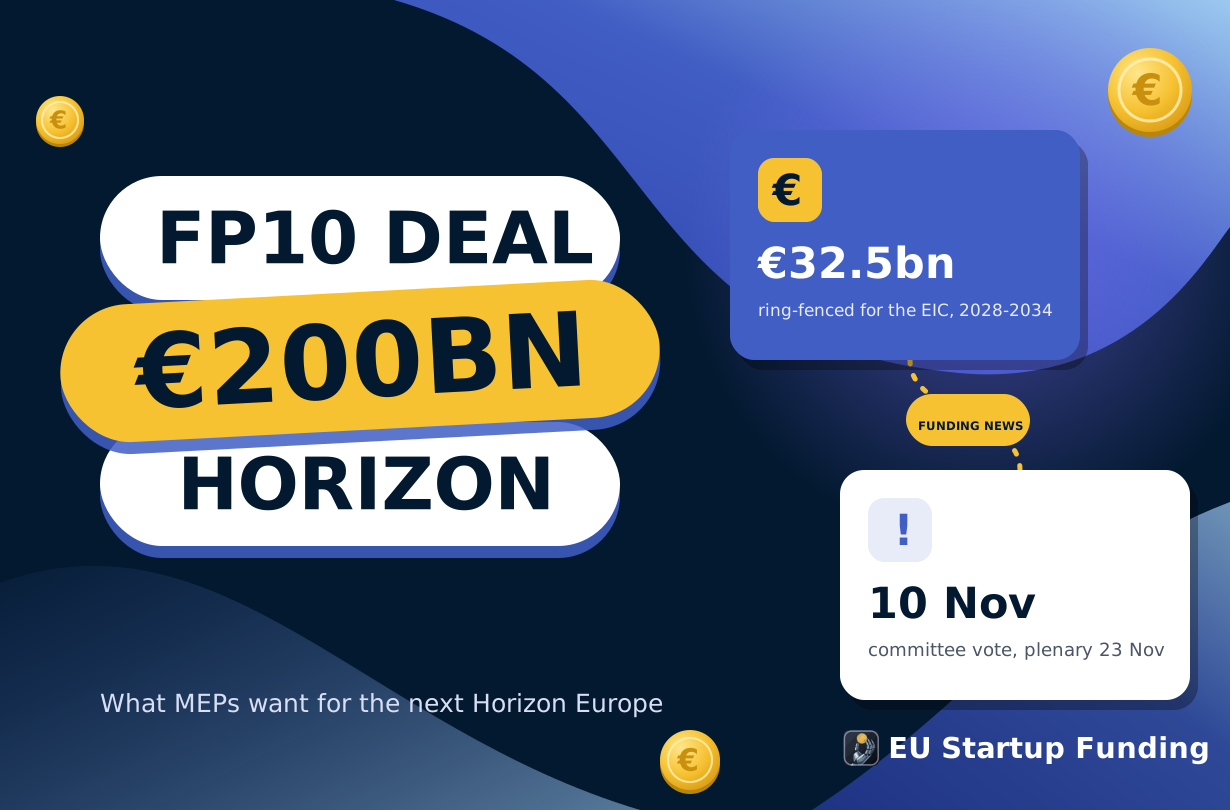
TL;DR: what do MEPs want for the next Horizon Europe?
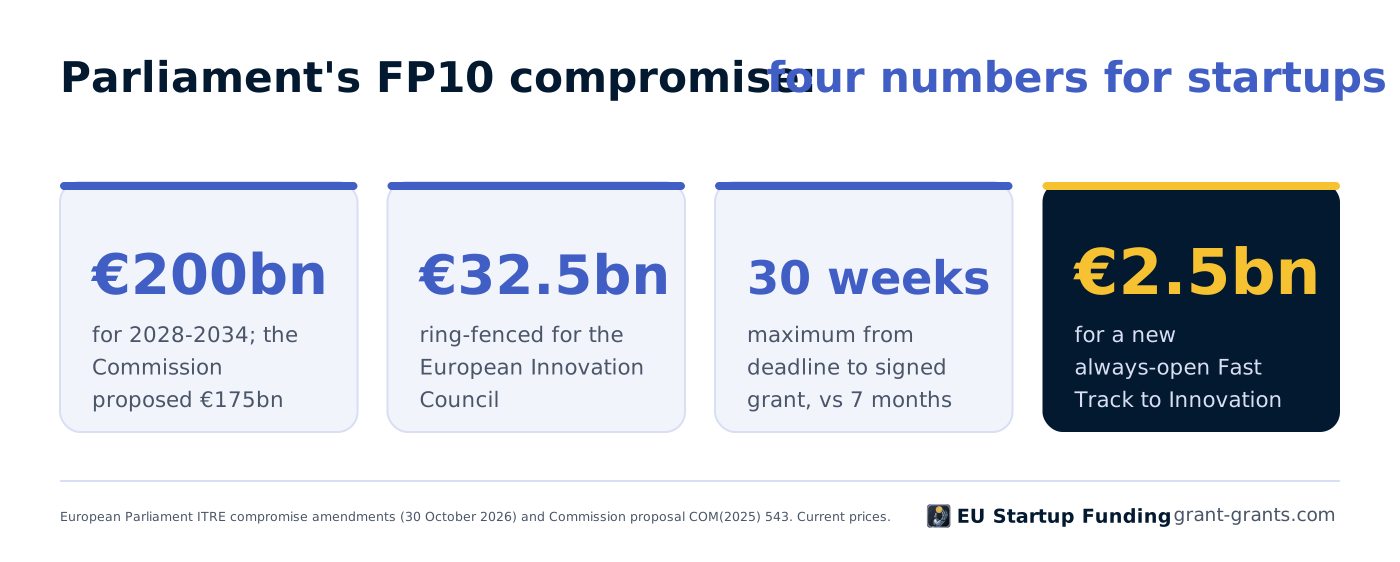
On 30 October 2026, the lead MEPs on the research committee released their compromise text on Horizon Europe 2028-2034, the EU's next research programme, often called FP10. It asks for €200 billion in current prices, €25 billion more than the Commission proposed, with €32.5 billion ring-fenced for the European Innovation Council (EIC). For startups, it also means faster grants (signed within 30 weeks of the deadline), a new always-open call for projects up to €2 million, and the Scaleup Europe Fund kept inside the EIC. This is Debated, not law: the committee votes on 10 November, the plenary on 23 November, and EU governments want a much smaller budget.
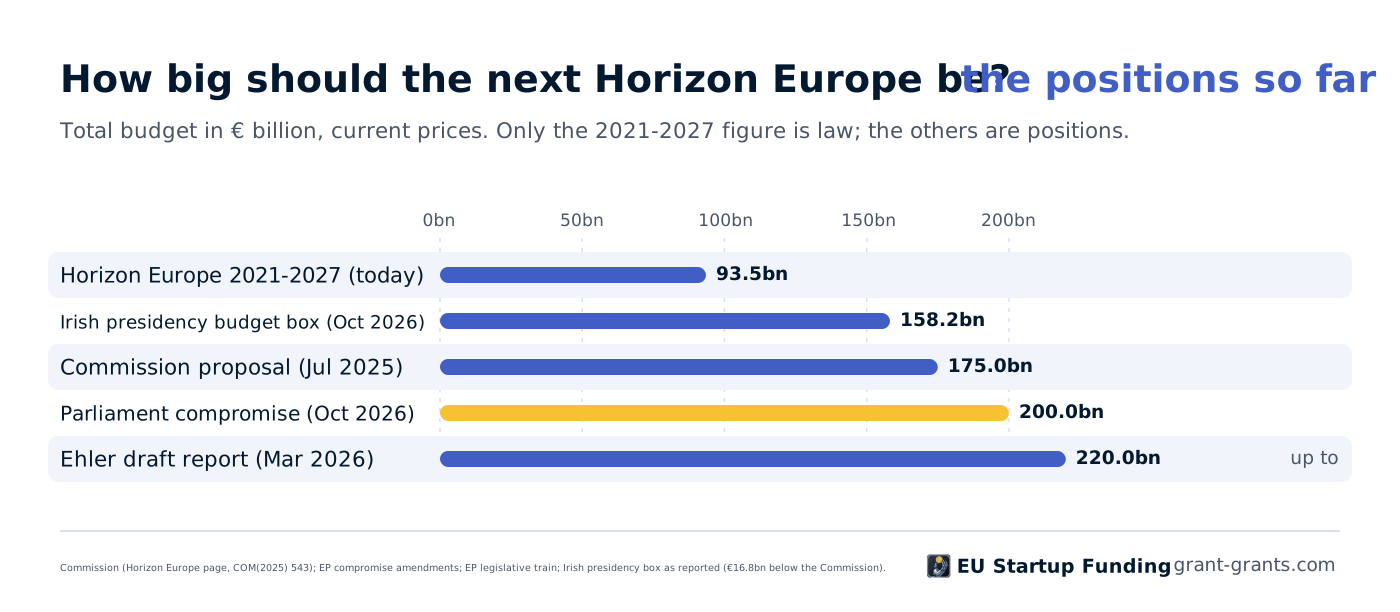
The fight over the next Horizon Europe now has three numbers on the table. The Commission proposed €175 billion in July 2025. EU governments, in the Irish presidency's budget box, would cut that by €16.8 billion. And Parliament's negotiators now want €200 billion. The money starts flowing in 2028, but the rules being written now decide how fast you get paid, how much of your costs are covered and which EIC instruments still exist. Here's what the compromise says and what it means if you plan to apply for EU funding after 2027.
What happened
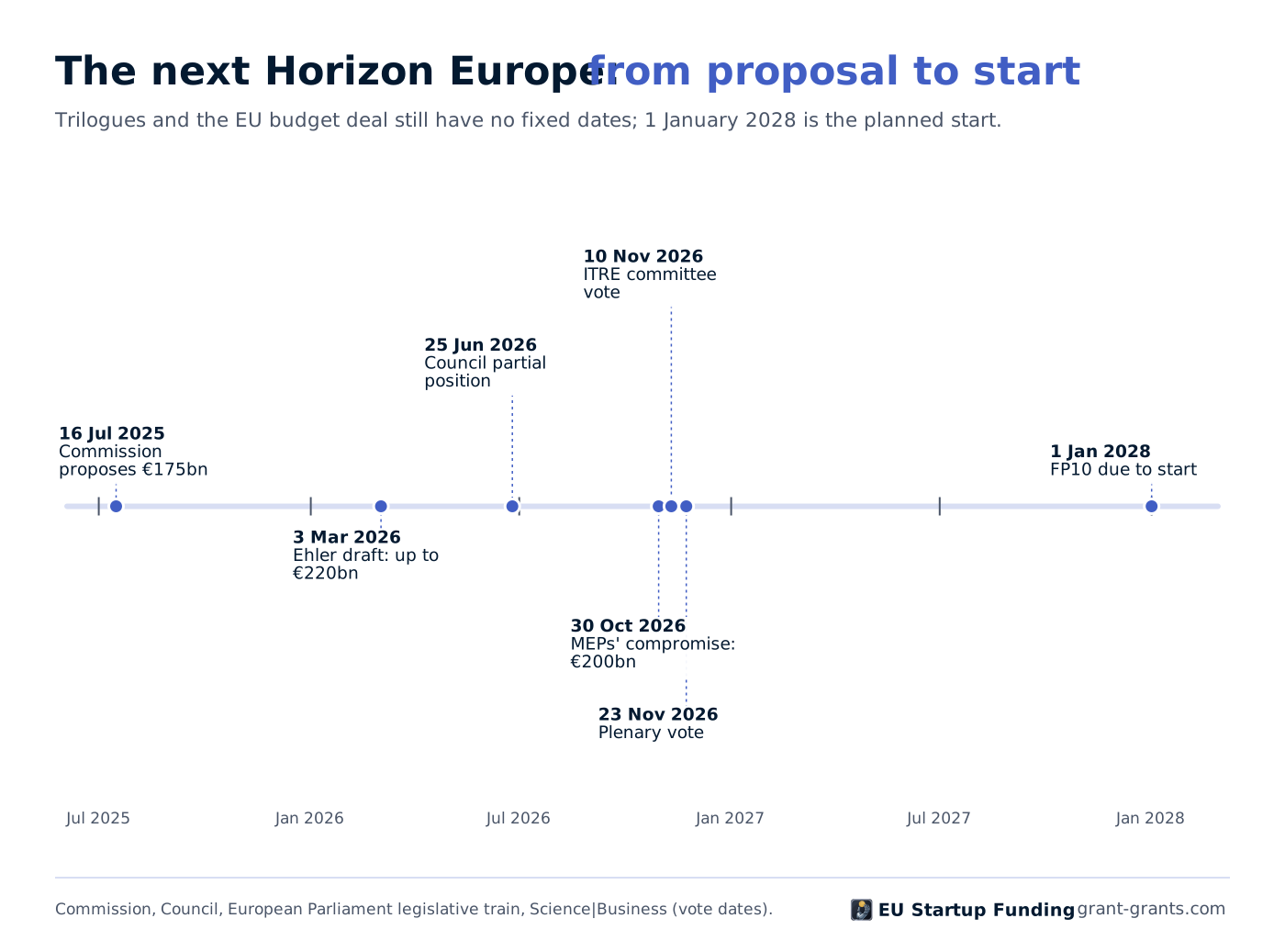
Lead MEPs Christian Ehler (EPP) and René Repasi (S&D) and the shadow rapporteurs of all political groups in Parliament's industry and research committee (ITRE) agreed a set of compromise amendments on the Horizon Europe regulation earlier in October. On 30 October 2026, Science|Business reported the finalised texts and published the compromise amendments themselves. The text replaces the Commission's budget article and rewrites large parts of the rules for participants.
According to Science|Business, ITRE is expected to vote on the texts on 10 November and the full Parliament on 23 November 2026. That vote would make it Parliament's official position for trilogue negotiations with the Commission and EU governments. EU governments agreed their own partial position on 25 June 2026, but left out the budget and other horizontal questions, which belong to the negotiations on the EU's 2028-2034 budget. Update: ITRE adopted its position on 10 November by 67 votes to 1, with 18 abstentions, and voted for a mandate to negotiate; the plenary date hasn't been set yet. Here's what the 10 November committee votes mean for startups.
Where the money would go
Article 6 of the compromise sets the budget at €200,003,562,000 in current prices, or €177.01 billion in 2025 prices. That matches the €200.003 billion that Parliament's budgets committee backed on 25 June 2026, and is below the "up to €220 billion" in Ehler's draft report of March 2026. The Commission's proposal was €175.002 billion, which the Parliament's research service puts at €154 billion in 2025 prices.
Source: Commission proposal COM(2025) 543, Article 6, and the ITRE compromise amendments, Article 6. Rounded.
The detail that matters most for startups is in Pillar III. Parliament gives the innovation pillar €2.4 billion less than the Commission did, but it writes a fixed €32.5 billion for the EIC into the regulation. The Commission's text left the split between the EIC and the other innovation activities open. For comparison, the EIC has had about €10 billion in the whole of the current 2021-2027 programme. Part of the cut in Pillar III moves to the new Fast Track to Innovation in Pillar II, which gets €2.5 billion.
What changes for startups and SMEs
Beyond the budget, the compromise rewrites several rules that decide what a startup can get and how quickly. Here are the ones that matter most, compared with the Commission's proposal:
Source: Commission proposal COM(2025) 543 (Articles 16d, 26, 27, recital 16) and the ITRE compromise amendments (Articles 15c, 16c, 16d, 26, 27, recital 16), read 1 November 2026.
Three of these are worth reading twice. First, faster grants: 30 weeks is about 6.9 months, so the gain on signature is small, but the result after 18 weeks (about 4.1 months) would come almost a month earlier than the Commission planned. Second, funding rates: under the Commission's text, any company that isn't an SME gets at most 70%. Under Parliament's text, the 70% cap applies only in Innovation Actions, and small mid-caps join SMEs at up to 100%. Third, the Scaleup Europe Fund: the Commission wanted to move all scale-up money to the new competitiveness fund, while MEPs want the EIC to keep it, and give the chair of the ECF's InvestEU Investment Committee a seat on the EIC Fund's supervisory board.
The text also keeps the EIC Plug-in, so certified national or regional programmes can still submit their best projects directly to EIC Transition or the Accelerator. On governance, Science|Business reports that a High-Level Council of at least 30 experts would advise on the priorities for collaborative research, and the compromise says at least 50% of the budget of the Pillar II windows should go to expert-led calls. On dual-use research, the same report says the text keeps the "exclusively civilian character" of Horizon Europe, although funding can continue if results later prove relevant for defence.
Why this isn't settled
Everything above is a negotiating position. After the plenary vote, Parliament has to agree a final text with EU governments, and the budget figures depend on the deal on the EU's 2028-2034 long-term budget, which needs the unanimous agreement of all member states. Governments are moving the other way: the Irish presidency's budget box would cut the Commission's €175 billion by €16.8 billion. We covered that in EU governments want to cut the next Horizon Europe by €16.8bn.
Horizon Europe would also be closely linked to the proposed European Competitiveness Fund, worth €234.3 billion in the Commission's proposal, or €409 billion in current prices together with Horizon Europe. Parliament's report on that fund is also due in plenary, with 23 November 2026 as the indicative date, and on 29 October the research committee's negotiators reached a cross-party deal on the Competitiveness Fund. How the two texts divide scale-up money between them is one of the questions to watch.
Meanwhile: the EIC's last year under the current rules
None of this affects calls before 2028. For 2027, the EIC is finalising its last work programme under the current Horizon Europe. According to a draft reported by Science|Business on 26 October, it would open calls worth €1.3 billion, including €578 million for the EIC Accelerator (€428 million Open, €150 million for Challenges), plus €400 million for the Scaleup Europe Fund. That draft isn't adopted yet. The EIC presents the final version at its online information day on 19 November 2026. For 2026, the EIC Accelerator Open budget is €414 million, and the competition is fierce: the latest Pathfinder Open round funded about 2% of proposals, as we reported in EIC Pathfinder Open 2026 results.
What this means for you
- Don't wait for FP10. The new rules start on 1 January 2028 at the earliest. If your project fits the EIC today, the current calls are your best route; our EIC Accelerator guide has the cut-off dates and how to apply.
- If you're growing past SME size, watch the scale-up definition. Parliament would open the Accelerator to "innovative scaleups" instead of small mid-caps, and keep the Scaleup Europe Fund in the EIC. For large equity rounds today, see our guide to STEP Scale Up investments.
- If you're a woman-led startup, the proposed EIC Fund compartment is years away. Today's dedicated options include Women TechEU, with a deadline on 14 January 2027.
- Plan with the low number. The final budget will be negotiated between Parliament's €200 billion and governments' much lower figure. In the 2027 EU budget fight, Parliament asked for more for Horizon Europe and SMEs but nothing extra for the EIC.
- Follow the votes on 10 and 23 November. If you want to weigh in, national contact points and your MEPs are the people negotiating the details now.
FAQ: Parliament's compromise on the next Horizon Europe
How much do MEPs want for the next Horizon Europe?
The compromise amendments released on 30 October 2026 set the 2028-2034 budget at €200,003,562,000 in current prices, or €177.01 billion in 2025 prices. The Commission proposed €175.002 billion in current prices. Both are positions, not law.
How much would the EIC get?
€32.48 billion in current prices over 2028-2034, written into the regulation as part of a €36.35 billion innovation pillar. The Commission's proposal gave the innovation pillar €38.785 billion without a separate EIC amount in its budget article. The EIC has had about €10 billion in the current programme.
Is this Parliament's official position?
Not yet. It is a compromise agreed by the rapporteurs and shadow rapporteurs of all political groups. According to Science|Business, the research committee votes on 10 November and the plenary on 23 November 2026. Then Parliament negotiates the final text with the Commission and EU governments.
When would the new rules apply?
The next Horizon Europe is due to run from 1 January 2028 to 31 December 2034. Calls in 2026 and 2027 follow the current rules, including the EIC's 2027 work programme, which the EIC presents on 19 November 2026.
What is the Fast Track to Innovation?
A new scheme in Parliament's text with €2.5 billion. It would run as a continuously open call for small, bottom-up collaborative projects relevant to industrial competitiveness, with budgets of up to €2 million and a duration of up to two years. It isn't in the Commission's proposal.
Would grants come faster?
Under Parliament's text, applicants would hear the result within 18 weeks of the deadline and sign the grant within 30 weeks. The Commission proposed 5 and 7 months. Parliament also wants the Commission to answer applicants' questions within five working days during grant preparation.
