TL;DR: what did the European Parliament decide on the 2027 EU budget, and does it change anything for startups?
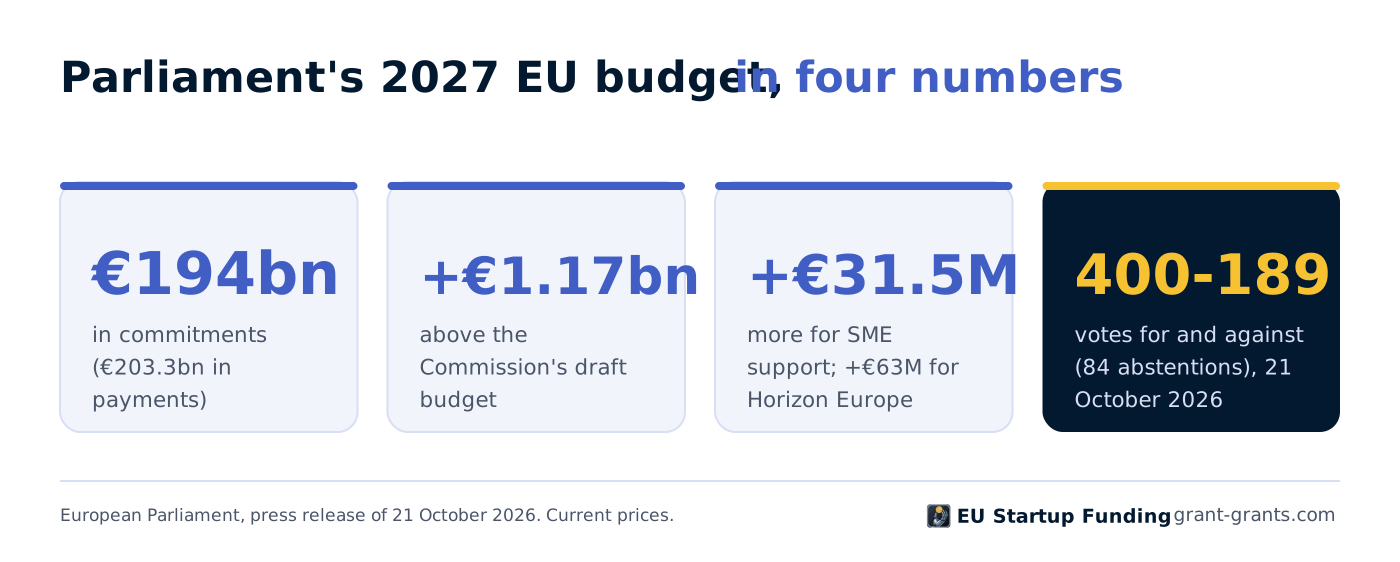
On 21 October 2026, the European Parliament adopted its position on the 2027 EU budget: €194 billion in commitments and €203.3 billion in payments. That's €1.17 billion more than the European Commission proposed, and about €2.1 billion more in commitments than EU governments want. MEPs want €63 million more for Horizon Europe and €31.5 million more for SME support, and they want to reverse every cut the Council made. The European Innovation Council (EIC) line gets no extra money. Nothing is final yet: Parliament and the Council have until 16 November to agree.
2027 is the last annual budget of the EU's current seven-year budget (2021–2027), so it's the money behind the calls that open next year: Horizon Europe, the EIC, Digital Europe, Erasmus+ and the Single Market Programme's SME support. The annual budget sets how much each programme can commit in calls and contracts. Here's what Parliament wants, where it clashes with the member states, and which lines matter if you apply for EU grants.
What happened
On Wednesday 21 October, MEPs meeting in Strasbourg set Parliament's position on the EU's 2027 budget. Status: Adopted as Parliament's reading of the budget. It is a negotiating position, not the final budget. The accompanying resolution passed with 400 votes in favour, 189 against and 84 abstentions.
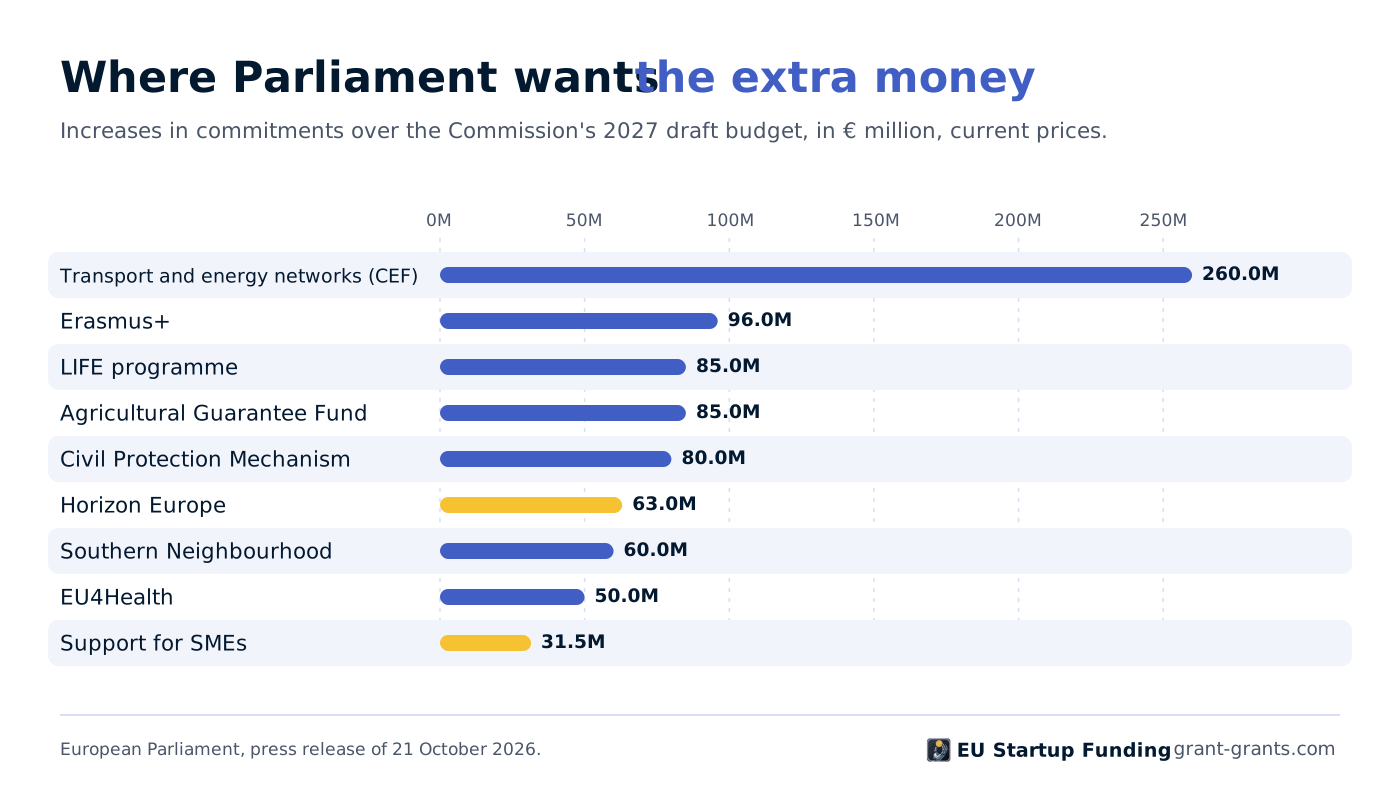
Parliament set commitments, the legal promises to pay in the same year or later, at €194 billion, and payments, the money actually paid out to beneficiaries, at €203.3 billion. All figures in this article are in current prices. The extra €1.17 billion over the Commission's proposal is spread across programmes:
- Research, industry and SMEs: Horizon Europe +€63 million, transport and energy networks +€260 million, support for small and medium-sized enterprises +€31.5 million.
- People and health: Erasmus+ +€96 million, EU4Health +€50 million.
- Farming, climate and disasters: European Agricultural Guarantee Fund +€85 million (including +€20 million for young farmers), LIFE programme +€85 million, Civil Protection Mechanism +€80 million.
- Borders, neighbourhood and the world: Asylum, Migration and Integration Fund +€20 million, Border Management and Visa Instrument +€40 million, military mobility +€20 million, Southern Neighbourhood +€60 million, Eastern Neighbourhood +€30 million, humanitarian aid +€40 million.
General rapporteur Nils Ušakovs (S&D, Latvia) said: "In this exceptionally difficult moment for Europe, simply having a budget is an achievement in itself." He added that "the NextGenerationEU recovery debt should not be repaid at the expense of Europe's next generation".
That last point is the real fight. The EU has to pay growing interest on the money it borrowed for the NextGenerationEU recovery plan and on the Ukraine Support Loan. Parliament says those costs should come from dedicated funding instruments, not from cuts to programmes such as Horizon Europe, Erasmus+ and civil protection. According to the Parliament's research service, the Budgets Committee wants 65% of the recovery instrument's extra interest costs paid from money freed up by cancelled commitments.
Three positions, one budget
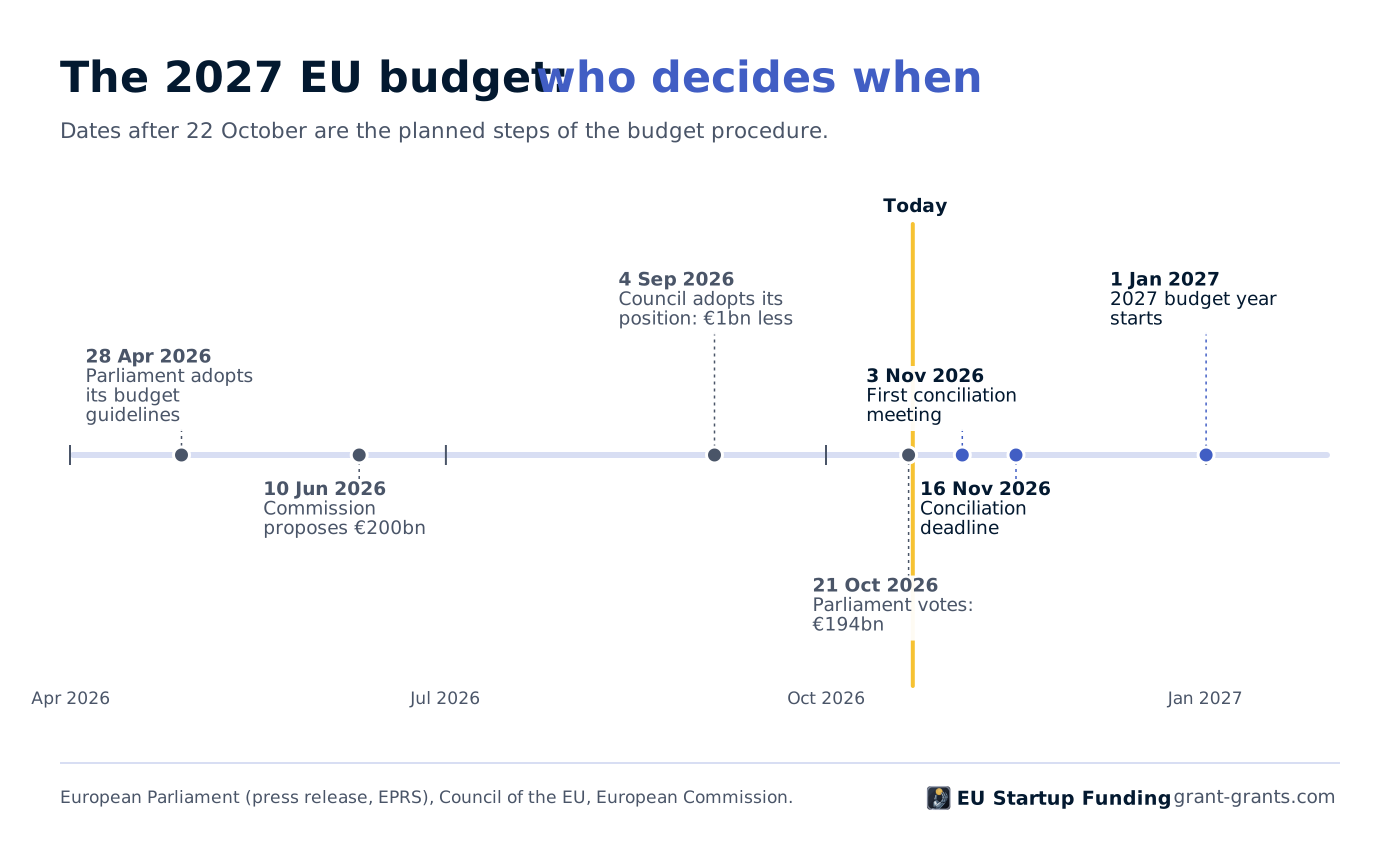
Every year, the Commission proposes a draft, the Council (the member states) adopts its position, Parliament adopts its own, and then the two negotiate. This year, the Council agreed its position in July and formally adopted it on 4 September. Ireland's finance minister Simon Harris, whose country holds the Council presidency, said "every euro must continue to deliver for our citizens". The Council cut about €1 billion in commitments and €0.5 billion in payments from the draft.
Sources: European Commission (IP/26/1311), Council of the EU (table of the Council's position), European Parliament (press release of 21 October, EPRS). The Council and Parliament totals exclude special instruments outside the multiannual financial framework (MFF). The gap between the two sides is about €2.1 billion in commitments and €1.2 billion in payments, our calculation. On 9 October, the Commission also lowered its own draft by €365.3 million in commitments with an amending letter, according to the EPRS.
Some governments want to pay less, not more. Agence Europe reported that Paris, Berlin and Rome want lower national contributions, so expect the Council to push back on Parliament's increases.
The lines that matter for startups and SMEs
The headline numbers hide the details that matter for grant applicants. The Budgets Committee's table of amendments shows every line Parliament changed, next to the draft, the Council's position and the 2026 budget. Here are the lines most relevant to startups and SMEs, in commitments:
Source: European Parliament, Committee on Budgets, amendments adopted on 13 October 2026 (Doc No 6). Rounded to €0.1 million. The Horizon Europe additions in this table add up to the €63 million in Parliament's press release.
What the table shows:
- SME support gets the biggest relative increase. The line for improving the competitiveness of enterprises, particularly SMEs, and their access to markets would rise by €30.8 million, or about 22.5%, above the draft. It's the SME strand of the Single Market Programme.
- The Council cut Horizon Europe lines by about €219 million in total, our sum of the lines in the amendments table. The biggest cuts were Clean Aviation (−€87 million, about −27%) and the Health cluster (−€74.5 million, about −10%). Parliament reversed all of them and then added €63 million across five Horizon lines: Health, Culture, EuroHPC, Climate and Food.
- Digital Europe Skills, which pays for advanced digital skills training, would lose 37% under the Council's position. Parliament restored it, together with the AI line.
- Some Horizon lines fall even in Parliament's version. The Climate, Energy and Mobility cluster drops from €1,532.7 million in 2026 to €1,279.2 million, and the ERC from €2,232.4 million to €2,160.0 million.
What about the EIC?
The EIC line isn't in Parliament's amendments, so Parliament proposes no change to it. In the Commission's draft budget, the EIC gets €1,144.3 million in commitments for 2027, against €1,160.8 million in 2026, a drop of about 1.4%. Its payments go up, from €1,310.4 million to €1,514.2 million, which is money for grants and investments already promised. The European Institute of Innovation and Technology (EIT) falls from €422.9 million to €379.4 million, about −10%.
In total, the Commission's draft gives Horizon Europe €12,838.5 million in commitments for 2027, 1.19% less than in 2026. Parliament's extra €63 million would cut that drop to about 0.7%, our calculation. If you're planning an EIC application, the EIC's 2027 budget line is about the same as this year's. For the cut-off dates and how the grant and equity work, see our EIC Accelerator guide. Competition is already fierce: the last EIC Pathfinder Open results funded about 2% of proposals.
What happens next
Parliament's vote opens three weeks of talks with the Council in a conciliation committee. The first meeting is expected on 3 November, and the 21-day conciliation period runs until 16 November 2026. Both sides say they want an agreement before the end of the year. Status: Debated. If they agree, Parliament and the Council each still have to approve the deal.
This is separate from the much bigger fight over the next long-term budget for 2028–2034, where EU governments want to cut the next Horizon Europe by €16.8 billion. The 2027 budget is about the last year of today's programmes; the 2028–2034 talks decide what comes after.
What this means for you
- Don't plan on the extra money yet. Parliament's increases are a negotiating position. The Council says it takes a "prudent approach" to next year's budget, so the €30.8 million SME top-up and the Horizon additions could shrink or disappear in the final deal.
- Expect 2027 calls of about the same size as 2026. The Commission's draft, which both sides use as the starting point, keeps Horizon Europe and the EIC close to this year's level. Use the 2026–2027 work programmes to plan. Our guide to Horizon Europe for SMEs beyond the EIC lists the collaborative calls where small companies take part.
- Watch the Health, Clean Aviation and Digital Europe lines. They're where the Council and Parliament disagree most. If your project fits health tech, aviation or digital skills, check the final figures after 16 November. Our guide to the Digital Europe Programme explains which calls are open to startups.
- Edtech startups: Erasmus+ would get €96 million more in Parliament's version. The main Erasmus+ line is managed indirectly, through national agencies; see how startups take part in our Erasmus+ funding guide.
- Look beyond 2027. The next long-term budget will reshape most of these programmes from 2028. Apply in the 2027 calls you can reach now, rather than waiting for the new rules.
FAQ: the 2027 EU budget and startup funding
How big is the EU budget for 2027?
It isn't final yet. The European Parliament wants €194 billion in commitments and €203.3 billion in payments (vote of 21 October 2026). The Council's position is €191.88 billion in commitments and €202.07 billion in payments. The Commission proposed about €200 billion in commitments including special instruments.
When will the 2027 EU budget be adopted?
Parliament and the Council negotiate in a conciliation committee from 3 November. The conciliation period ends on 16 November 2026. If they agree, both institutions then approve the deal; both say they want an agreement before the end of 2026.
Does Horizon Europe get more money in 2027?
Parliament wants €63 million more than the Commission's draft and reversed the Council's cuts of about €219 million. Even so, the draft gives Horizon Europe €12,838.5 million in commitments, about 1.2% less than in 2026.
Does the EIC get more money in 2027?
Not under Parliament's position, which doesn't change the EIC line. The Commission's draft gives the EIC €1,144.3 million in commitments for 2027, against €1,160.8 million in 2026.
What is the SME support increase in the 2027 EU budget?
Parliament wants €31.5 million more for SME support, mostly €30.8 million on the Single Market Programme line for the competitiveness of enterprises, particularly SMEs, raising it from €137.1 million to €167.1 million. The Council wants €136.3 million.
Is the 2027 budget the same as the 2028–2034 budget talks?
No. The 2027 annual budget is the last year of the current 2021–2027 framework. The next long-term budget, including the next Horizon Europe, is negotiated separately; there, EU governments want to cut Horizon Europe by €16.8 billion.
