TL;DR: how hard is it to win an EIC Pathfinder Open grant?
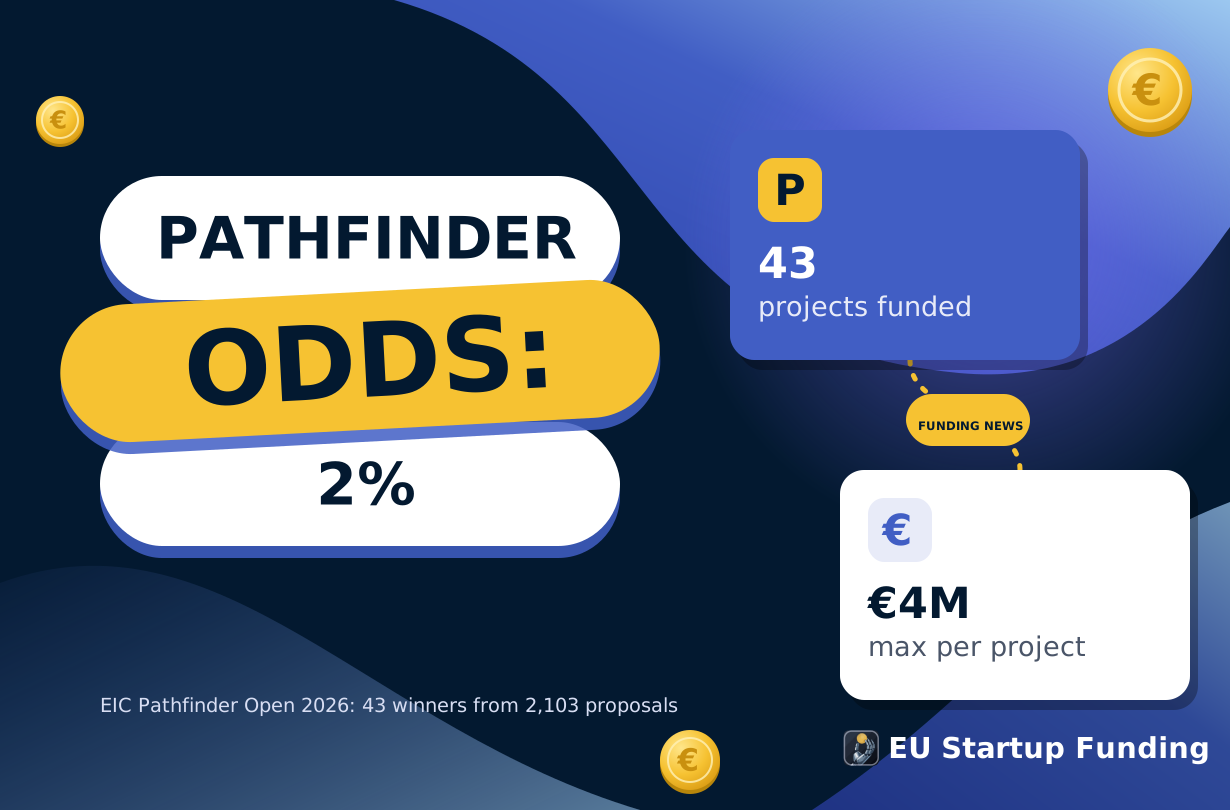
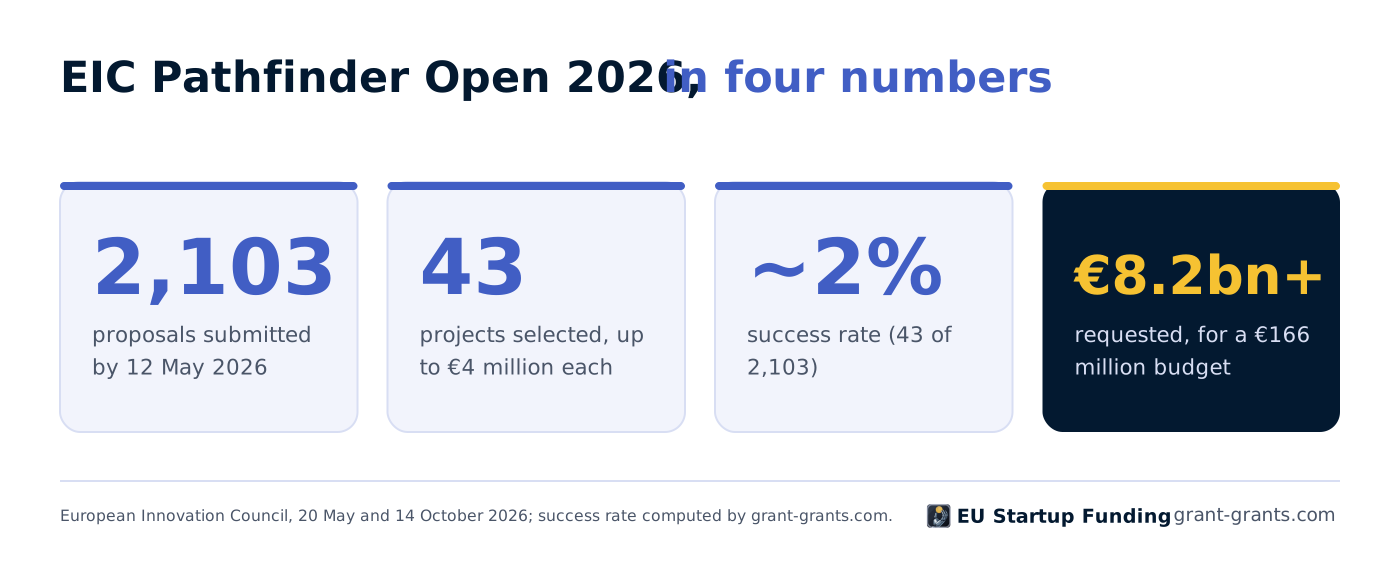
Harder than ever. On 14 October 2026, the European Innovation Council (EIC) selected 43 projects from the 2,103 proposals submitted to the Pathfinder Open 2026 call. That's a success rate of about 2%, the same as in 2025 and down from almost 7% in 2022 and 2023. Each project can get up to €4 million. Startups and SMEs take part in most of the winning projects, but only as consortium partners: Pathfinder Open doesn't accept single applicants.
EIC Pathfinder Open is the EU's main bottom-up grant for early-stage, high-risk research that could create new technologies and new markets. Demand has exploded. Applicants asked for more than €8.2 billion this year, for a call with an indicative budget of €166 million. In other words, the money on offer covered about 2% of what was requested.
What happened
The EIC announced the results on 14 October. The 43 selected projects bring together 218 organisations from 30 countries, including 24 EU Member States. Across their 266 consortium participations, 44% come from universities and other education establishments, 28% from research organisations, 25% from private companies and 3% from other organisations and public bodies. SMEs take part in 34 of the 43 projects.
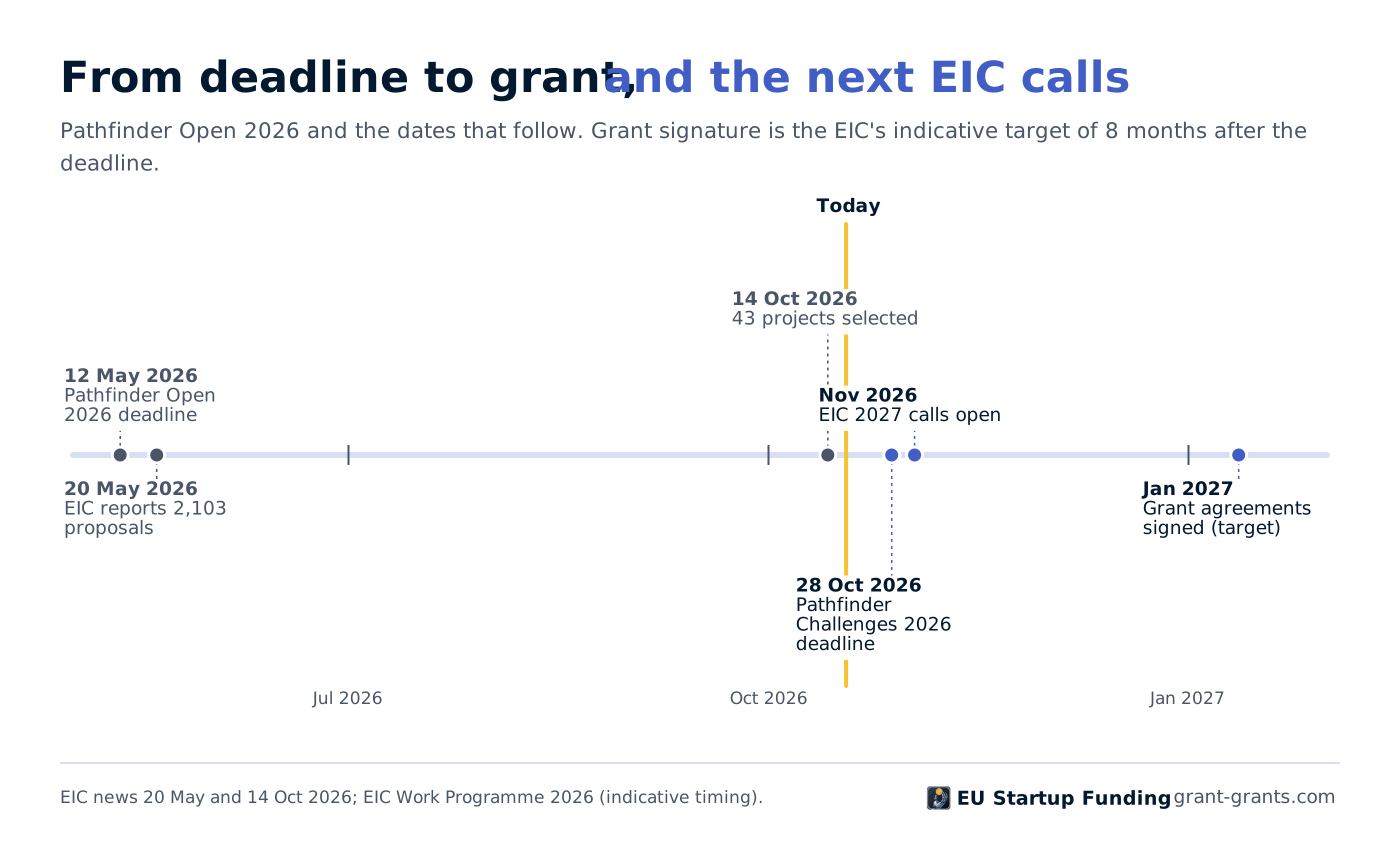
The call closed on 12 May 2026. A week later, the EIC reported 2,103 proposals from 76 countries, with 12,399 beneficiary participations from 4,633 unique organisations, and said the number had risen again compared with 2025. In its results announcement, it says the call received a record number of proposals "for the second consecutive year", making it one of the most competitive calls in Horizon Europe.
Status: Results announced. All applicants have been notified, and the winners are now preparing their grant agreements. As the EIC puts it, "Funding will be dependent upon the signing of these agreements." The EIC hasn't published a total amount awarded for 2026, only the €166 million indicative budget.
Among the examples the EIC highlights: LUNGBOT, which uses inhalable engineered bacteria to produce cancer drugs inside lung tumours; NoBIQu, on fault-tolerant quantum computing; DyHoLIT, on holographic lithography for precision manufacturing; and DEW2ROOT, a wood-based membrane that moves moisture from the air to plant roots.
Four years of shrinking odds
In 2022, the EIC picked 57 projects from 858 evaluated submissions. This year, it picked 43 from 2,103. The number of proposals has almost doubled since 2024, while the number of winners keeps slipping. Other EU research grants are seeing the same rush: the ERC received 7,710 Starting Grant applications for 2027, 60.4% more than a year earlier, after it widened who can apply.
Sources: EIC results announcements for each year and submission announcements for 2025 and 2026. Success rates are our calculation. The EIC counted evaluated submissions up to 2024 and proposals received from 2025, so the series isn't perfectly like-for-like.
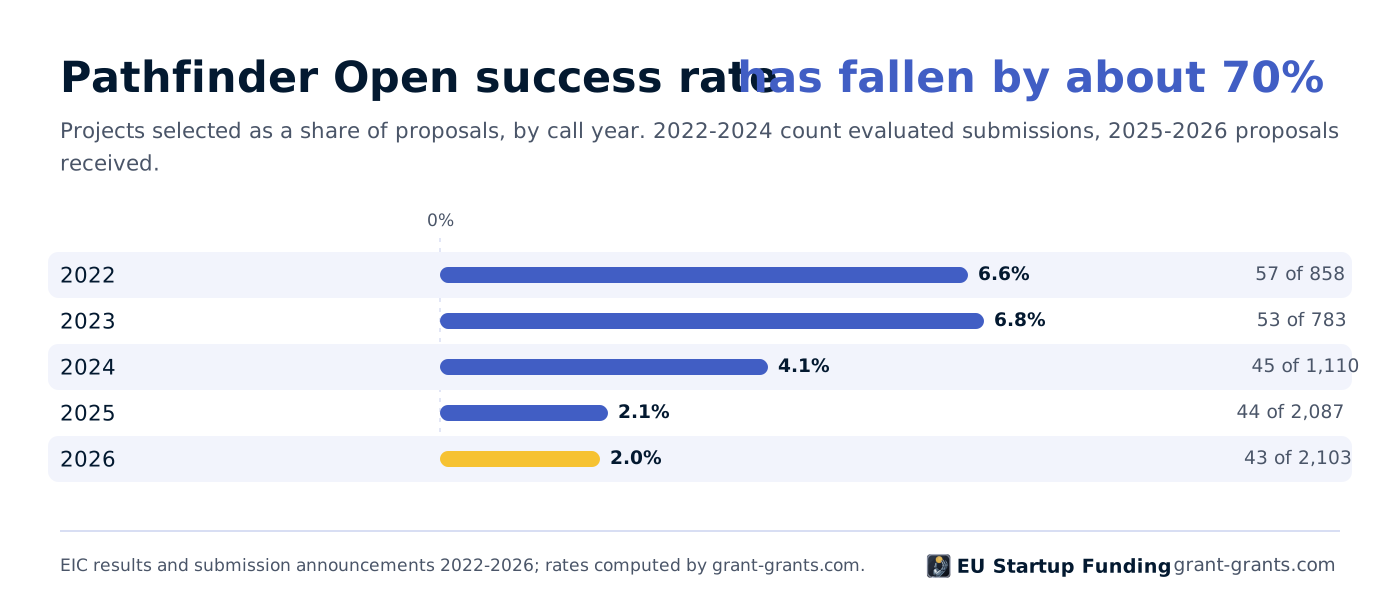
Two things changed. In 2025, submissions jumped by 86.5% in a single year, to 2,087. Then, for 2026, the EIC raised the indicative project size from €3 million to €4 million, "to enable progress to proof-of-concept stage", according to the EIC Work Programme 2026. Bigger grants from a budget that grew more slowly mean fewer winners. The money requested rose from more than €6.23 billion in 2025 to more than €8.2 billion in 2026, while the number of proposals barely moved.
Who won
We counted the coordinators in the official list of selected projects. Spain leads with 6 projects, ahead of France, Italy and the United Kingdom with 5 each. Nine of the 43 projects are coordinated from the UK and Switzerland, both associated to Horizon Europe.
Source: EIC Pathfinder Open 2026 call results (list of selected projects); our count. Most projects run for 48 months.
Five projects are led by companies rather than universities or research institutes: EIGHTSIX SCIENCE LTD (UK), SWHL GmbH (Switzerland), TRACER EUROPE BV (Netherlands), Ploid AI Biotech S.L. (Spain) and PhalconBio GmbH (Switzerland). The list doesn't say whether they are SMEs. So a company can coordinate a Pathfinder Open project, but it still needs at least two partners from other countries.
The rules startups need to know
The EIC Work Programme 2026 sets the terms. Pathfinder Open funds research at technology readiness levels 1 to 3, up to proof of concept, in any field.
- No single applicants. A proposal needs at least three independent legal entities, each in a different country: at least one in an EU Member State and two more in other Member States or Associated Countries. Startups, SMEs, universities, research organisations, industrial partners and even natural persons can take part. A startup can't apply alone.
- Up to €4 million at 100%. The EIC considers requests up to €4 million appropriate, and more if duly justified. The grant covers 100% of eligible costs as a lump sum, so you propose the amount from your estimated project costs.
- 22 pages. Sections 1 to 3 of part B (Excellence, Impact, Implementation) are limited to 22 A4 pages.
- Timing. Results within 5 months of the deadline and grant signature within 8 months (both indicative). For the 2026 call, that points to agreements around January 2027.
- Follow-on money. Pathfinder projects can get Booster grants of up to €50,000 to explore commercialisation, apply to EIC Transition, or use the Fast Track route into the EIC Accelerator.
If you can't build a three-country consortium, the EIC Pathfinder Challenges call is the alternative: it accepts single applicants and smaller consortia, but only on set themes. The 2026 Challenges call has a €96 million budget and closes on 28 October 2026 at 17:00 Brussels time, according to the EIC Pathfinder page and the Work Programme. See our EIC deadlines before the end of 2026 for the other open EIC calls.
The bigger picture: Horizon Europe can't fund most good ideas
A 2% success rate isn't only a Pathfinder problem. On 14 October, the EU research Commissioner, Ekaterina Zaharieva, said that supporting all high-quality Horizon Europe proposals today "would need over an additional €150 billion", Science|Business reports. She also said each €1 billion cut from Horizon Europe would mean about 1,700 fewer awardees, including more than 300 SMEs.
That matters because EU governments are negotiating the next long-term budget for 2028–2034. The Irish Council presidency's draft would cut the next Horizon Europe by 9.6% compared with the Commission's proposed €175 billion. Status: Proposed; nothing is agreed yet. If the cut goes through, competition for bottom-up grants like Pathfinder is unlikely to ease.
Meanwhile, the next round is close. The EIC says it will open its 2027 funding opportunities "in the beginning of November". The 2027 Pathfinder Open deadline and budget are not yet published.
What this means for you
- Join a consortium, don't wait for one. SMEs sit in 34 of the 43 winning projects. Offer a university team what it lacks: a use case, prototyping skills or a route to market. Our guide to consortium requirements for collaborative grants covers the three-country rule.
- Treat Pathfinder as a long shot. At about 2%, even an excellent proposal is likely to miss. Plan national grants and other EU calls alongside it. Our EIC Pathfinder guide explains when it's the right fit.
- Budget like a lump sum. You propose a fixed amount, and evaluators check it. Read how lump sums differ from cost reimbursement before you build your budget.
- Look at the Challenges call first if you're working alone. It closes on 28 October 2026 at 17:00 Brussels time and accepts single applicants on its themes.
- Rejected this year? Most excellent proposals were. Read the evaluation summary and use our tips on reapplying after a rejection for the 2027 call.
- Think beyond the first grant. Pathfinder results can lead to EIC Transition funding to bring the technology closer to market.
For comparison, the 2025 results are on the EIC's 2025 announcement; the 44 winners shared over €140 million.
FAQ: EIC Pathfinder Open 2026 results
How many projects did EIC Pathfinder Open 2026 fund?
The EIC selected 43 projects, announced on 14 October 2026. Each can receive up to €4 million, and funding depends on signing the grant agreement.
What is the EIC Pathfinder Open success rate?
About 2% in 2026: 43 projects from 2,103 proposals. It was 2.1% in 2025, 4.1% in 2024 and about 6.6–6.8% in 2022 and 2023, based on the EIC's own figures.
Can a startup apply to EIC Pathfinder Open alone?
No. Pathfinder Open needs a consortium of at least three independent legal entities in three different countries, with at least one in an EU Member State. Single applicants can only apply to Pathfinder Challenges.
How much money was requested in 2026?
More than €8.2 billion, for an indicative budget of €166 million. The average request was about €3.9 million per proposal.
When is the next EIC Pathfinder deadline?
Pathfinder Challenges 2026 closes on 28 October 2026 at 17:00 Brussels time. The EIC says its 2027 calls open in the beginning of November; the 2027 Pathfinder Open deadline is not yet published.
Do SMEs win EIC Pathfinder grants?
Yes, as partners. SMEs take part in 34 of the 43 projects selected in 2026, and 25% of all participations are private companies. Five projects are coordinated by companies.
