TL;DR: what happened to the ERC Starting Grants?
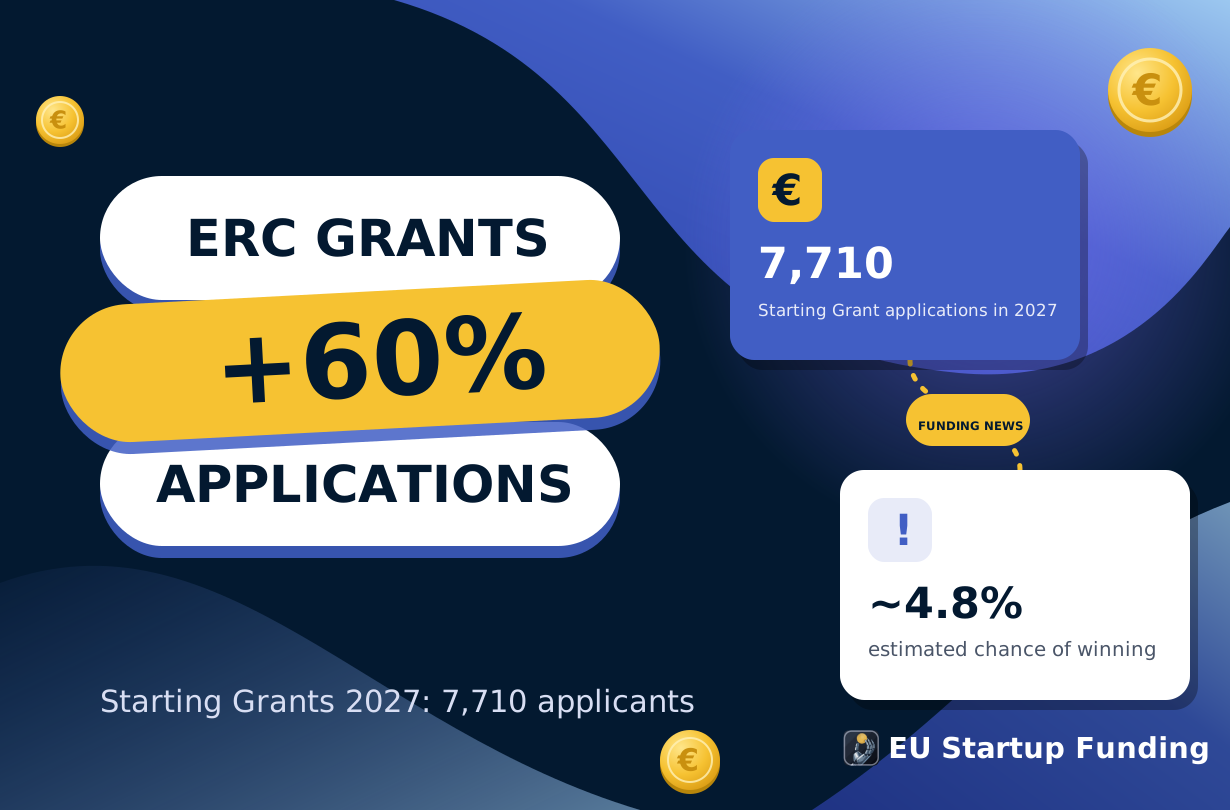
The European Research Council (ERC) received 7,710 applications for its 2027 Starting Grants, 60.4% more than a year earlier, according to preliminary figures published on 23 October 2026. The main reason is a wider eligibility window: researchers up to 10 years after their PhD could apply, against 2 to 7 years in the previous call. The budget went the other way: €594 million for about 373 grants, down from €705 million for 421 winners in the 2026 round. By our estimate, roughly 1 in 21 applicants (about 4.8%) will be funded, against 8.8% last time. Results are planned for summer 2027.
The ERC isn't a startup programme, but it sits at the start of Europe's deep-tech pipeline: many research spin-offs begin as ERC projects, then move on to Proof of Concept money and the EIC. When demand for its grants jumps 60% while the budget shrinks, researcher-founders, the startups they create and the companies that partner with them all feel it. Here's what the new numbers say and what to do about them.
What happened
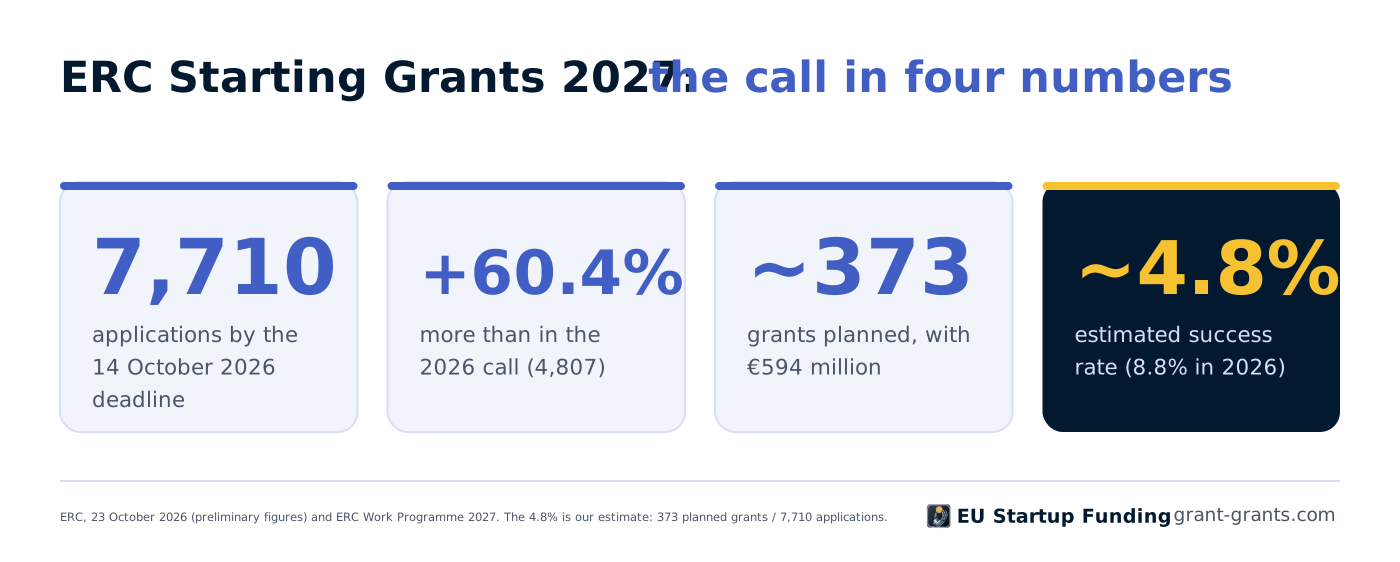
The ERC Starting Grant 2027 call closed on 14 October 2026. On 23 October, the ERC published preliminary application figures: 7,710 applications, an increase of 60.4% on the previous call. Demand was already rising before that: applications grew by 22.4% in the 2026 call and by 13% in the 2025 call.
Physical sciences and engineering drew the most proposals, with 3,314 (43%), followed by social sciences and humanities with 2,220 (29%) and life sciences with 2,176 (28%). Women submitted nearly 39% of the proposals.
The ERC itself points to the rule change. Its Scientific Council "broadened the eligibility windows" for the 2027 Starting and Consolidator Grant calls, so comparisons with earlier years should take that into account. In the 2026 call, a researcher had to have defended their PhD 2 to 7 years before 1 January 2026. For 2027, the Starting Grant is open to anyone who defended their PhD in the 10 years before 1 January 2027, that is, between 1 January 2017 and 31 December 2026. That roughly doubles the number of PhD year groups who can apply.
The 2027 rules also add a lifetime limit: a researcher can lead only one Starting Grant in their career, and researchers who already held a Starting or Consolidator Grant can't apply for the same type again.
More applicants, less money
The ERC Work Programme 2027 earmarks €594 million for an estimated 373 Starting Grants. For comparison, the 2026 Starting Grant results in September gave €705 million to 421 researchers, out of a then-record 4,807 proposals, a success rate of 8.8%.
Source: ERC press releases of 3 September and 23 October 2026 and the ERC Work Programme 2026 and 2027 data on the EU Funding & Tenders portal. The 2027 success rate is our own calculation (373 ÷ 7,710) and will change with the final number of eligible proposals and grants.
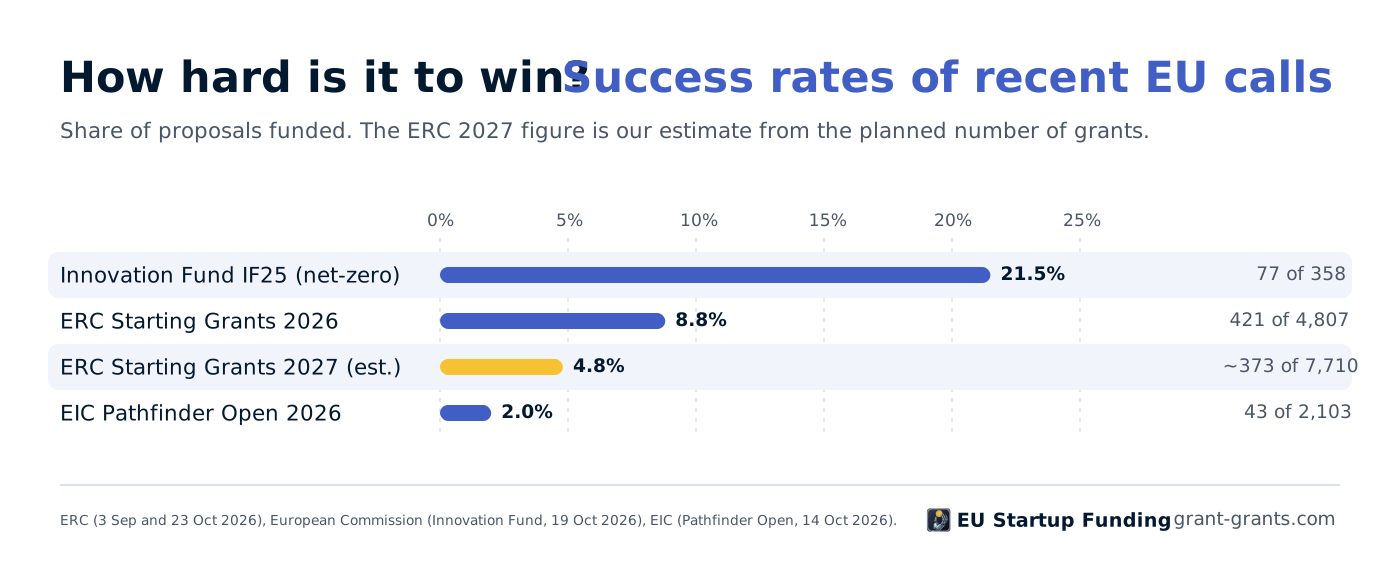
The ERC isn't alone. Earlier this month, EIC Pathfinder Open funded 43 of 2,103 proposals, about 2%. Research money is getting more contested just as EU governments argue about the next budget: the Council presidency's draft for the 2028–2034 budget would cut the next Horizon Europe by €16.8 billion. That cut is Debated, not adopted: the final budget needs agreement among all EU governments and the European Parliament's consent.
Why this matters if you're building a startup
ERC grants fund a Principal Investigator (PI) and their team at a host institution. A startup can't apply for its own product development. Two details still make the ERC relevant to founders:
- The host doesn't have to be a university. The ERC says the PI "can be hosted by any legal entity" in an EU member state or associated country, as long as it offers the conditions to lead the research independently. In practice almost all hosts are universities and research centres.
- ERC projects feed the spin-off pipeline. Researchers with an ERC grant can apply for a Proof of Concept (PoC) grant, a €150,000 lump sum for 18 months, to test the commercial or social potential of their results. An ERC report on biotech research published on 30 September counted 531 PoC grants in biotech between 2014 and 2023, 72 spin-off companies and 24 projects that went on to win 25 EIC Transition grants.
So fewer Starting Grants today means fewer PoC grants and fewer research-based spin-offs a few years from now. It also means more excellent researchers who miss out and look for other routes, some of them through industry partnerships and startups.
Source: ERC grant pages and EU Funding & Tenders portal call data, opened 28 October 2026. Researchers moving to the EU or an associated country from elsewhere to take up a Starting or Consolidator Grant can ask for up to €2 million in extra funding instead of €1 million.
What comes next
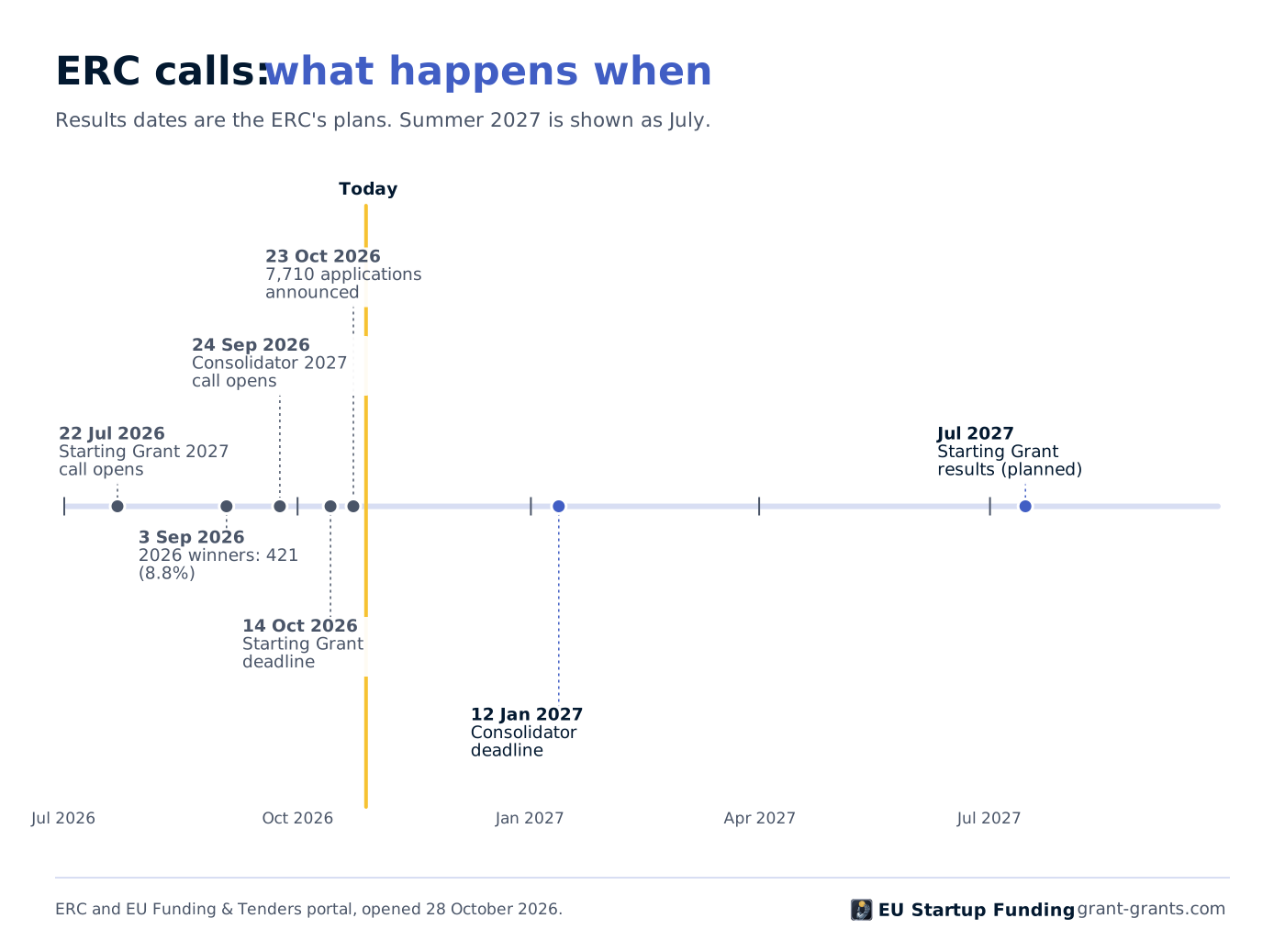
- Evaluation (under way): the ERC has started evaluating the 7,710 Starting Grant proposals. Results are planned for summer 2027.
- Consolidator Grants 2027 (open): the Consolidator Grant call closes on 12 January 2027. It is open to researchers who defended their PhD 5 to 15 years before 1 January 2027, so the two windows now overlap: anyone who defended between 2017 and 2021 fits both.
- ERC Plus Grants: the first call of this new scheme for outstanding researchers, with €210 million, drew 198 proposals by 2 September. Results are expected in spring 2027.
- From 2028 (planned): the ERC plans a new evaluation panel for the fundamentals of AI (PE12) from the 2028 calls under the EU's next research programme, whose budget is still being negotiated.
What this means for you
- Treat ERC money as a long shot. At about 1 in 21, don't plan a spin-off's runway around a Starting Grant. Build the plan on several sources, and use our comparison of which EU grants are worth applying for to see where the odds are better.
- If you're an ERC grantee, use Proof of Concept early. €150,000 is a small, fast way to test a market before you set up a company. Sort out ownership of results with your host institution first; our guide to intellectual property in grant-funded research covers the basics.
- Plan the next step after the lab. Results from ERC and other EU research projects can lead to EIC Transition, which funds technology and business validation. See our guide to EIC Transition.
- Look beyond the ERC for deep-tech R&D. National innovation agencies, EIC calls and cascade funding often have better odds for company-led projects. Our overview of research grants for deep-tech startups lists the main options.
- Write for a crowded field. When success rates fall, small weaknesses decide the outcome. Our guide on how to increase your grant win rate shows what evaluators look for.
FAQ: ERC Starting Grants 2027
How many people applied for ERC Starting Grants 2027?
The ERC received 7,710 applications by the 14 October 2026 deadline, according to preliminary figures published on 23 October 2026. That is 60.4% more than the 4,807 proposals in the 2026 call.
Why did applications rise so much?
Mainly because the eligibility window was widened. In the 2026 call, applicants needed a PhD defended 2 to 7 years before 1 January 2026. For 2027, anyone who defended their PhD in the 10 years before 1 January 2027 could apply. The ERC says comparisons with earlier calls should take this change into account.
What are the chances of winning an ERC Starting Grant in 2027?
The ERC Work Programme 2027 plans about 373 Starting Grants with €594 million. Divided by 7,710 applications, that is about 4.8%, or roughly 1 in 21. This is our estimate; the ERC has not published an official success rate for the 2027 call. In the 2026 call, 8.8% of proposals were funded.
When will the ERC Starting Grant 2027 results be announced?
The ERC plans to announce the projects selected for funding in summer 2027.
Can a startup apply for an ERC grant?
Not for its own product development. ERC grants go to a Principal Investigator and their research project at a host institution. The ERC says the host can be any legal entity in an EU member state or associated country that lets the researcher work independently, but almost all hosts are universities and research centres. ERC grantees can later apply for a €150,000 Proof of Concept grant to explore commercialisation.
Is the ERC Consolidator Grant 2027 still open?
Yes. The Consolidator Grant 2027 call opened on 24 September 2026 and closes on 12 January 2027. It is for researchers who defended their PhD 5 to 15 years before 1 January 2027 and offers up to €2 million over five years. The portal lists €618.5 million for about 296 grants.
