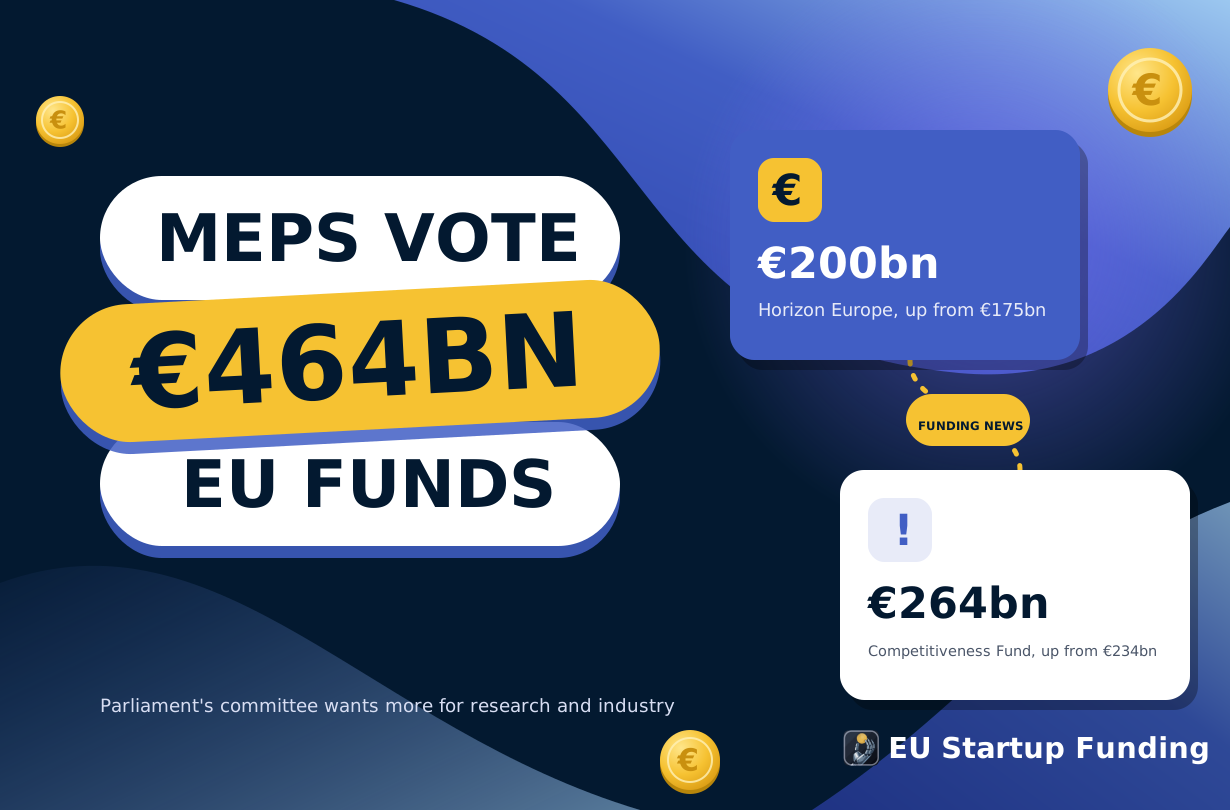
TL;DR: what did MEPs vote for on 10 November?
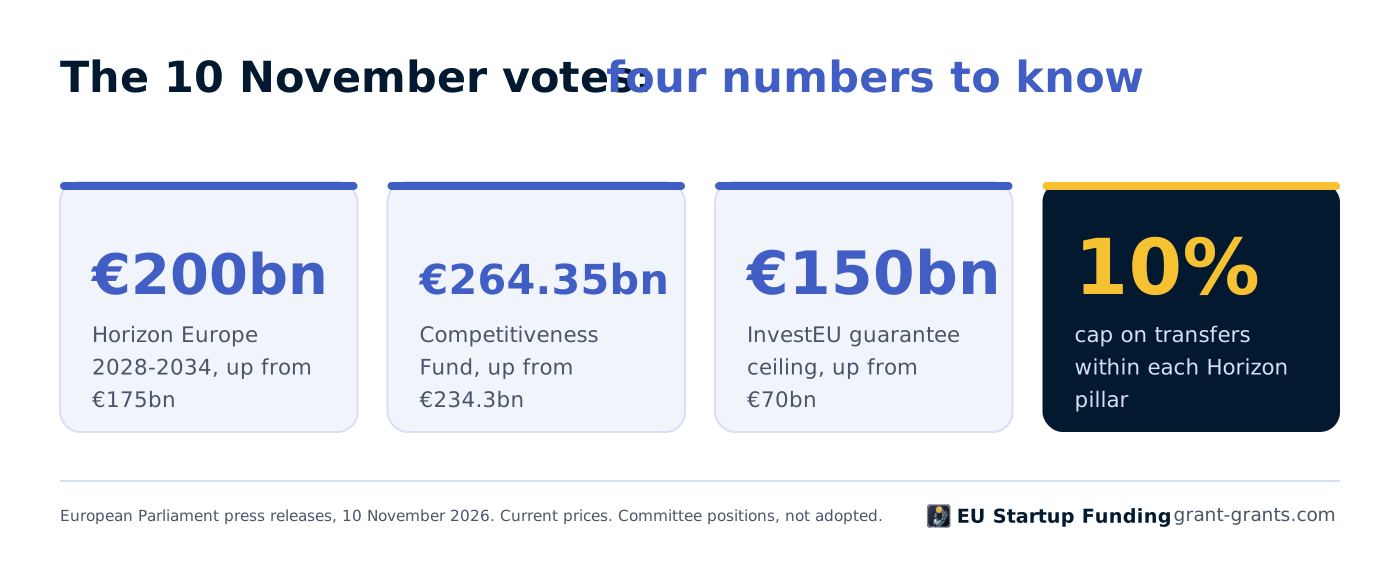
The European Parliament's industry and research committee (ITRE) voted for a €200 billion Horizon Europe for 2028-2034, up from the Commission's €175 billion, and a €264.35 billion European Competitiveness Fund (ECF), up from €234.3 billion. Both figures are in current prices. MEPs also want ring-fenced money and more independence for the European Innovation Council (EIC), a 10% cap on budget transfers within each Horizon pillar, a €150 billion InvestEU guarantee and a blended-finance instrument for defence start-ups and scale-ups. This is Debated, not law: the plenary still has to confirm the votes, and talks with EU governments can't start until they agree the size of the next long-term budget.
Two weeks ago we covered the deals Parliament's negotiators struck on the next Horizon Europe and the European Competitiveness Fund. On Tuesday 10 November 2026, the full committee voted on both, and the results are now public. For startups the headline is simple: Parliament wants more money for the two funds that will pay for EU grants, loans and equity from 2028, and harder walls around the EIC. Here's what passed, by how much, and what it changes for you.
What happened on 10 November
ITRE voted on three texts that make up the EU's research and industry funding for 2028-2034. According to Parliament's press release on Horizon Europe, the committee adopted its position on the Horizon Europe regulation by 67 votes to 1, with 18 abstentions, and on the specific programme decision by 66 votes to 1, with 19 abstentions. A separate press release on the Competitiveness Fund gives 61 votes to 13, with 12 abstentions, for the ECF position.
MEPs also gave themselves mandates to negotiate with EU governments: 65 to 18, with 2 abstentions, for Horizon Europe, and a much closer 56 to 26, with 4 abstentions, for the ECF. The lead MEPs are Christian Ehler (EPP, Germany) on the Horizon Europe regulation and, with Dan Nica (S&D, Romania), on the ECF, and René Repasi (S&D, Germany) on the specific programme. Parliament's legislative observatory records the committee vote on 10 November.
Source: European Parliament press releases 20261109IPR48713 and 20261109IPR48712, 10 November 2026.
Horizon Europe: €200 billion and walls around the EIC
MEPs want to raise the programme from the Commission's €175 billion to €200 billion in current prices, or €177 billion in 2025 prices. They keep the four parts of today's programme: excellent science, competitiveness and society, innovation, and the European Research Area. Ehler pointed to the Draghi report: "There is only one EU programme for which the Draghi report recommended a specific budget: Horizon Europe's €200 billion," he said.
For startups, the changes that matter most are about the EIC, which runs the EIC Accelerator and Pathfinder:
- Budget guarantees for the EIC and the ERC. The committee wants "strong budget guarantees" for both and warns against any erosion of their independence. Ehler said the EIC "needs to become more autonomous and agile".
- A 10% cap on transfers. Each pillar gets its own budget lines, and the Commission could move at most 10% of the money within a pillar. That makes it harder to shift EIC money to other priorities.
- Fast tracks. New "fast track to excellence" and "fast track to innovation" schemes would speed projects up. The rapporteurs' compromise text we reported on 1 November described the innovation fast track as continuously open, with up to €2 million over two years.
- Experts help write the calls. A high-level council of at least 30 independent experts from science, industry and civil society would advise on priorities, partnerships and money, and help draft calls for proposals.
The press release doesn't give pillar figures for the adopted text. The compromise we covered on 1 November ring-fenced €32.5 billion for the EIC; check Parliament's published report before relying on that number. If you're planning an EIC application, our EIC Accelerator guide covers how the scheme works today.
Competitiveness Fund: €264 billion and a defence start-up instrument
The ECF would merge 14 EU funding instruments, including Digital Europe, InvestEU, LIFE and the SME strand of the Single Market Programme, into four policy windows. The committee voted to raise it to €264.35 billion in current prices, from the Commission's €234.3 billion, with binding minimum amounts for each window and a new €10.11 billion flexibility reserve for unforeseen needs. "Through a flexibility reserve of €10bn, we make flexibility visible and feasible," Ehler said.
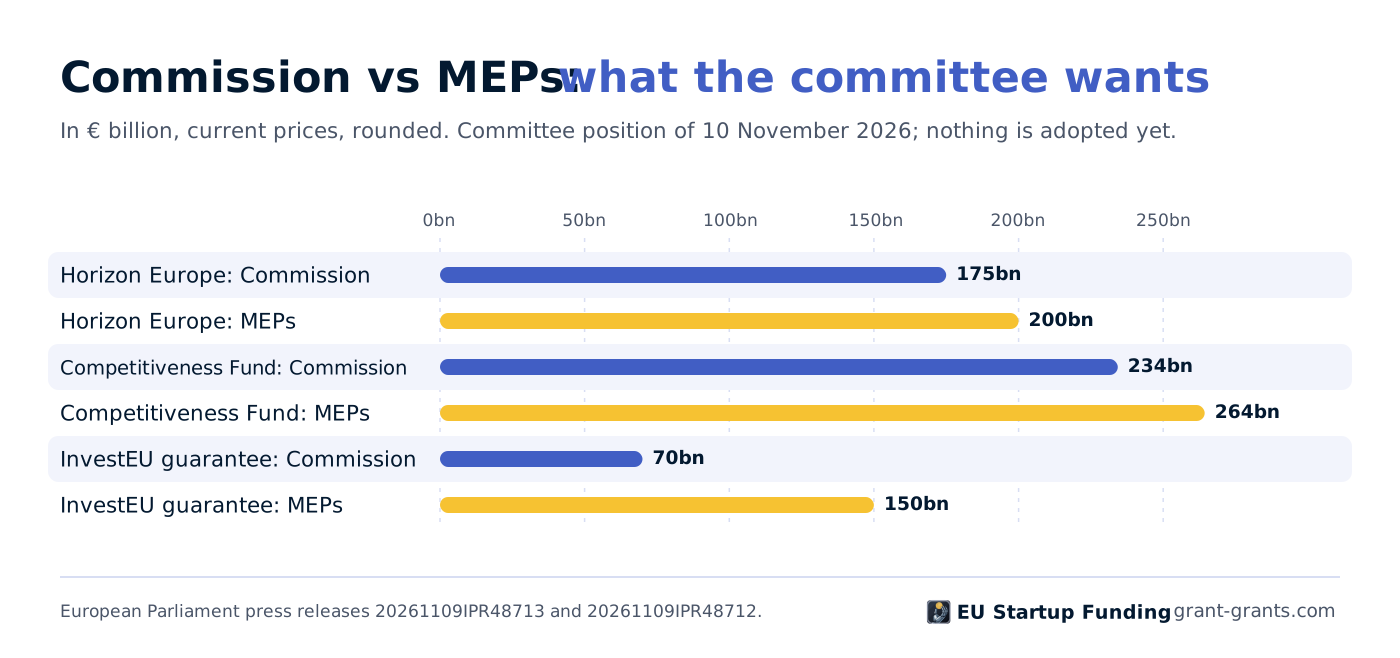
Added together, MEPs want €464.35 billion for the two funds, about €55 billion more than the Commission's €409.3 billion. What's new for companies, according to the press release:
- Defence start-ups get their own instrument. MEPs want a defence research and innovation programme with three instruments, one of them "a blended-finance instrument for defence start-ups and scale-ups developing disruptive technologies". The other two are an upstream defence research programme and collaborative applied research tied to capability priorities.
- A bigger InvestEU guarantee. The ECF InvestEU Instrument would get a maximum guarantee of €150 billion instead of the €70 billion the Commission proposed, with new support for clean-tech manufacturing for housing, building renovation, energy communities and social investment.
- From lab to market. New Horizon Europe Pathway actions would take Horizon research results to market deployment through the ECF.
- Raw materials and energy. A dedicated budget envelope and governance for critical raw materials, and a section for energy infrastructure. "Without affordable and reliable energy, there is no European industry," Nica said.
- New governance. Several independent bodies would replace the Commission's single Strategic Stakeholders Board, and three of the four windows get new names that stress industry and economic security.
In October, Science|Business described Parliament's ECF figure as €234 billion in 2025 prices. Our reading is that it's the same amount as today's €264.35 billion in current prices: the ratio between the two, 1.13, is the same as between Horizon Europe's €200 billion and €177 billion. If your company uses bank loans backed by the EU, our guide to InvestEU loan guarantees and debt financing explains how that money reaches SMEs today.
Commission vs Parliament: the main differences
Source: European Parliament press releases of 10 November 2026; Commission figures as quoted there. All amounts in current prices unless stated.
Why none of this is settled
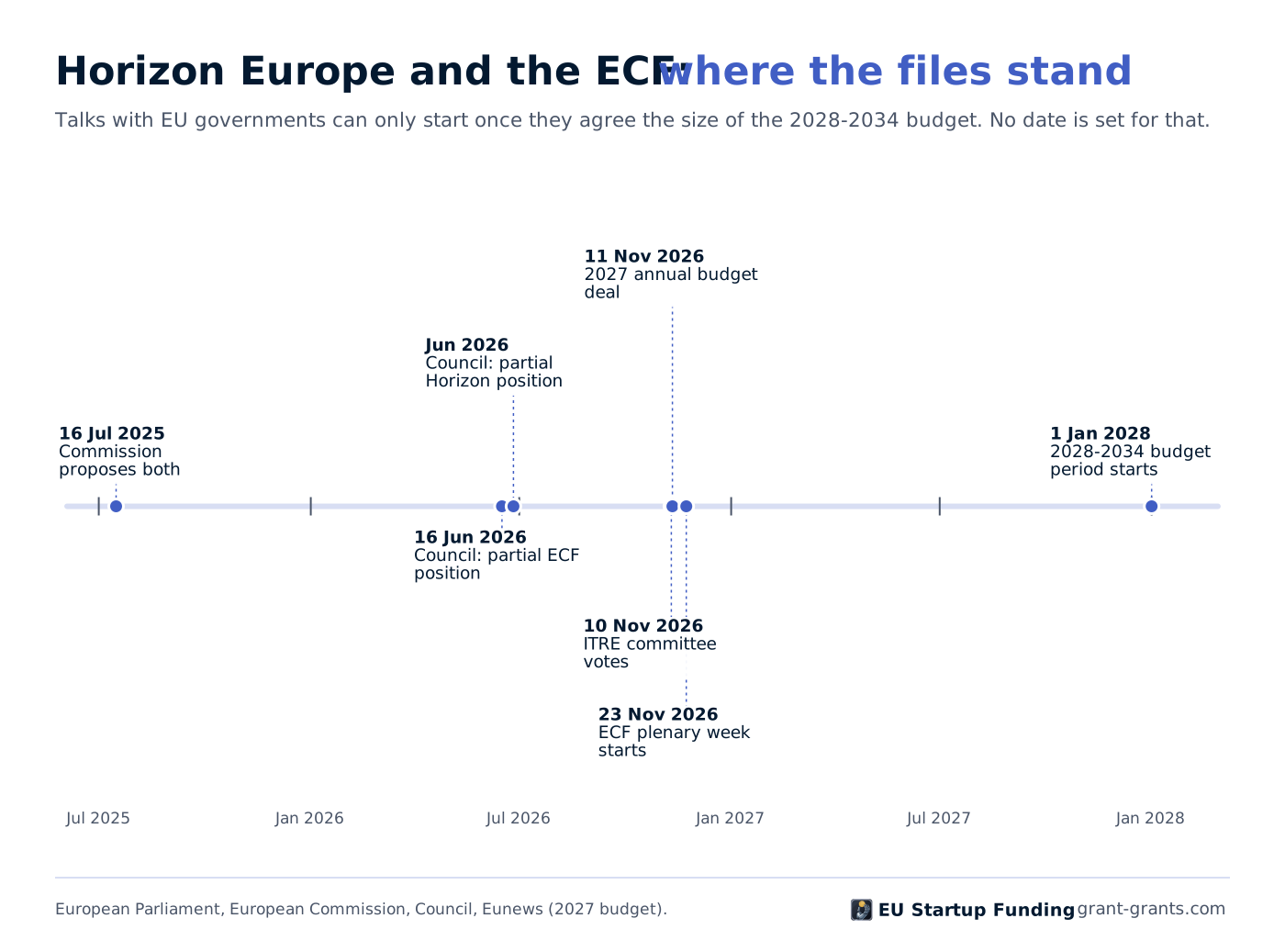
A committee vote is not a law. The Horizon Europe position "is expected to be approved at one of forthcoming plenary sessions", and the ECF vote is expected to be announced for the 23-26 November plenary, according to Parliament. More importantly, MEPs can only start negotiating with EU governments "once member states have adopted their full mandate, including the overall funding levels for the EU's long-term budget". The Council agreed partial positions on both files in June 2026, without budget figures.
Governments want to spend less, not more. The Irish presidency's draft budget box would cut the next Horizon Europe by €16.8 billion below the Commission's proposal, as we reported in EU governments want to cut the next Horizon Europe by €16.8bn. So the €200 billion and €264 billion are Parliament's opening bid, and the final numbers will come out of the 2028-2034 budget deal, which needs every member state to agree.
Meanwhile: the 2027 budget deal
A day after the committee votes, Parliament and EU governments agreed the EU's annual budget for 2027, the last year of today's Horizon Europe. According to Eunews, citing the Council, the deal totals €199.7 billion in commitments and €211.5 billion in payments. Parliament won an extra €21.5 million for Horizon Europe, €22.5 million for transport and energy networks and €14 million for Erasmus+, and the €1 billion in cuts the Council had made were reversed. Parliament and the Council have 14 days to approve the agreement, and the Council is expected to endorse it on 23 November.
That's a small rise for research, but it secures the money behind next year's calls, including the EIC Work Programme 2027. For Parliament's starting position in October, see what MEPs wanted in the 2027 EU budget.
What this means for you
- Nothing changes before 2028. Today's Horizon Europe, EIC, Digital Europe and InvestEU keep running until the end of 2027, and the 2027 budget deal funds next year's calls. Apply under the current rules.
- The EIC looks safer. Ring-fenced lines and a 10% transfer cap would make EIC money harder to raid, if they survive the talks. That's good news if you plan EIC Accelerator applications after 2027.
- Defence tech has a new door. A blended-finance instrument for defence start-ups and scale-ups would usually mean grant money combined with investment; the details aren't public yet. Watch the defence window if you build dual-use or security tech.
- Expect more money through banks and funds. A €150 billion InvestEU guarantee would mostly reach SMEs as loans and equity from intermediaries, not as grants you apply for directly.
- Treat the numbers as an opening bid. Parliament's figures are the high end and governments are pushing for cuts, so don't plan on more than the Commission's €175 billion and €234.3 billion.
FAQ: the 10 November votes on Horizon Europe and the ECF
What did the European Parliament vote on 10 November 2026?
Its industry and research committee (ITRE) adopted its positions on Horizon Europe 2028-2034 (regulation 67-1-18, specific programme 66-1-19) and on the European Competitiveness Fund (61-13-12), plus mandates to negotiate with EU governments (65-18-2 and 56-26-4).
How big would Horizon Europe 2028-2034 be?
MEPs want €200 billion in current prices, or €177 billion in 2025 prices, against the Commission's €175 billion. EU governments haven't agreed any figure yet and are pushing for less.
How big would the European Competitiveness Fund be?
MEPs voted for €264.35 billion in current prices, up from the Commission's €234.3 billion, with binding minimum amounts per window and a €10.11 billion flexibility reserve.
What changes for the EIC?
The committee wants strong budget guarantees for the EIC and the ERC, protection of their independence and a 10% cap on Commission transfers within each pillar. Pillar figures for the adopted text aren't in the press release.
Is there new money for defence start-ups?
The committee wants a defence research and innovation programme with a blended-finance instrument for defence start-ups and scale-ups developing disruptive technologies. It's a Parliament proposal, not yet agreed with governments.
When will the new programmes start?
Both are part of the 2028-2034 EU budget, so from 1 January 2028 at the earliest. The plenary votes come first, then talks with governments once they agree the long-term budget's size.
