TL;DR: what did MEPs agree on the EU Competitiveness Fund?
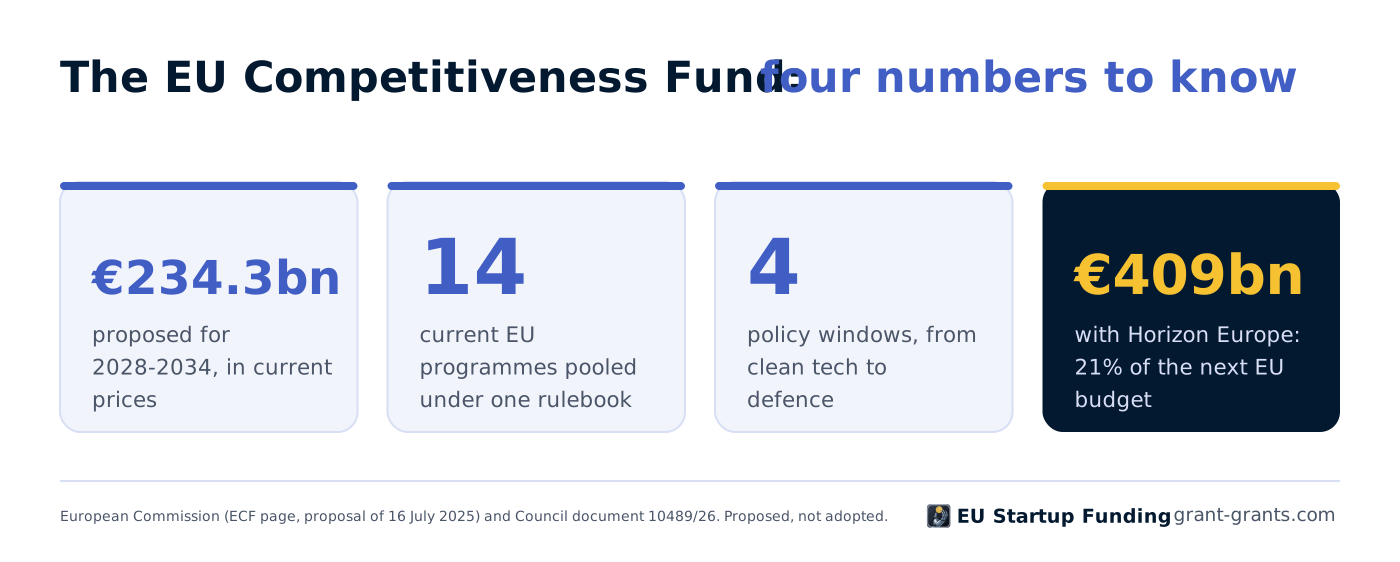
Parliament's research committee (ITRE) has a cross-party deal on the European Competitiveness Fund (ECF), the €234.3 billion fund that would merge 14 EU programmes, from Digital Europe to InvestEU and the SME strand of the Single Market Programme, from 2028. According to Science|Business, the compromise gives first-time applicants priority when proposals tie on score, ring-fences money to advise newcomers, and keeps decisions on research topics inside Horizon Europe. This is Debated, not law: the committee votes on 10 November, the plenary on 23 November, and the fund's size depends on the EU's 2028-2034 budget deal.
If your startup has used Digital Europe, InvestEU, LIFE, EU4Health or the Enterprise Europe Network, the money behind them is due to move into one fund in 2028. The Commission calls it a "single gateway" with one rulebook. Two days after we reported Parliament's deal on the next Horizon Europe, its negotiators have now also agreed their line on this second, bigger fund. Here's what's in it, what's still open and what it means if you plan to apply for EU funding after 2027.
What happened
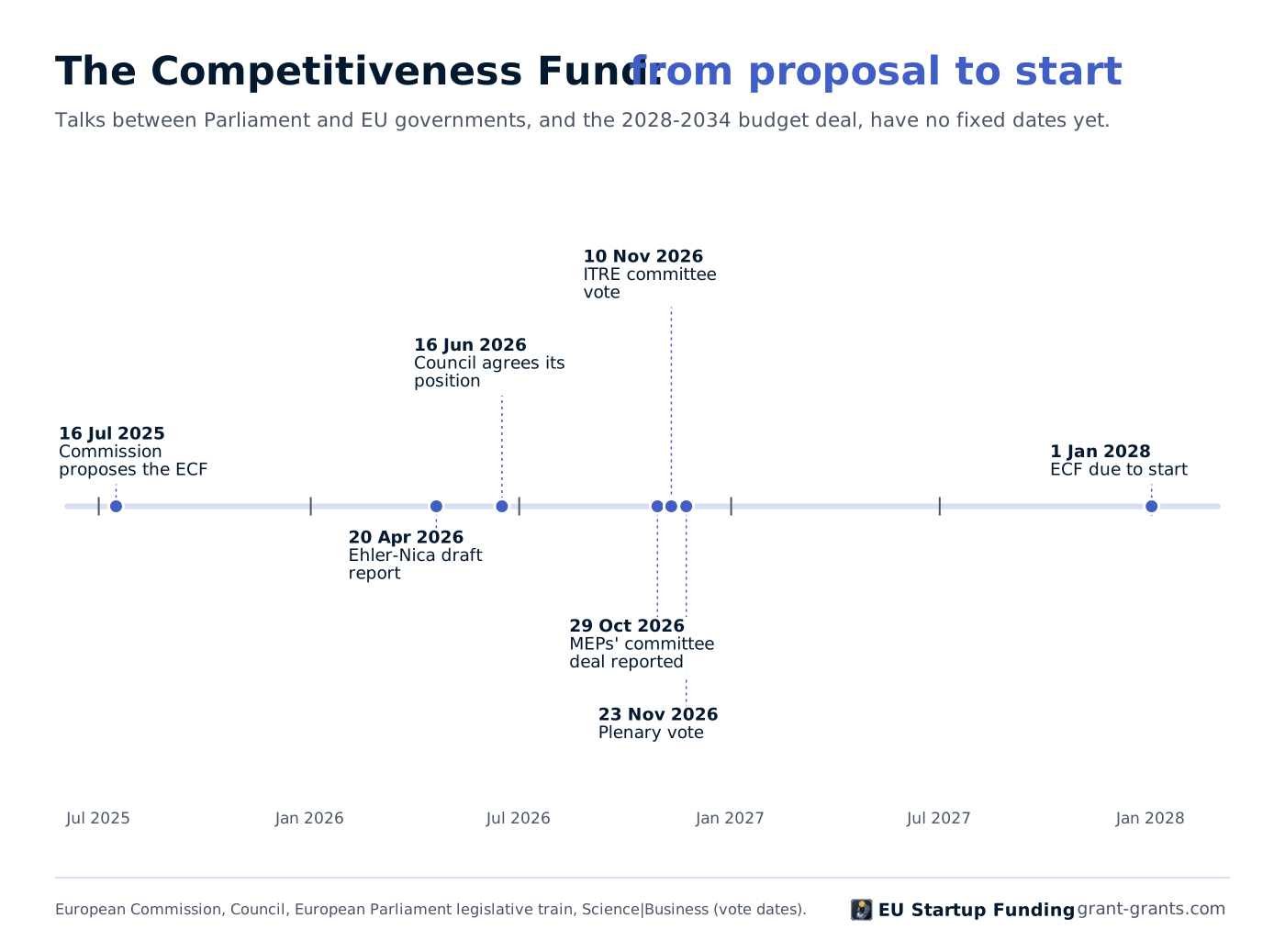
On 29 October 2026, Science|Business reported that the industry and research committee (ITRE) of the European Parliament had reached a compromise amendment on the ECF regulation, which means a majority of the political groups back the text. The lead MEPs are Christian Ehler (EPP, Germany) and Dan Nica (S&D, Romania), according to Parliament's legislative observatory. Science|Business says the committee votes on 10 November and the full Parliament on 23 November 2026. The vote in plenary would set Parliament's mandate for negotiations with EU governments. Update: the committee adopted its position on 10 November by 61 votes to 13, with 12 abstentions, and raised the fund to €264.35 billion in current prices. Read what MEPs voted for and what it means for startups.
The deal took a while. The Council's progress report of 14 June 2026 still expected the committee vote on 10 September and the plenary in October. Parliament's legislative train counts 2,287 amendments tabled to the rapporteurs' April draft report, and Science|Business reports 3,438 amendment proposals from the research committee and nearly 7,800 once the other committees' opinions are counted.
The compromise text itself hasn't been published, so the details below come from the MEPs quoted by Science|Business. Shadow rapporteur Yvan Verougstraete (Renew) said the biggest change from the draft report was a stronger strategic direction: "A fund of this scale cannot simply distribute funding," he said.
What the deal means for first-time applicants
Two measures in the compromise are aimed squarely at companies that have never won EU money. They come from Danuše Nerudová (EPP), who wrote the economics committee's opinion on the fund, and the lead rapporteur accepted them, according to Science|Business:
- A tie-break for newcomers. When evaluators have to separate proposals with the same score, first-time applicants for EU funding would be put first.
- A ring-fenced advice budget. Money set aside to advise less experienced and first-time applicants on how to apply.
Neither changes how good a proposal has to be. A tie-break only applies between proposals that score the same, so your score still decides. If you're new to EU grants, our guide to how European grant applications are scored explains how evaluators reach those scores and why ties happen.
EU governments have their own version of this. In the partial position the Council adopted on 16 June 2026, they added "a greater focus on small and medium-sized enterprises", with SME elements in work programmes and dedicated calls, and expanded project advisory and business support, linked to the future EU for Business Network and to national contact points. The Commission's own description of the fund already promises faster procedures and a common "Seal for Competitiveness" for SMEs, startups and scale-ups.
Where the money would go
The Commission proposed €234.3 billion for 2028-2034 in current prices. Together with Horizon Europe's €175 billion, which stays a separate programme linked to the fund, that's €409 billion, or 21% of the next EU budget. Defence, security and space would take more than half of the ECF money.
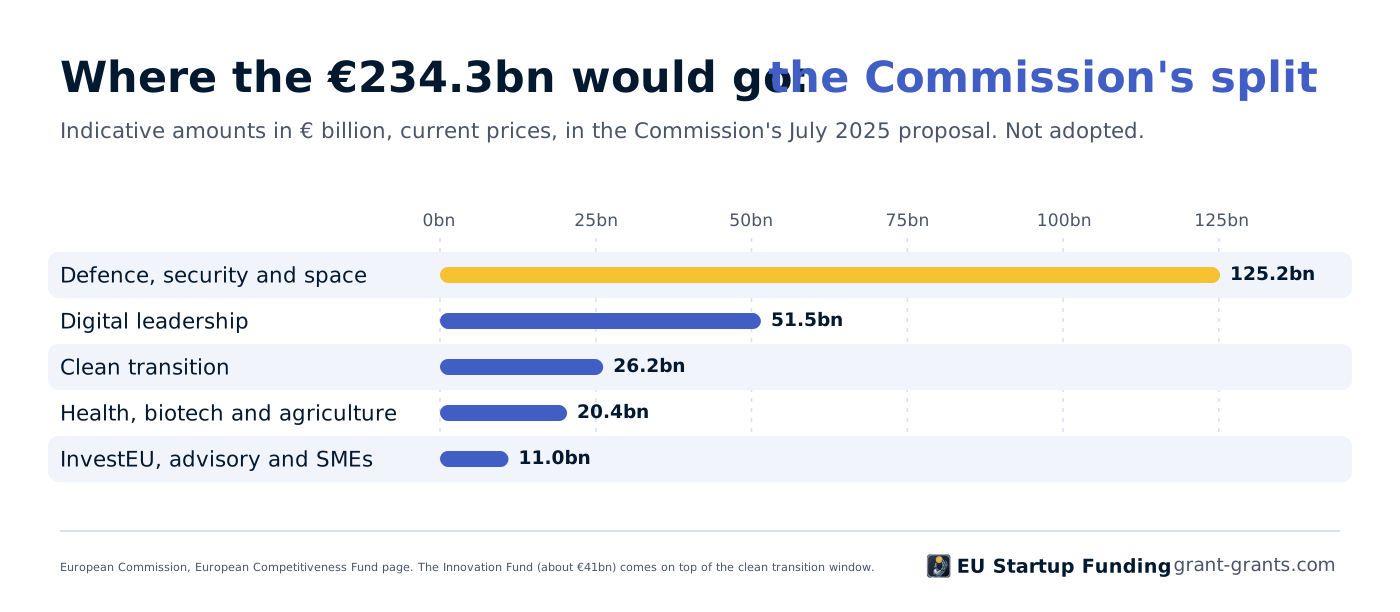
Science|Business describes Parliament's figure as €234 billion in 2025 prices, while the Commission and Council documents give €234.3 billion in current prices. Either way, the final size is decided in the negotiations on the 2028-2034 long-term budget, which need the unanimous agreement of all member states. Until then, the Council has put every provision with budget implications in square brackets, outside its position.
InvestEU, which today backs bank loans and guarantees for SMEs, becomes the ECF InvestEU Instrument. The Commission says InvestEU has mobilised nearly €300 billion in four years, with each €1 of EU guarantee supporting €15.20 of investment. Stine Bosse (Renew), who wrote the budget and environment committees' opinions, said on LinkedIn that InvestEU "will gain €40 billion" under Parliament's text, as quoted by Science|Business; the comparison point isn't stated. If you use bank finance today, see our guide to InvestEU loan guarantees and debt financing.
The 14 programmes the fund would pool
Parliament's legislative train lists the programmes the ECF brings under one framework. Here's what each of them funds today:
Source: European Parliament legislative train (ECF file) and the Commission's ECF page. EDIP, ASAP and EDIRPA, and the Space Programme and IRIS², are listed separately in the 14.
For Digital Europe in particular, the cascade calls that many startups apply to, such as the SECURE open call for Cyber Resilience Act compliance, run under the current rules until the programme ends. Our Digital Europe Programme guide covers how it works today.
Commission, Council and Parliament: where they stand
Source: Commission ECF page; Council document 10489/26; Science|Business, 29-30 October 2026. The compromise text isn't public.
The link with Horizon Europe was the easy part, according to Verougstraete, who said it "was settled quickly and by consensus". Under the Pathway Actions, decisions on which research to fund stay in Horizon Europe, and the ECF helps turn the results into businesses, a clear difference from the Commission's plan for shared priorities. The harder questions, he said, were governance, how to balance excellence with a preference for European companies, and whether non-EU countries can join the defence parts. Rihards Kols (ECR) said the ECR "fought hard" to make it easier for companies from all over Europe to take part. For the Horizon side of the same fight, see MEPs want a €200bn Horizon Europe with €32.5bn for the EIC.
Why this isn't settled
After the plenary vote, Parliament still has to agree a final text with EU governments, and the money depends on the 2028-2034 budget deal. Governments are pushing for less spending: the Irish presidency's budget box would already cut the next Horizon Europe by €16.8 billion, as we covered in EU governments want to cut the next Horizon Europe by €16.8bn. The Council also left the rules on non-EU countries in the defence and space windows open. The Commission's timetable has the ECF entering into force on 1 January 2028.
What this means for you
- Nothing changes before 2028. Digital Europe, InvestEU, LIFE, the Innovation Fund and the SME strand keep running under today's rules until the end of 2027, so current calls are still your route.
- If you've never applied, the new rules could help you. A tie-break and an advice budget would favour newcomers, but only if they survive the talks with governments. Small teams can already win today; see applying for grants as a solo founder or micro-company.
- Expect one gateway, not 14. If the Commission's single rulebook holds, you'd deal with one set of rules for grants, loans and equity across the four windows.
- Check where your sector lands. More than half of the proposed money goes to defence, security and space. Clean tech, health and bio get much smaller windows.
- Follow the votes on 10 and 23 November. National contact points and your MEPs can tell you how the final text affects your sector.
FAQ: the European Competitiveness Fund
What is the European Competitiveness Fund?
A fund the Commission proposed on 16 July 2025 for the EU's 2028-2034 budget. It would pool 14 current EU programmes, including Digital Europe, InvestEU, LIFE, EU4Health and the SME strand of the Single Market Programme, under one rulebook and one application gateway, with four policy windows. Horizon Europe stays separate but linked.
How big is it?
The Commission proposed €234.3 billion in current prices, or €409 billion together with Horizon Europe, 21% of the next EU budget. Science|Business describes Parliament's figure as €234 billion in 2025 prices. The final size depends on the 2028-2034 budget deal.
What did MEPs agree?
According to Science|Business, the research committee's compromise keeps decisions on research topics inside Horizon Europe through Pathway Actions, links the EIC to InvestEU, gives first-time applicants priority in a tie-break and ring-fences a budget to advise newcomers. The text hasn't been published.
Is it law?
No. The committee votes on 10 November and the plenary on 23 November 2026, according to Science|Business. Then Parliament negotiates with EU governments, which agreed their partial position on 16 June 2026 without any budget figures.
Can my startup apply to the ECF now?
No. The fund is due to start on 1 January 2028. Until then, apply to the current programmes: Digital Europe, InvestEU through banks and funds, LIFE, the Innovation Fund, the EIC under Horizon Europe and national schemes.
Does the tie-break mean first-time applicants win more often?
Only when proposals score the same. The quality of the proposal still decides. It would apply only if it survives the negotiations with EU governments.
