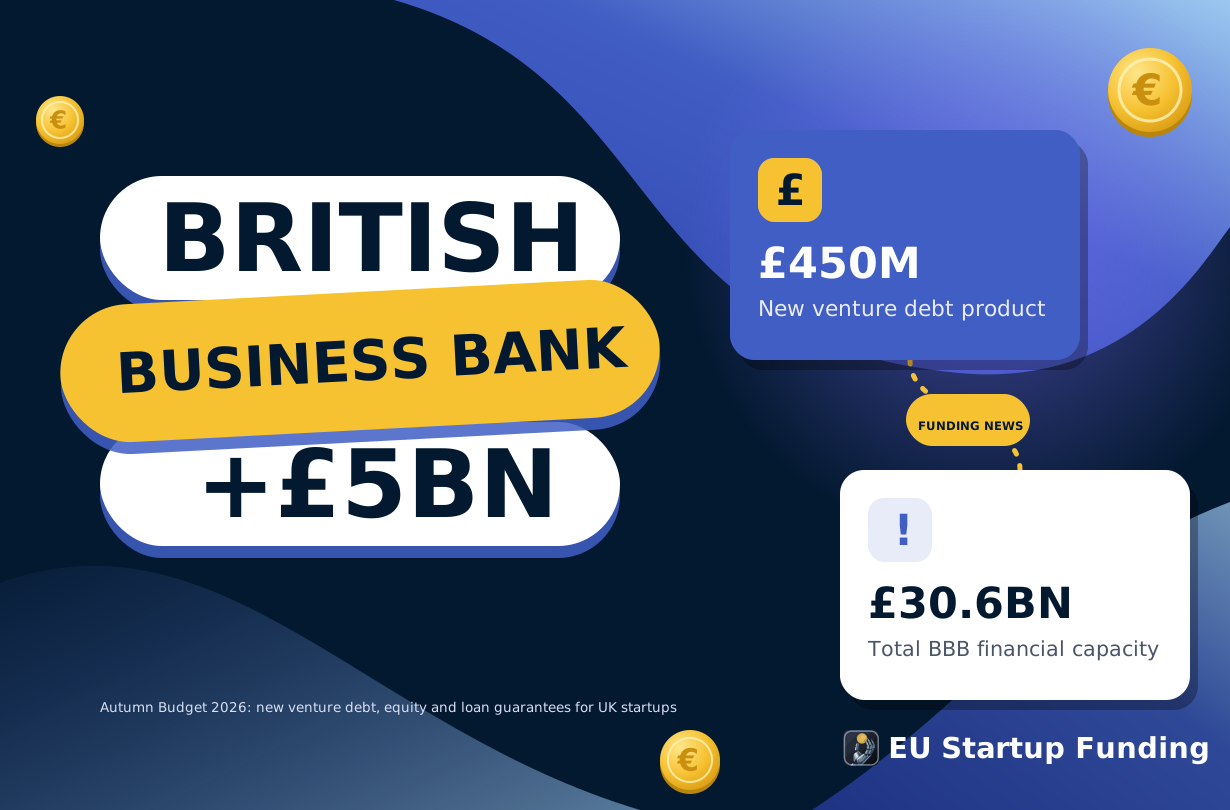
TL;DR: What does the Autumn Budget 2026 give the British Business Bank?
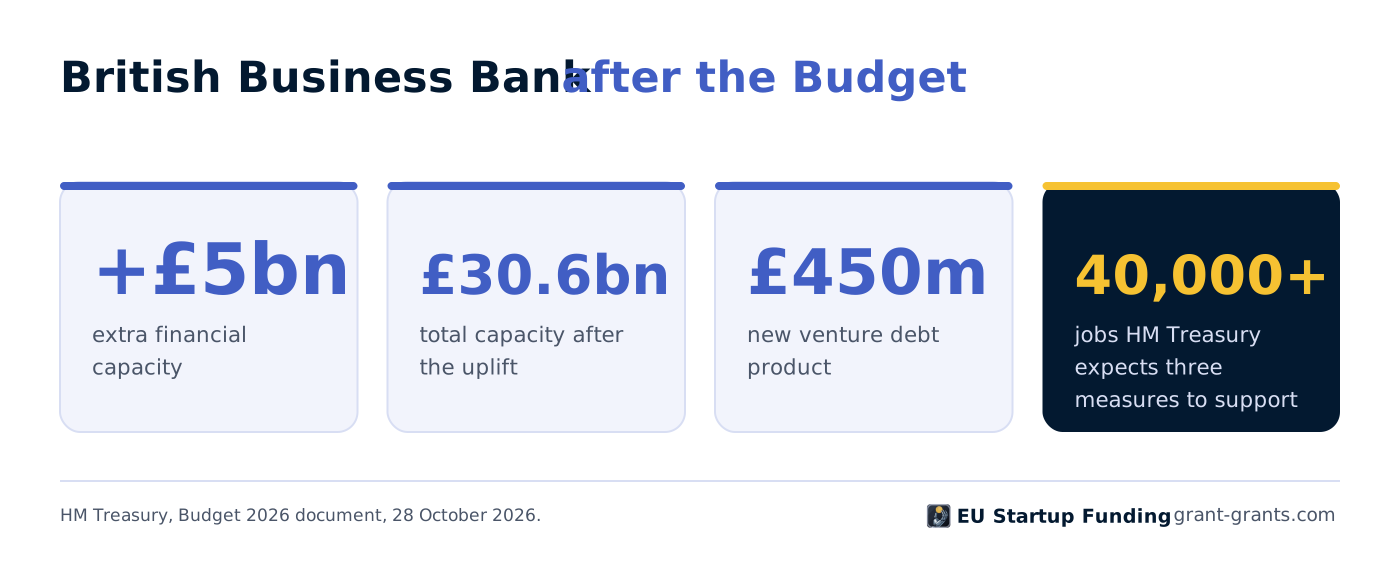
The UK Autumn Budget on 28 October 2026 adds £5 billion to the British Business Bank's financial capacity, taking it to £30.6 billion. That pays for a £6.5 billion expansion of the Growth Guarantee Scheme for SME loans, £1.4 billion of new equity commitments, £165 million for community lenders and a new £450 million venture debt product for tech firms. None of the new products has opened yet, so the work now is getting ready.
Chancellor John Healey's Budget is mostly about wages, rates and tax, and our sister site covers everything the Autumn Budget 2026 changed for small businesses. This article covers the money side: which public finance a UK startup or SME can tap after this Budget, through which door, and what is still missing.
What did the Budget announce for the British Business Bank?
According to the Budget 2026 document, the government is recapitalising its two public finance bodies, the National Wealth Fund and the British Business Bank, with £20.4 billion. The British Business Bank's share is £5 billion of extra capacity. Here is what it pays for:
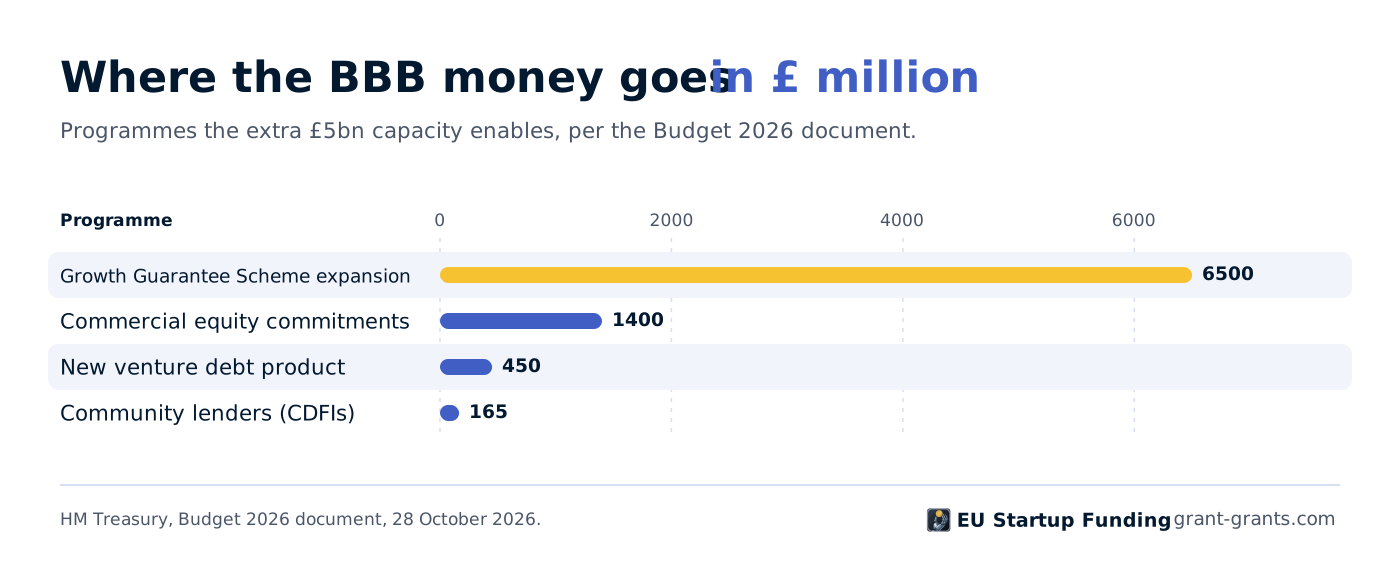
The Treasury expects the Growth Guarantee, equity and venture debt lines together to create or support more than 40,000 jobs. For context, the bank says it has deployed £9 billion of public money since it started, mobilised £23 billion of private capital and guaranteed £16 billion of lending to more than 260,000 businesses.
What is the new £450 million venture debt product?
Venture debt is a loan for startups that already have investors. The company repays it with interest and keeps its shares, which is why the Budget calls it non-dilutive finance. It suits a company that has raised equity and wants more runway without a new round at a lower valuation.
The Budget names high-growth tech firms and defence and dual-use technology companies as the targets. It does not give a launch date, ticket sizes, interest terms or whether the bank lends directly or through partner funds. Until those details land, treat it as a signal: if you plan a raise in 2027, put venture debt next to equity in your funding mix. Our guide to blended finance with grants and equity shows how founders stack the pieces.
How do SMEs use the Growth Guarantee Scheme?
The Growth Guarantee Scheme runs through accredited lenders: banks and specialist lenders apply for a government-backed guarantee on part of a loan, which lets them say yes to businesses they would otherwise refuse. The Budget funds a £6.5 billion expansion of the lending it supports over this Parliament. You don't apply to the British Business Bank yourself; you ask your lender whether it offers the scheme.
If a bank has already said no, the £165 million for Community Development Finance Institutions matters more. These are local, mission-driven lenders that serve firms mainstream banks turn down, and the Budget names Social Investment Scotland, Finance for Enterprise and BCRS Business Loans in Wales as examples. Our guide to bank loans and debt financing for startups explains how lenders assess a young company.
What else in the Budget funds founders?
Two tax measures sit next to these: a new Founders' Relief with a 10% Capital Gains Tax rate on up to £10 million of gains for qualifying founders from 6 April 2027, and EMI2, which doubles tax-advantaged share options to £120,000 per employee. Women founders weighing grants against loans can compare their options in our business grants for women guide, which separates real grants from loans.
How does this compare with EU funding?
The UK package is mostly loans, guarantees and equity, with very little grant money in it. EU programmes mix both: the EIC Accelerator pairs a grant with equity, and InvestEU backs loan guarantees much like the Growth Guarantee Scheme. If you run a company in both markets, read our overview of European funding beyond grants and the InvestEU loan guarantees explainer side by side.
The EU's own 2027 budget fight is still running, as our report on the Parliament's €194bn budget position shows, so neither side's numbers are final for 2027. Still at the side-income stage? The Budget's £3,000 trading allowance matters more to you this year than any loan scheme. Selling software or services to UK companies? Plan for UK e-invoicing from April 2029 as well. Selling goods through Amazon or eBay? Check how online marketplace VAT changes your cash flow from October 2027. Working for yourself? Our list of self-employed tax changes shows what the Budget changes for sole traders from 2027 to 2029.
More on this story: Autumn Budget 2026: what it changes for small businesses and first-time founders (Fe/male Switch Foundation); Founders' Relief: a 10% CGT rate on up to £10 million from April 2027 (MeanCEO); Trading allowance triples to £3,000 from 6 April 2027 (Fe/male Switch); UK e-invoicing from April 2029: what founders must do (MeanCEO); Online marketplace VAT from October 2027: what UK sellers must know (Fe/male Switch); Self-employed tax changes in Budget 2026: the full list for sole traders (MeanCEO).
More on this story: Autumn Budget 2026: what it changes for small businesses and first-time founders (Fe/male Switch Foundation); Founders' Relief: a 10% CGT rate on up to £10 million from April 2027 (MeanCEO); Trading allowance triples to £3,000 from 6 April 2027 (Fe/male Switch); UK e-invoicing from April 2029: what founders must do (MeanCEO); Online marketplace VAT from October 2027: what UK sellers must know (Fe/male Switch); Self-employed tax changes in Budget 2026: the full list for sole traders (MeanCEO).
What this means for you
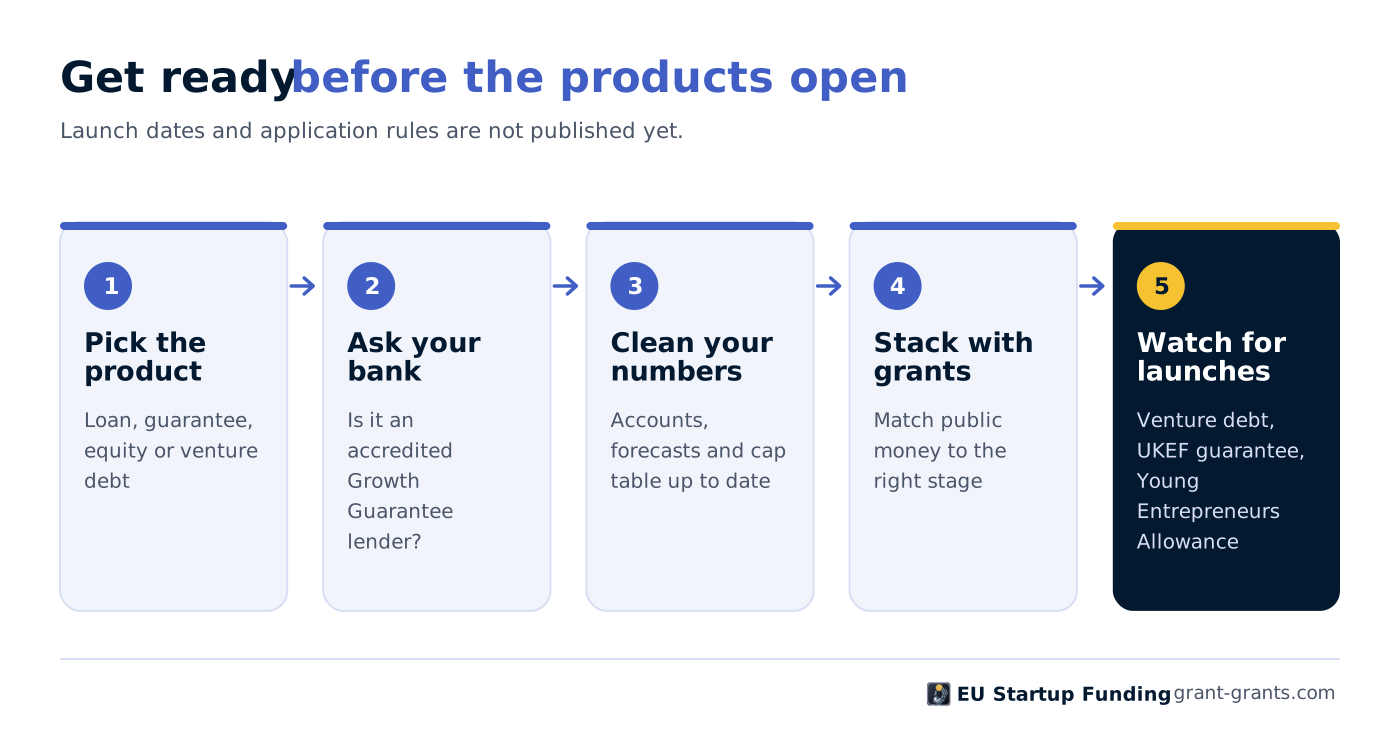
- Decide what kind of money you need. A loan for stock or equipment points to the Growth Guarantee Scheme; growth capital for an unprofitable tech company points to equity or venture debt.
- Ask your bank directly whether it is an accredited Growth Guarantee lender and what the guarantee changes for your application.
- Turned down? Contact a community lender (a CDFI) in your region before you give up on debt.
- Get investor-ready. Venture debt lenders look at your existing investors, cash runway and cap table, so keep them current.
- Combine public money in the right order. Grants for early R&D, guarantees and loans for working capital, equity and venture debt for scale.
- Watch for launch details of the venture debt product, the UK Export Finance guarantee and the Young Entrepreneurs Allowance. We'll cover each one when the rules are published.
Never miss a deadline
EU and national calls, with their exact cut-off times, are in our grant deadlines calendar.
FAQ: British Business Bank and the Autumn Budget 2026
How much did the Budget give the British Business Bank?
£5 billion of extra financial capacity, taking its total to £30.6 billion, announced on 28 October 2026.
What is the British Business Bank venture debt product?
A new £450 million product giving non-dilutive finance to high-growth tech firms, including defence and dual-use companies. Launch date and terms are not published yet.
Can I apply to the British Business Bank directly?
For the Growth Guarantee Scheme, no: you apply for a loan through an accredited lender, and the lender uses the guarantee.
What is the Growth Guarantee Scheme expansion?
The Budget funds £6.5 billion of additional SME lending under the scheme over this Parliament, first announced at Mansion House.
Is there new funding for women founders?
The British Business Bank has a pipeline of more than £100 million for women-led funds, and the government will launch a scale-up programme for women founders.
What is the Young Entrepreneurs Allowance?
A pilot in England that pays successful applicants towards living costs during the first year of their business. Eligibility rules are not published yet.
