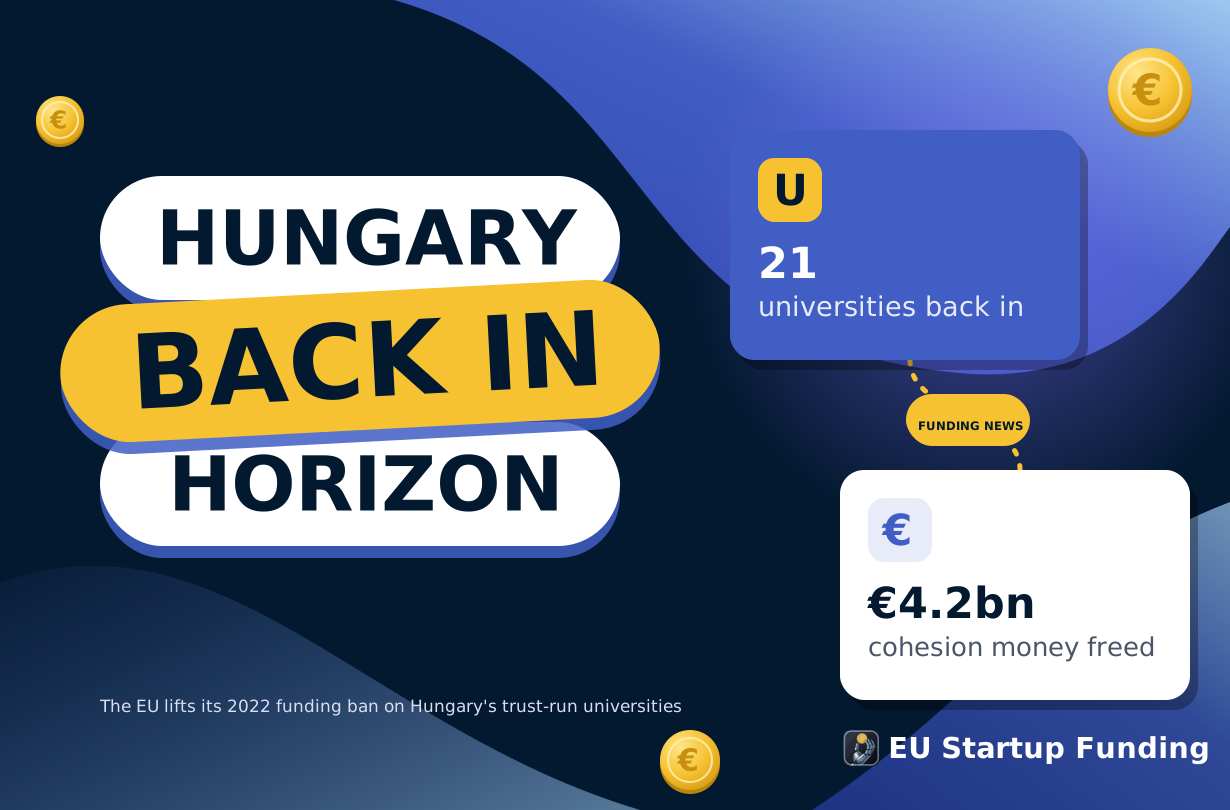
TL;DR: can Hungarian universities join Horizon Europe and Erasmus+ projects again?
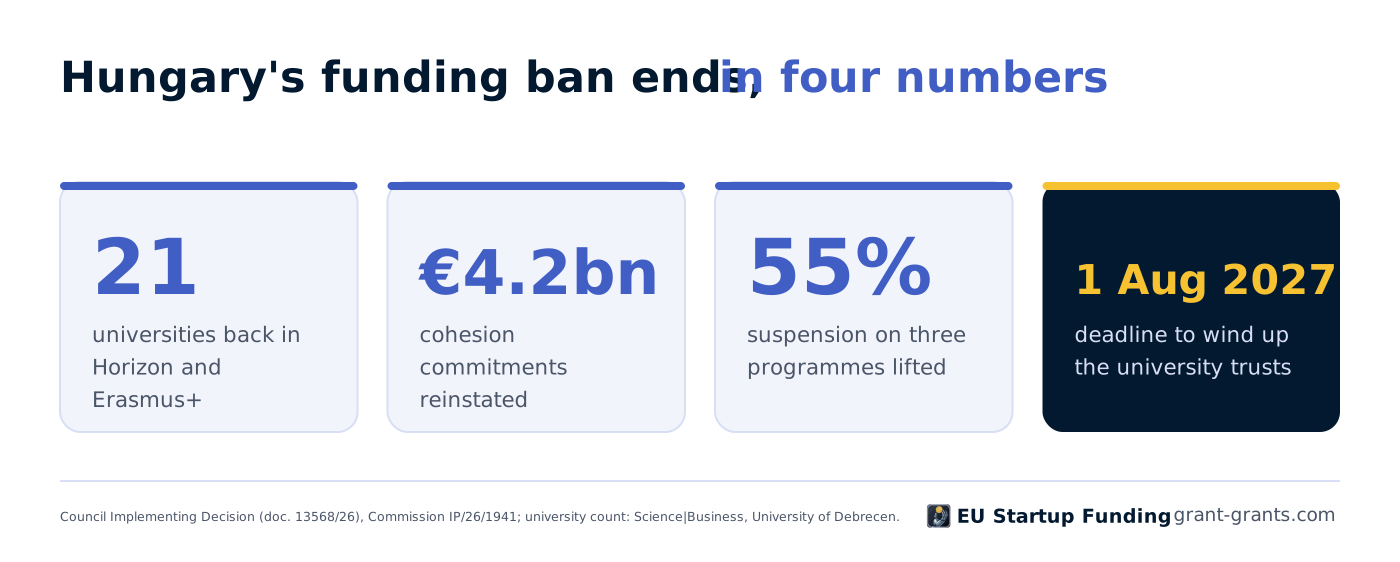
Yes. On 13 October 2026, EU governments in the Council lifted the budget protection measures they imposed on Hungary in December 2022, according to Science|Business and Euronews. That ends a ban on new EU grants to universities run by Hungarian public interest trusts, 21 of them by Science|Business's count, including the University of Debrecen. It also reinstates €4.2 billion of suspended cohesion funding. For startups and SMEs, a group of Hungarian research partners is back on the table for Horizon Europe consortia.
For almost four years, some of Hungary's largest universities couldn't sign new Horizon Europe or Erasmus+ grants. European partners dropped them from consortia, and students lost Erasmus funding. That chapter has now closed, after a change of government in Budapest and a long list of anti-corruption reforms.
What happened
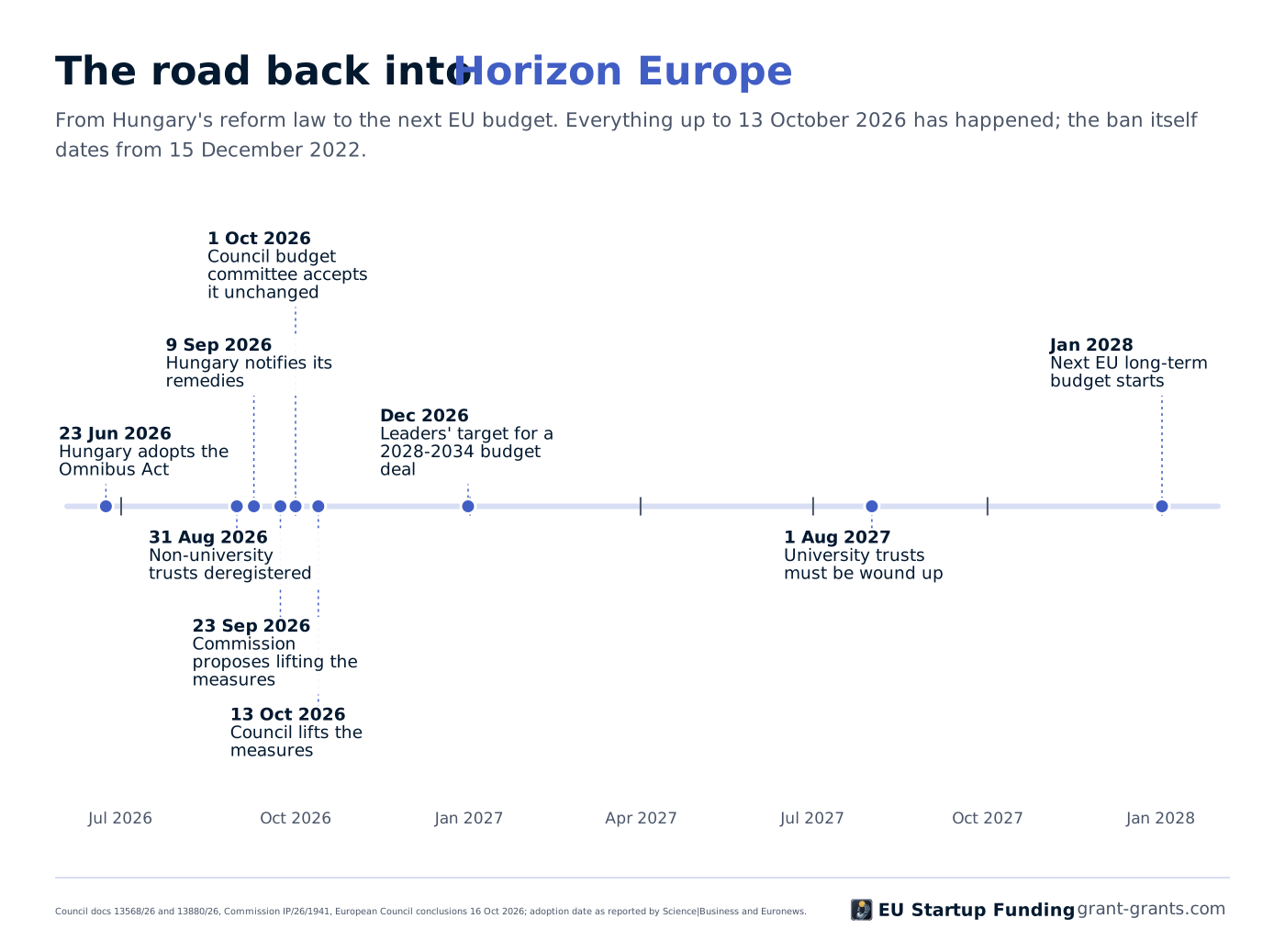
On 23 September 2026, the European Commission proposed lifting the measures that the Council adopted against Hungary on 15 December 2022 under the EU's Conditionality Regulation, the law that protects the EU budget from breaches of the rule of law. The Commission found that Hungary had addressed the weaknesses it had identified in public procurement, the anti-corruption framework, conflicts of interest and the effectiveness of prosecutions.
The Council's budget committee accepted the proposal without any changes, and the final text of the Council Implementing Decision is dated 6 October. It says the conditions for the measures "are no longer fulfilled", lifts them and repeals the 2022 decision. It takes effect on the day it is notified to Hungary. The Council's secretariat put it forward for adoption without discussion, as an "A" item, and EU ministers adopted it on 13 October, Science|Business reports. We haven't found the decision in the Official Journal yet.
Status: Adopted, according to reporting by Science|Business and Euronews; the University of Debrecen also confirms the decision. Ursula von der Leyen, the Commission President, called it "a new chapter" for Hungary and for Europe on social media.
"While a few measures fell short of meeting in their entirety the commitments and goals originally envisaged, in many instances Hungary went beyond what it undertook to do in 2022." Council Implementing Decision, 6 October 2026
What exactly the decision changes
The 2022 decision did two things. It suspended 55% of the budget commitments for three cohesion programmes expected to be spent mainly through public procurement. And it banned the Commission from signing new legal commitments with public interest trusts, known in Hungary as KEKVA, and with any entity they run, for EU money managed directly or indirectly by the EU, such as Erasmus+ and Horizon Europe. Both measures are now gone.
Sources: Council Implementing Decision (doc. 13568/26), Commission press release IP/26/1941 of 23 September 2026; the recovery fund and academic freedom amounts are as reported by Science|Business.
Hungarian startups and SMEs were never covered by the ban itself. It applied only to the trusts and the entities they run. What changes for companies is who they can partner with, and the cohesion money that flows back into public tenders in Hungary.
How Hungary got here
The measures stayed in place through Commission reviews in December 2023 and December 2024. The turning point came after Péter Magyar's Tisza party won Hungary's election and formed a new government. Its Omnibus Act of 23 June 2026 handed the founder's rights over the trusts to the state and set up two processes to close them. All trusts that don't run universities were removed from the register on 31 August 2026. The ones that do run universities get a longer process, so that teaching, scholarships and clinical services aren't disrupted, and must be wound up by 1 August 2027.
Hungary sent its remedies to the Commission on 9 September 2026. They strengthened the powers of the Integrity Authority and its access to data, created a broad asset declaration system for high-risk officials, extended judicial review of decisions not to prosecute, and tightened controls over EU funding. Hungary has also joined the European Public Prosecutor's Office.
Where Hungary fell short, and why SMEs should care
The Council didn't give Hungary full marks. The decision lists three remedies that weren't met in full, including two that were meant to help small companies win public contracts. The Council lifted the measures anyway, because it judged the reforms "considered as a whole" to be enough.
Source: Council Implementing Decision, doc. 13568/26, sections 2.7, 2.8, 2.13 and 2.14. The national anti-corruption strategy is the third remedy the Council lists as falling short.
In about one in five tenders paid from Hungary's national budget, only one company still bids. For SMEs selling to the Hungarian public sector, the reinstated €4.2 billion for transport, energy efficiency and local development projects matters more than the research news. Those programmes were expected to be spent mainly through public procurement.
The bigger budget picture
The decision arrives in the middle of a fight over the next EU budget for 2028–2034. EU governments have already proposed to cut the next Horizon Europe compared with the Commission's plan. On 16 October, EU leaders asked for a deal on the long-term budget before the end of 2026, so that "EU funding reaches beneficiaries without interruption in January 2028". They also asked the Commission for a proposal to cut reporting obligations, "in particular for SMEs". Status: Debated; there are no figures in the conclusions.
The case also shows how the conditionality tool works in practice: grant beneficiaries, not just governments, pay the price when funds are frozen. Universities had to renegotiate partnerships because they had become "a risk factor", the University of Debrecen's head of international relations said, as reported by the Debrecen Sun.
What this means for you
- Look again at Hungarian partners. Universities that were off-limits since 2022 can now join your Horizon Europe consortium as full partners. Our guide to Horizon Europe opportunities for SMEs explains which calls suit small companies.
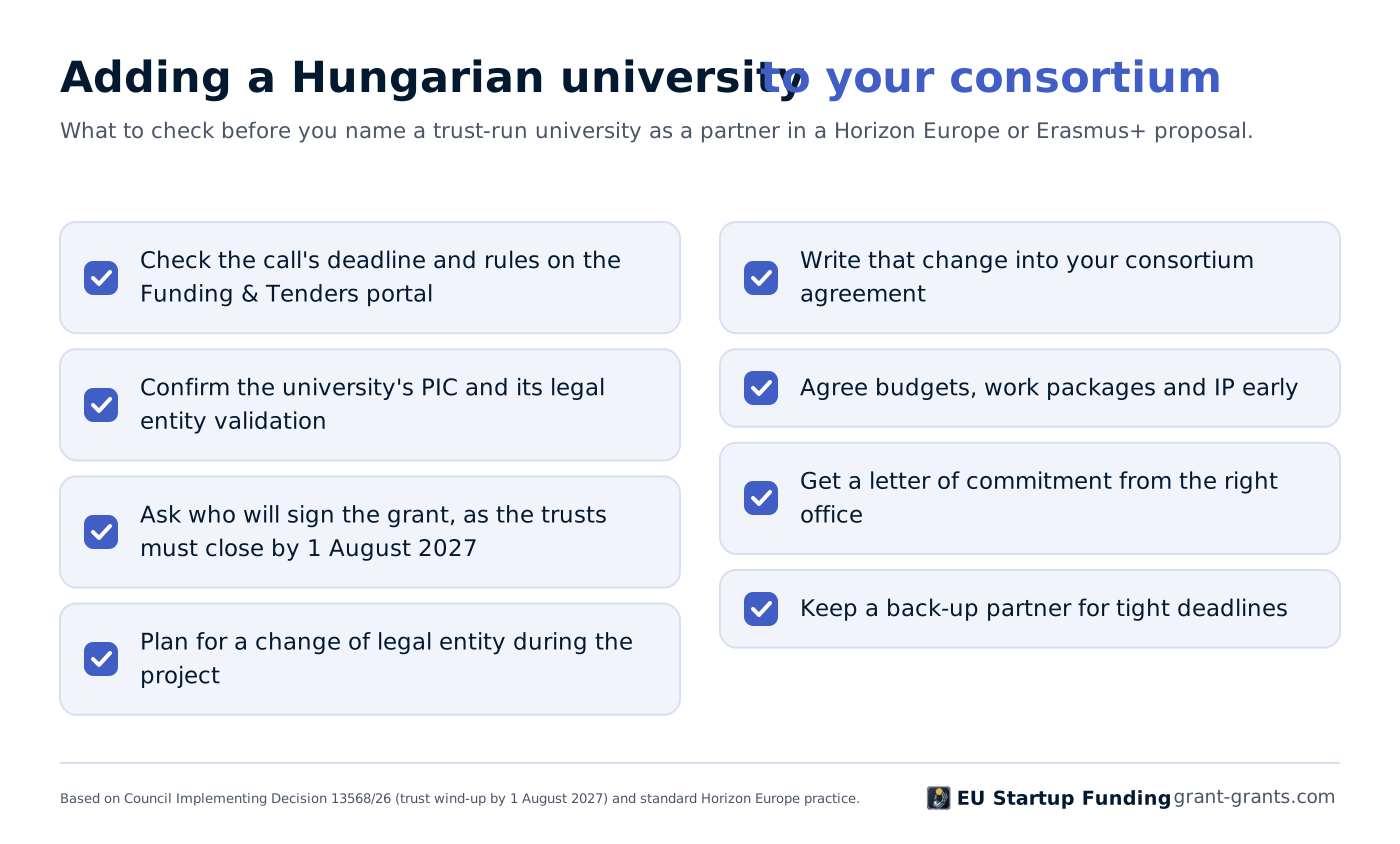
- Plan for the trusts closing. The trusts that run these universities must be wound up by 1 August 2027, so the entity that signs your grant may change during the project. Cover it in your consortium agreement.
- Check the consortium rules. Hungary is an EU Member State, so a Hungarian partner counts towards the usual minimum of three countries. See our guide to consortium requirements for collaborative grants.
- Use the next deadlines. New Horizon Europe calls for 2027 are already out; see the +€500 million calls for 2027. We haven't found Commission guidance yet on calls that are already open, so ask the call's helpdesk before you submit.
- EdTech and training projects: Erasmus+ is open again to these universities too. Read our guide to Erasmus+ funding for EdTech.
Partners from newly reopened countries can make your project stronger, but evaluators and auditors still look at how each partner handles money. Read what the EU's auditors found about SME errors in research grants before you sign.
FAQ: Hungary, Horizon Europe and Erasmus+
Is Hungary back in Horizon Europe?
Hungary never left Horizon Europe as a country, but since December 2022 the EU couldn't sign new grants with universities run by Hungarian public interest trusts. The Council lifted that ban on 13 October 2026, as reported by Science|Business and Euronews.
Which Hungarian universities were affected?
The universities run by public interest trusts (KEKVA): 21 universities among more than 30 institutions, according to Science|Business. The University of Debrecen is one of them.
Were Hungarian startups banned from EU grants?
No. The 2022 ban applied only to the public interest trusts and the entities they run. Hungarian companies could keep applying to Horizon Europe, the EIC and other EU programmes.
How much EU money did the decision release?
It reinstates €4.2 billion of suspended commitments in three cohesion programmes. Another €10 billion from the recovery fund and €2.2 billion tied to academic freedom milestones are still pending, according to Science|Business.
What happens to the university trusts?
Under Hungarian law, the trusts that run universities must be wound up by 1 August 2027. The trusts that didn't run universities were removed from the register on 31 August 2026.
Can I add a Hungarian university to a Horizon Europe proposal now?
The decision takes effect once it is notified to Hungary, and the universities can sign new grants again. For calls that are already open, check the call's rules and ask its helpdesk, as we haven't found specific Commission guidance yet.
