TL;DR: what did the EU's auditors find about grants for startups and SMEs?
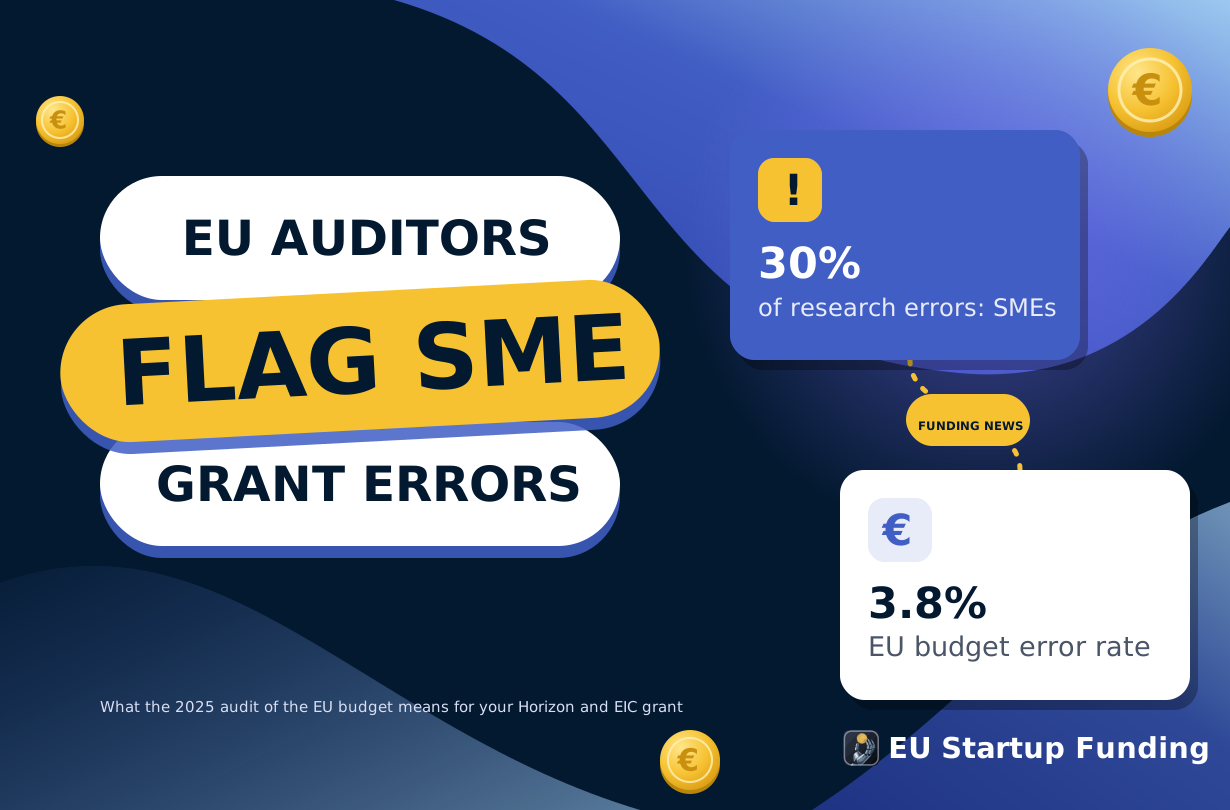
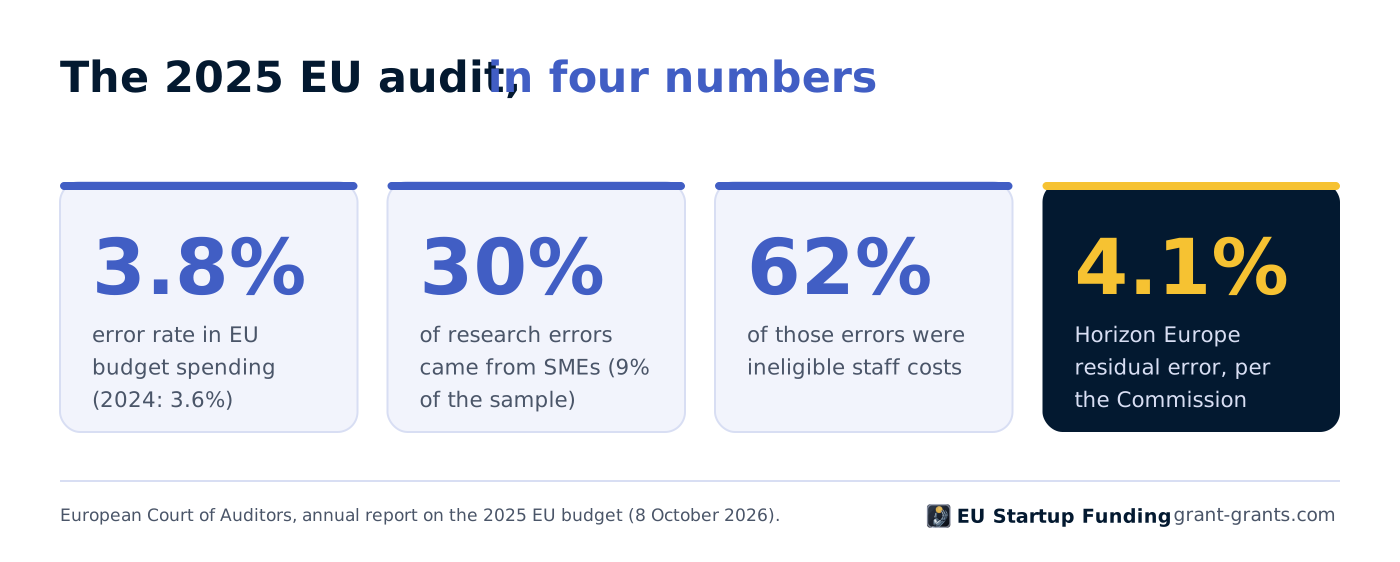
On 8 October 2026, the European Court of Auditors published its annual report on the 2025 EU budget. It found that 3.8% of the spending it audited broke EU or national rules, up from 3.6% in 2024. In research and innovation, the area that includes Horizon Europe and the EIC, small and medium-sized enterprises made up 9% of the transactions audited but 30% of the estimated error. Most errors were ineligible staff costs: days claimed when people were absent, or daily rates calculated the wrong way. If your startup holds an EU grant, these are the mistakes that can cost you money at an audit.
Every year, the EU's external auditor checks a sample of payments from the EU budget to see how much money was spent against the rules. This year's report has a clear message for small companies: auditors keep finding the same mistakes in cost claims, and SMEs, especially first-time grantees, make more of them than universities and large firms.
What happened
Tony Murphy, the President of the European Court of Auditors (ECA), presented the 2025 annual report to the European Parliament's Budgetary Control Committee on 8 October 2026. The Court gave a clean opinion on the EU's accounts and revenue, but an adverse opinion on budget spending for the seventh year in a row.
The auditors examined €130.8 billion of spending. They estimate that 3.8% of it did not comply with EU and national rules, with a 95% confidence range of 2.7% to 4.9%. Anything above 2% counts as material. Murphy stressed in his speech that the figure "is not a measure of fraud, inefficiency or waste": it estimates how much money was paid out against the rules.
Sources: European Court of Auditors, 2025 annual report and the President's speech of 8 October 2026. The research figure includes other programmes under the same budget heading, such as the Connecting Europe Facility and Digital Europe.
Why SMEs stand out
For research and innovation, the Court checked 126 transactions, 90 of them under Horizon 2020 and Horizon Europe. It found errors in 37 of them and estimates the error rate at 2.9%, slightly better than the 3.2% of 2024. But the problem is concentrated: "SMEs represented 9 % of the sample (11 out of 126 transactions) but accounted for 30 % of the estimated error rate", the report says. Six SME transactions had errors, and four of those SMEs had no or very limited previous experience of EU-funded projects.
The Commission agrees. In its official reply, it "shares the assessment of the ECA that newcomers and SMEs are the most error-prone beneficiaries", but says their participation is vital to the programme and will keep being encouraged. It runs workshops on avoiding errors in cost claims, including the 2026 Horizon Europe national events known as the "tour des capitales".
Simplification hasn't fixed the problem yet. The auditors found no significant difference between Horizon 2020 and Horizon Europe, even though Horizon Europe replaced hourly rates with simpler daily rates. The Commission's own estimate of the residual error rate for Horizon Europe, after its corrections, is 4.1%, which led its two research executive agencies, HaDEA and REA, to issue reservations in their annual reports.
"Despite all the simplification measures introduced into the legal base over time and the Commission's guidance to beneficiaries, the situation has remained unchanged for years." European Court of Auditors, 2025 annual report
The mistakes that cost grant money
Ineligible staff costs make up 1.8 of the 2.9 percentage points, or 62% of the research error. Missing supporting documents and ineligible other direct costs, such as VAT, travel and equipment, account for 0.5 points each. These are the cases the Court describes:
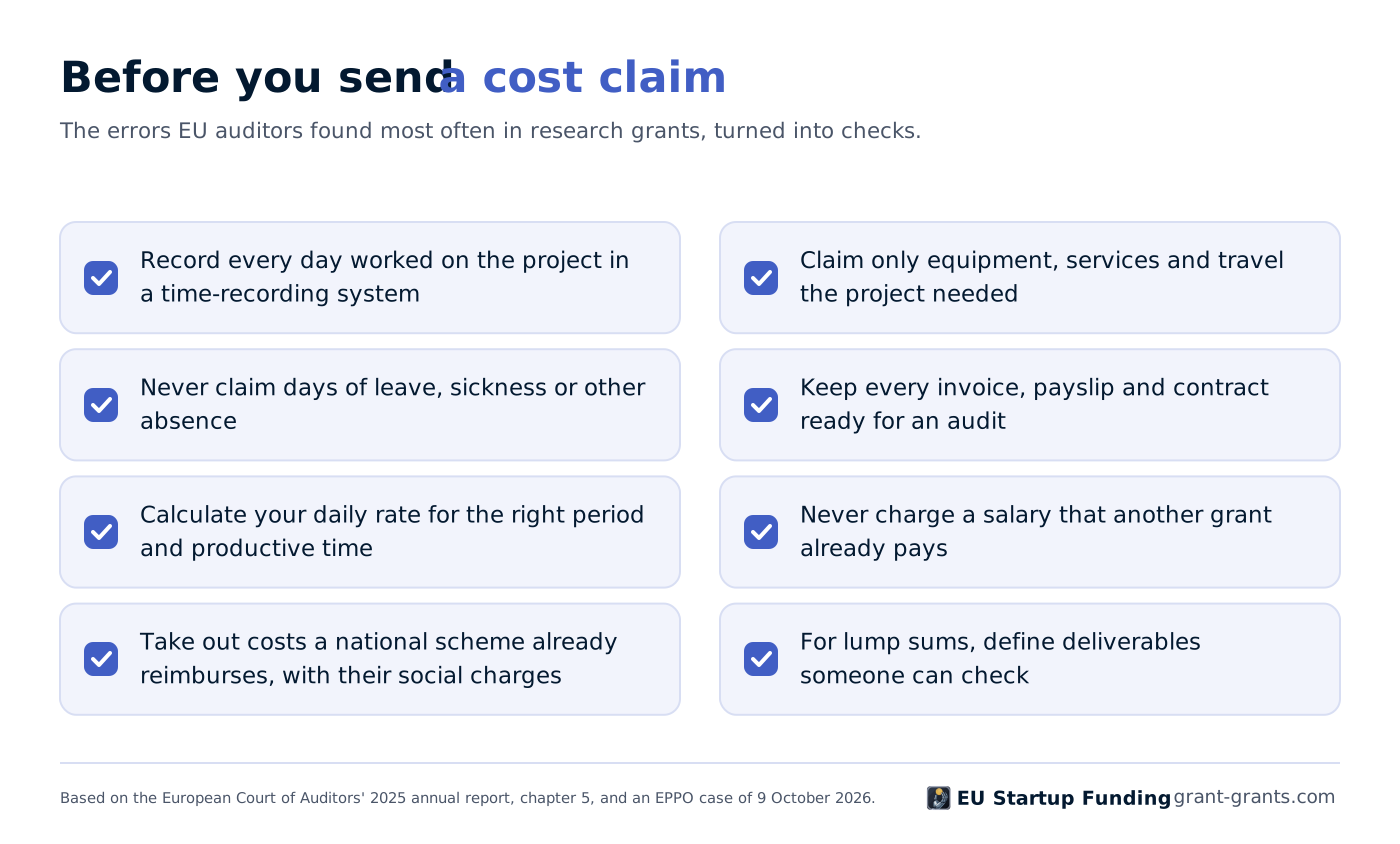
- Days that weren't worked. In 7 of the 50 Horizon Europe transactions, beneficiaries claimed days when staff were absent, or days not backed by time records. See our guide to time tracking and effort reporting.
- Wrong daily rates. Beneficiaries used the wrong productive time or period, or put indirect costs into their rates. A Danish beneficiary charged parental-leave costs that the state already reimburses; a French public body removed ineligible costs but not the social security contributions linked to them. Our guide to calculating personnel costs explains the method.
- Costs the project didn't need. Ten transactions included equipment that wasn't used, services delivered outside the project period or travel with no link to the project.
- Private costs. One SME outside the EU claimed flights for a relative of its CEO; another couldn't show how its staff time was calculated.
Double funding can become a crime. On 9 October, the European Public Prosecutor's Office reported that a Spanish court had convicted a company and its director for charging salaries already paid by Government of Navarra hiring and export subsidies to a Horizon 2020 project. The damage was €26,000, including €10,200 of EU money. The company was fined €6,500 and banned from subsidies for nine months.
Lump sums: less paperwork, new risks
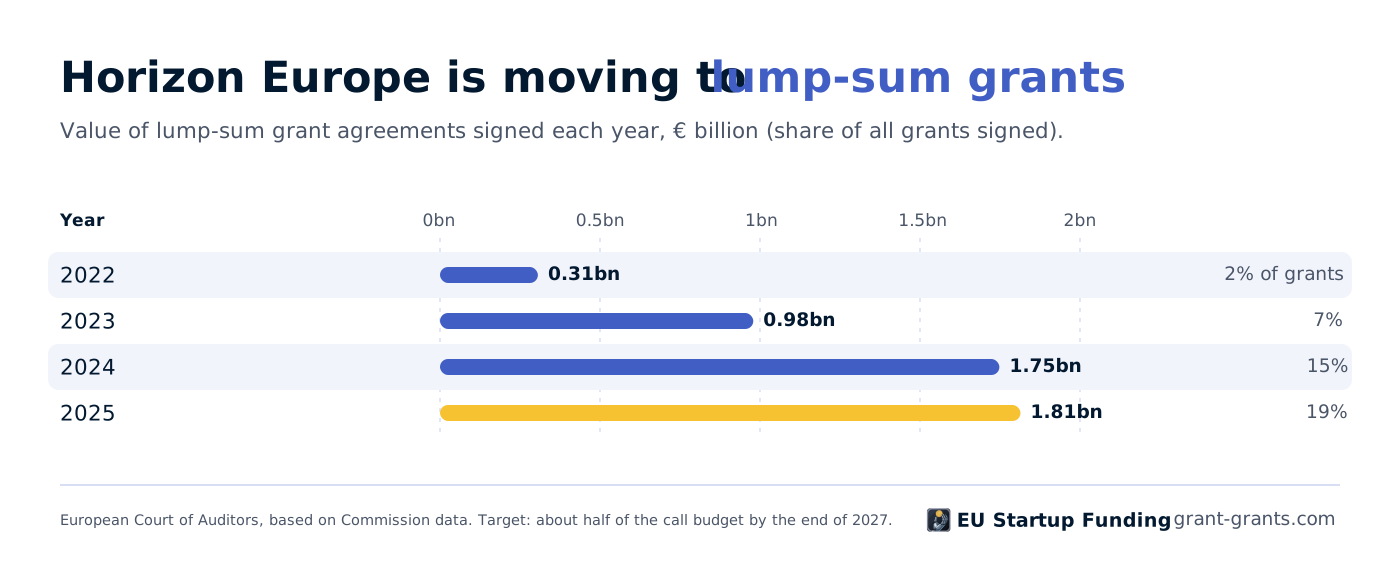
Lump-sum grants pay a fixed amount when each work package is done, with no timesheets to audit. They are growing fast: lump-sum grants signed under Horizon Europe went from €306 million in 2022 to €1,814 million in 2025, 19% of all grants signed that year. The Commission wants to give around half of the Horizon Europe call budget as lump sums by the end of 2027.
The auditors looked at three lump-sum projects and found two weak points: budgets that external experts had doubts about but didn't adjust, and deliverables so vague that nobody could check whether a work package was done. In one project, they consider part of the payment undue. If you are weighing the two models, read our comparison of cost reimbursement and lump-sum grants.
What it means for the next EU budget
Murphy used the report to send a warning about the 2028–2034 budget, which governments are negotiating now; their latest proposal would cut the next Horizon Europe compared with the Commission's plan. The next budget is expected to pay more money on results rather than costs, as the Recovery and Resilience Facility does. "Simplification should reduce unnecessary administrative burden, not merely relocate it, and must not weaken accountability," he told MEPs.
The Court also reported 17 cases of suspected fraud to the EU anti-fraud office OLAF in 2025 and 12 to the European Public Prosecutor's Office. Since 2010, OLAF has recommended recovering €555.6 million in closed investigations based on the Court's information. The report also feeds into the Parliament's yearly discharge procedure, its verdict on how the Commission managed the budget.
What this means for you
- Expect to be checked. Auditors know that SMEs and newcomers make the most errors, so first-time grantees should plan for an audit from day one. Our guide to audit requirements for EU-funded projects shows what they ask for.
- Fix your time records now. Most money is lost on staff costs. Daily time records, correct daily rates and no absent days fix most of the problem.
- Keep national and EU funding apart. If a salary is already paid by a national subsidy, it can't go into an EU claim. See common grant compliance issues and how to solve them.
- Don't let this stop you from applying. The Commission says SME participation is vital. Plan your cost reporting before you sign and keep applying: see the last EIC deadlines of 2026.
FAQ: the 2025 EU audit and your grant
What did the European Court of Auditors find for 2025?
It estimated that 3.8% of the EU budget spending it audited, €130.8 billion in total, did not comply with EU and national rules, up from 3.6% in 2024. It gave an adverse opinion on spending for the seventh year in a row.
Does a 3.8% error rate mean 3.8% of EU money was stolen?
No. The Court says the error rate is not a measure of fraud, inefficiency or waste. It estimates the money paid out against the rules, for example for ineligible costs or without supporting documents.
Why are SMEs singled out?
In research and innovation, SMEs made up 9% of the 126 audited transactions but 30% of the estimated error. Four of the six SMEs with errors had no or very limited experience of EU-funded projects.
What is the most common mistake in EU research grants?
Ineligible staff costs, which made up 62% of the research error rate: days claimed when staff were absent or without time records, and daily rates calculated the wrong way.
Are lump-sum grants safer for startups?
They remove timesheets, but the auditors found inflated budgets and vague deliverables in lump-sum projects. You still need clear, checkable deliverables, and grant cuts for work packages that are only partly done are being clarified by the end of 2027.
Can claiming the same salary twice lead to prosecution?
Yes. On 5 October 2026, a Spanish court convicted a company and its director for charging salaries already paid by regional subsidies to a Horizon 2020 project, after a case brought by the European Public Prosecutor's Office.
