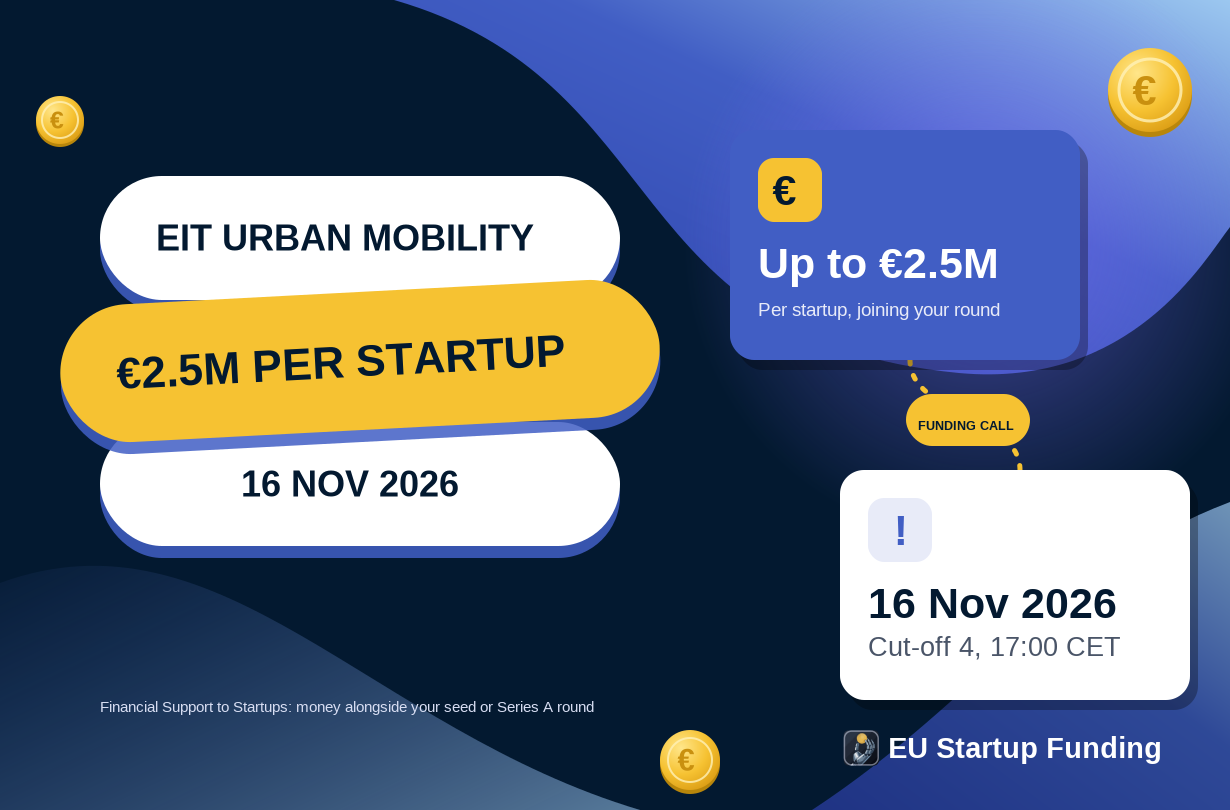
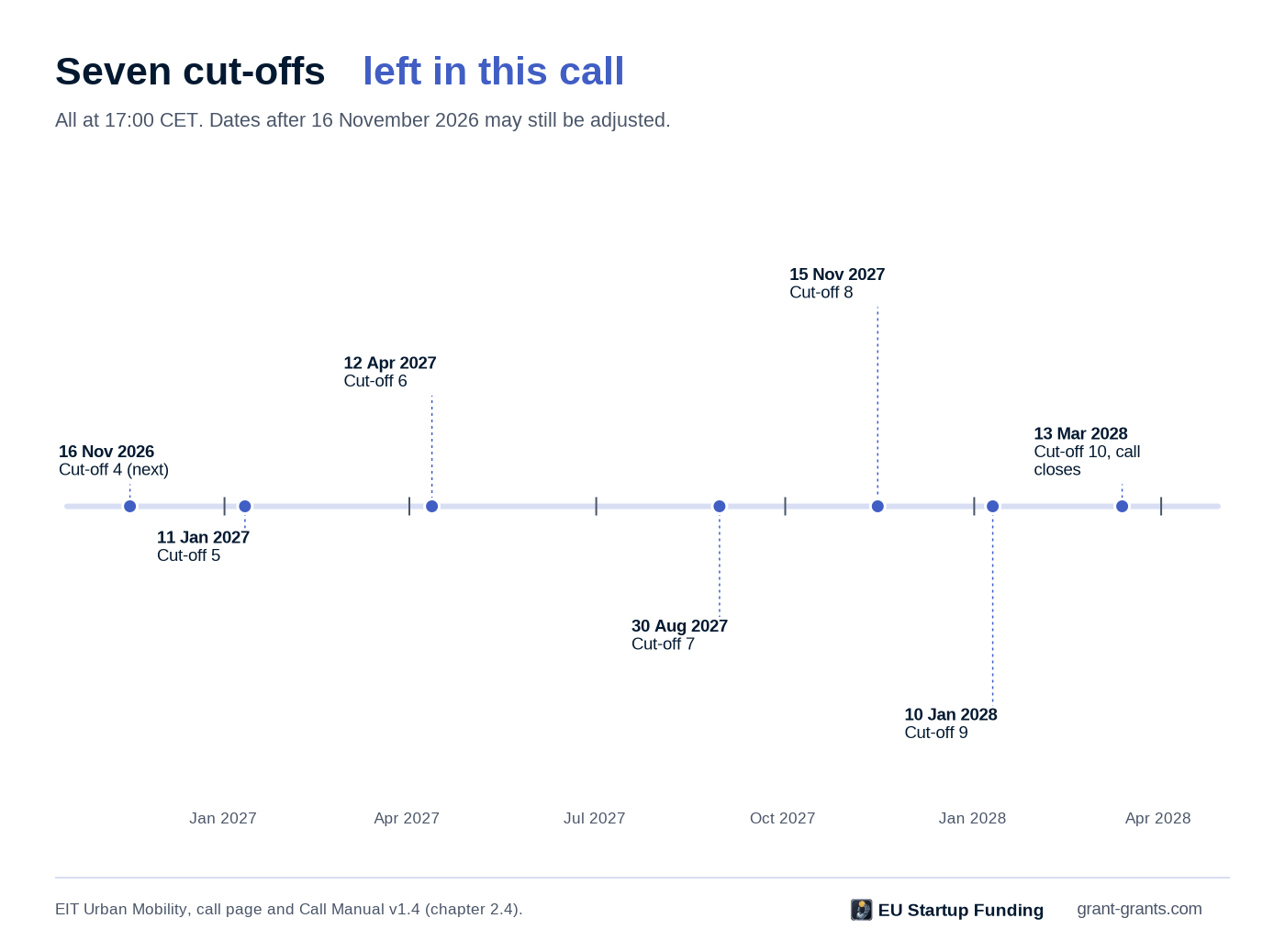
Update: Cut-off 4 closed on 16 November 2026. The open call itself stays open: the next cut-off is 11 January 2027 at 17:00 CET, followed by 12 April 2027, 30 August 2027, 15 November 2027, 10 January 2028 and 13 March 2028 (the last one). If you applied to cut-offs 3 and 4, you must skip cut-off 5.
Raising a pre-seed, seed or Series A round for an urban mobility startup? EIT Urban Mobility can put up to €2.5 million into it. Its Financial Support to Startups Open Call pays the money as a sub-grant, but it works like a co-investment: you need a live equity round with other investors, and EIT Urban Mobility expects to take shares. The next cut-off is 16 November 2026 at 17:00 CET, and the Call Manual was updated on 15 October. Here's who qualifies, what the equity part really means and how the three-stage selection works.
What's new before the 16 November cut-off
This is a multi-cut-off call: it opened on 23 December 2025 and runs until 13 March 2028, with ten cut-offs in total. Three have passed (23 February, 18 May and 31 August 2026). On 15 October 2026, EIT Urban Mobility published Call Manual version 1.4, which applies from cut-off 4. The changes that matter:
- A hearing in the final stage. From cut-off 4 onwards, pre-selected startups are invited to a hearing with the Selection Committee, where they present and answer questions.
- A clearer definition of "active fundraising". You must be seeking external equity investment and actively talking to investors, in a round that should end in newly issued shares or other equity instruments. The round doesn't have to be closed when you apply.
- A clearer 40% rule. Founders and executive team members together must hold more than 40% of the equity in the ultimate parent company (or the applicant, if there is no parent) before the current round.
- Twice the time to appeal. The appeal window went from 7 to 14 calendar days.
- Data room materials don't score on their own. Only the application form and the pitch are the official basis for evaluation, so put everything essential there.
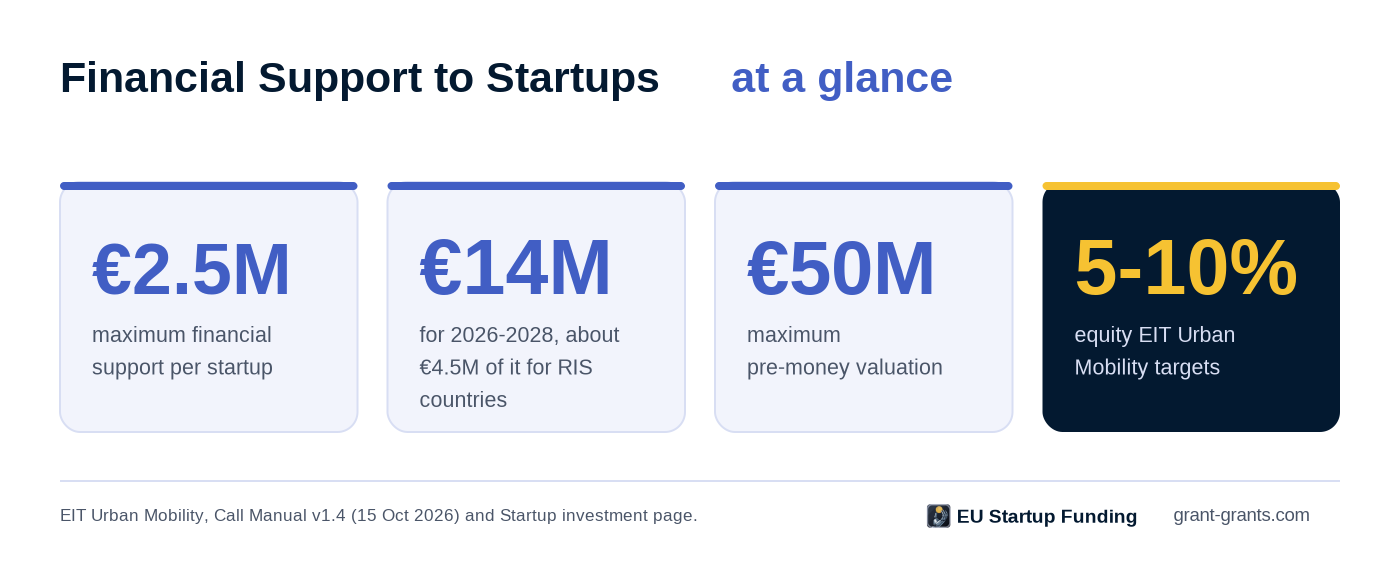
The call has also grown. The February 2024 edition offered up to €500,000 per company from €12 million, and the October 2024 edition up to €2 million from €10 million. The current call raises the ceiling to €2.5 million and spreads €14 million across 2026-2028. Our guide to EIT Urban Mobility grants explains how this call fits next to the KIC's other programmes.
Who can apply
A startup applies alone: no consortium, no partner letters. But it can't apply without investors. The call is only for companies that are raising a real equity round right now, and EIT Urban Mobility says in its FAQ that it invests in companies that "have a lead investor secured". Every rule below is checked before any expert reads your application.
Some rounds don't count. EIT Urban Mobility can exclude an application if no genuine primary equity raise is happening, if the round only consists of grants or revenue-based financing, if it only sells existing shares, if it is purely internal among existing shareholders, or if the money isn't meant for the company. The startup that applies must also be the entity that receives and spends the money; in a holding structure, a subsidiary that does the work applies, while the shares come from the top company.
The call gives no age, staff or turnover limits, and selected companies join as SME partners and may have to become paying members of EIT Urban Mobility. Before you start, you need a nine-digit PIC from the EU Funding & Tenders portal; our checklist of registrations for EU grants walks through it.
What the money is for, and the equity part
The call funds startups with high growth potential in five sectors: urban logistics, public and shared transport, mobility data management, electrification and alternative fuels, and health and mobility. Projects run from 2 to 36 months and must end by 31 December 2028. All spending must follow Horizon Europe cost rules, and if you spend less than the approved budget, the support is reduced to match. For the wider funding landscape in this sector, see our overview of mobility and transport innovation funding.
Now the part founders should read twice. Legally, this is financial support under Horizon Europe, not a classic investment. But EIT Urban Mobility must become financially self-sustaining, and this call is "central" to that strategy, according to the Manual. The documents describe the equity side differently:
- The Call Manual calls a shareholding arrangement voluntary and says it is not "a prerequisite or automatic condition" for the grant.
- The Startup investment page calls allocating shares "a key requirement", with shares subscribed at nominal value, and targets 5-10% equity per company.
- The application form asks yes or no: will you accept EIT Urban Mobility as a shareholder, pari passu with the other investors in your round?
- The pitch scoring rates your willingness to contribute to its financial sustainability strategy under "ROI potential", worth 10 of the 35 pitch points.
- The Project Implementation Handbook says that if this financial sustainability mechanism (equity) is not achieved, the grant is cut by 60% at the final review.
Our reading: plan for EIT Urban Mobility to take a minority stake for nominal value, through your priced round or a SAFE, and model the dilution before you apply. It doesn't lead rounds or normally take board seats. The grant and the cheap shares can both have tax effects, which EIT Urban Mobility itself says to check with a local tax adviser. The EIC Accelerator is the closest EU comparison: it also mixes grant money with equity, but there the equity part is a separate, optional investment.
How the selection works
After the eligibility check, three independent external experts score your application anonymously on four criteria worth 15 points each: strategic fit, excellence and innovation, impact and financial sustainability, and quality of implementation. You need at least 3 points on each. Applicants that pass pitch live, online, to the Investment Committee: team (10 points, minimum 7), product and innovation (10, minimum 7), market, financials and impact (5, minimum 3) and ROI potential (10, minimum 7). Our tips on grant pitch presentations apply here, with a stronger investor flavour.
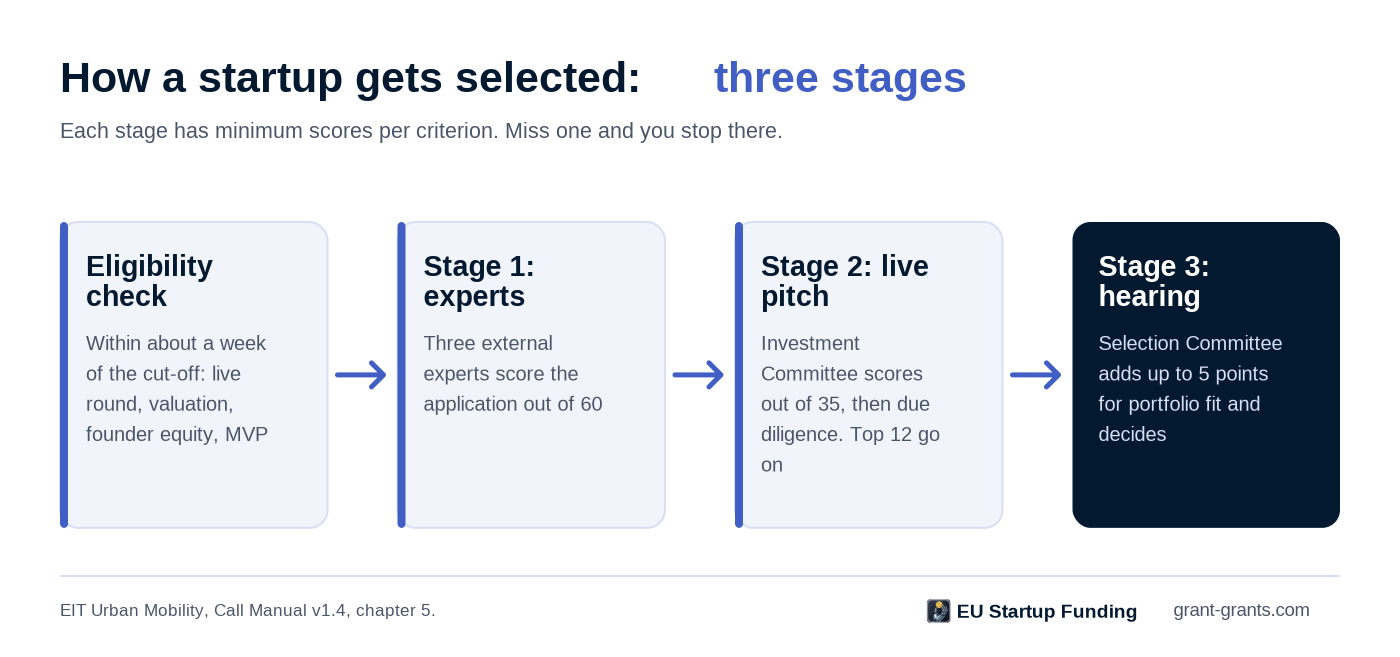
After the pitch, EIT Urban Mobility may open a data room, run due diligence (cap table, contracts, IP, finances, compliance) and interview the founders. Only the top 12 move on: the best 4 from RIS countries and the best 8 from the rest. Ties go to the higher ROI score. The Selection Committee then adds up to 5 points for fit with its existing portfolio and decides who is selected, put on a reserve list (valid for a year) or rejected. Diverse teams score better, and the Manual says women-led or women-founded teams get priority. Spain and Israel don't count as RIS countries in this call; startups from Central, Eastern and Southern Europe may compete in the smaller RIS pool, so check with the team. Our guide to grant opportunities in Eastern Europe explains the RIS idea.
How to apply before 16 November
- Check the round. You need an active external equity round with other investors in it, ideally with a lead; a signed term sheet is optional but helps.
- Get a PIC and register early. Fill in the Partner Information Form in the EIT Urban Mobility Programmes Portal. Processing can take up to two working days, so don't leave it to the last weekend.
- Fill in the application form in English, following the Application Form Guidance. External links in the form are ignored.
- Upload the mandatory documents: the deed of incorporation (it may stay in its original language) and your investor pitch deck in English. Missing or blank documents mean automatic rejection.
- Submit by 16 November 2026 at 17:00 CET. Once submitted, an application can't be edited. If you submit twice, only the last one counts.
The FAQ puts the whole process, when expedited, at about 12-16 weeks from cut-off to decision and payment. For the 16 November cut-off, that points to roughly February or March 2027 (our estimate, not an official date). Once the contract package is signed, the whole approved amount is normally transferred in one go, though EIT Urban Mobility can pay in tranches tied to milestones. If you applied at both cut-off 2 (18 May) and cut-off 3 (31 August), you must skip 16 November and can apply again on 11 January 2027.
Not raising yet, but already selling? EIT Urban Mobility's SME Market Expansion call pays €60,000 per SME that brings an end client, with no equity, and closes on 1 December 2026.
Never miss a cut-off
This call and dozens of other EU and national deadlines are in our grant deadlines calendar.
FAQ: EIT Urban Mobility Financial Support to Startups
When is the next deadline?
Cut-off 4 is 16 November 2026 at 17:00 CET. The next ones are 11 January 2027 and 12 April 2027, also at 17:00 CET, and the call closes on 13 March 2028.
How much can a startup get?
Up to €2.5 million per company. EIT Urban Mobility decides the amount case by case, based on your round, your stage, the other investors and the stake it targets.
Is it a grant or an investment?
Formally a sub-grant under Horizon Europe rules, but EIT Urban Mobility expects to become a shareholder, targeting 5-10% at nominal value, and the handbook cuts the grant by 60% if that equity mechanism isn't achieved.
Can a startup apply alone?
Yes, no consortium is needed. But you must be in an active pre-seed, seed or Series A equity round with other investors, because EIT Urban Mobility joins rounds and doesn't lead them.
Which countries are eligible?
Startups established in EU Member States and Horizon Europe associated countries. About €4.5 million is earmarked for RIS countries; Spain and Israel don't count as RIS in this call.
Can I apply again if I'm rejected?
Yes, but you can't apply to three cut-offs in a row: after two consecutive applications, skip at least one cut-off.
