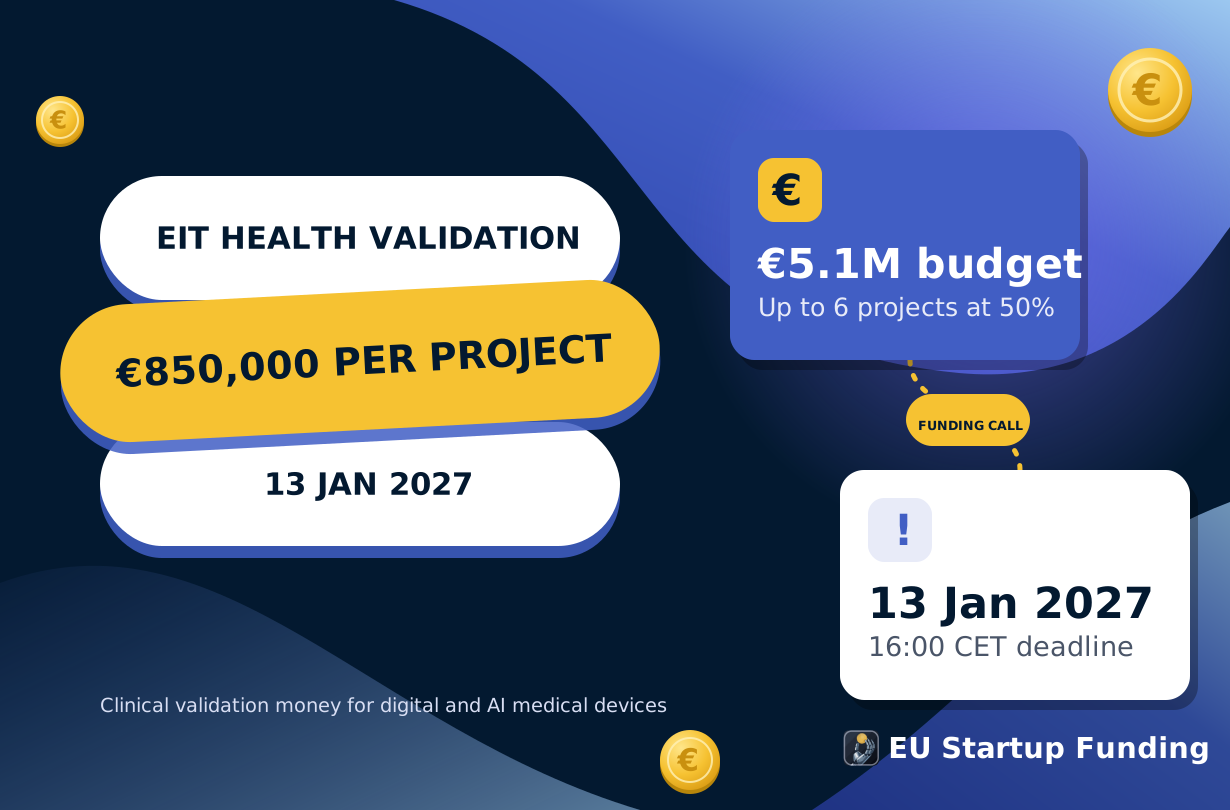
Have a digital or AI-powered medical device that is ready for its pivotal clinical study but not yet CE-marked? EIT Health's Innovation Validation Call 2027 pays up to €850,000 per project, half the cost, to run that study, prepare the regulatory submission and plan the market launch. There's €5.1 million for up to six projects, and the deadline is 13 January 2027 at 16:00 Brussels time. A startup can't apply alone: it needs at least one partner from another country, and a small company that leads must already have raised €250,000 from investors. The money also comes with an equity option for EIT Health. Here's who qualifies, how the deal works and how to apply, starting with the info webinar on 28 October.
What the call funds
EIT Health is the European Institute of Innovation and Technology's health community, funded through Horizon Europe. This call targets one of the most expensive gaps in medtech funding: the step between a working prototype and a CE mark, when a company needs clinical evidence that investors and regulators will accept. Projects must cover four kinds of work:
- Pivotal clinical trials designed to show safety and efficacy with statistically valid results.
- Final solution and IP work: verification testing, IP protection, minor iterations and completing the technical file.
- Regulatory approval: preparing and submitting the technical file and the clinical evidence dossier.
- Market launch: market analysis, pricing, business model and go-to-market strategy.
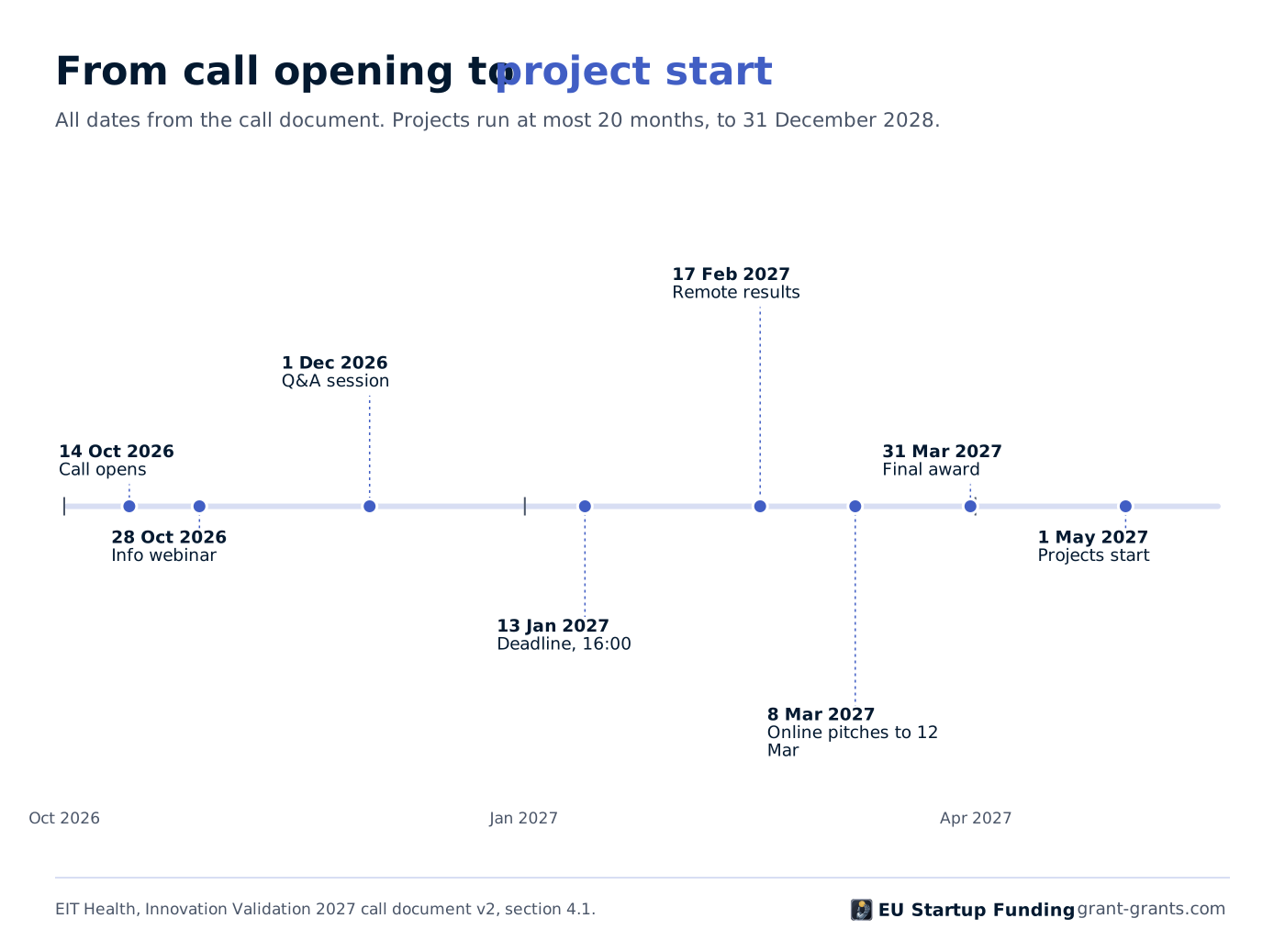
Projects last at most 20 months, from 1 May 2027 to 31 December 2028. The mandatory deliverables include ethics approval for each clinical site, a data management plan, patient recruitment reports, a final clinical study report and proof of the regulatory submission by month 20. The solution must address an unmet medical need through screening, diagnosis, treatment or monitoring. Wellness and lifestyle apps, non-medical devices and healthcare management software that doesn't affect patient care are out of scope. AI is welcome, but the FAQ says it isn't an eligibility requirement. For other routes into digital health funding, see our guide.
Who can apply, and why a startup can't go alone
This is a consortium call. You need at least two legal entities that are independent of each other and based in different countries, from at least two of industry, education and research. A hospital, university or research institute in another country is the obvious second partner, as it can also run the clinical study. Our guide to consortium requirements explains how to set up the roles. Partners can be in EU member states, Horizon Europe associated countries (the UK and Switzerland included) or certain low- and middle-income countries. Canadian organisations can take part, but can't lead and can get at most €60,000. According to the FAQ, Hungarian organisations, including those run by public interest trusts, can receive EIT funding again since 20 October 2026, after the Council lifted the budget measures.
The lead must be the Commercialising Entity, the for-profit company with the rights to take the product to market. Medium-sized and large companies can lead too. If the lead is a micro or small company under the EU SME definition, it must also meet these extra conditions, checked at submission:
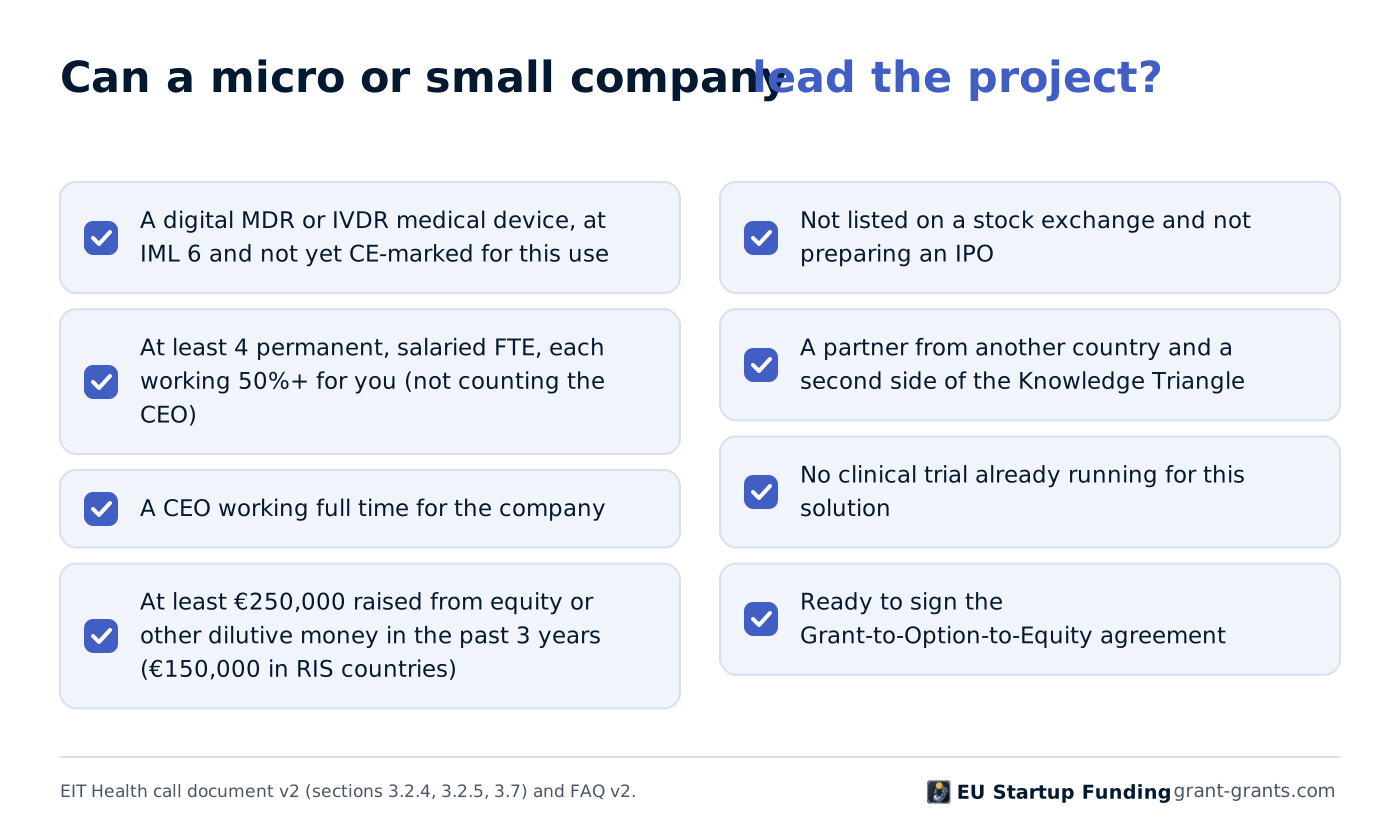
Two points catch many early-stage teams. Freelancers and consultants don't count towards the four permanent FTE. And grants don't count towards the €250,000: only equity or other dilutive money raised in the past three years does. This investor test is new in the 2027 call; the 2026 call document didn't have it.
On maturity, the device must be at IML 6 overall on EIT Health's innovation maturity framework. To pass the eligibility check, it must reach IML 6 in at least one of four areas (clinical, market, regulatory, technology), and evaluators then judge the overall level. A device already CE-marked for a different use, indication or risk class counts as pre-CE for the new use. If you're already running clinical trials or gathering their results, the FAQ says you're too far along for this call.
How much, and the equity strings attached
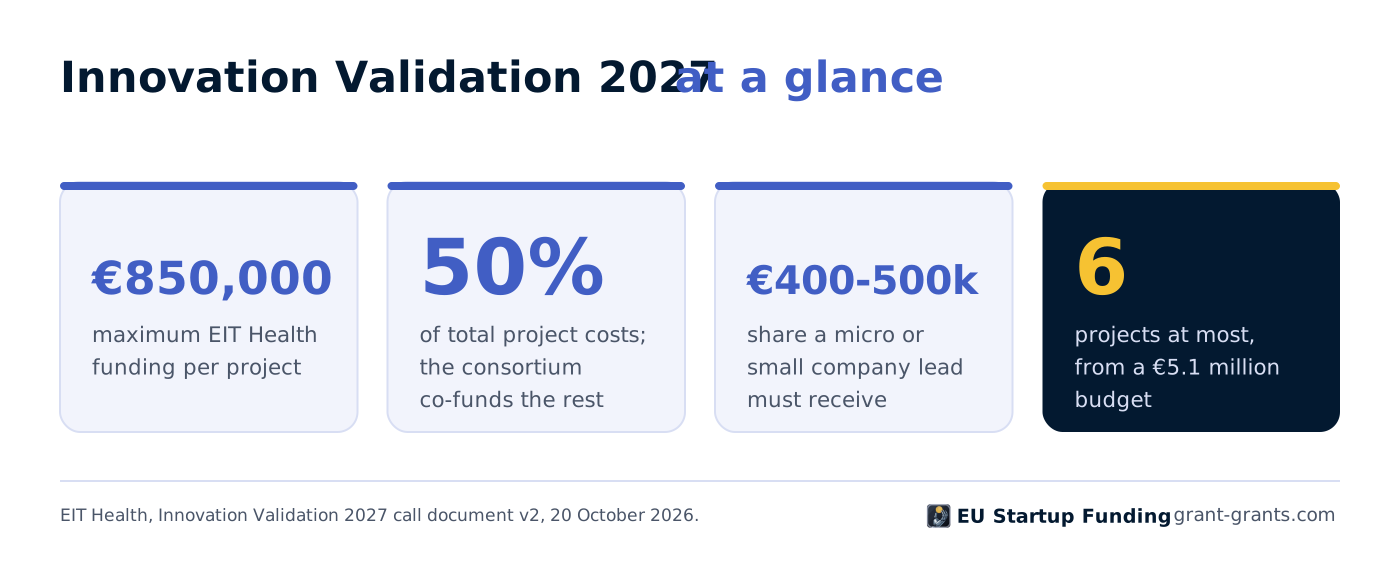
EIT Health pays up to 50% of total project costs, with a maximum of €850,000 per project. The other half must come from non-EIT Health sources, such as your own money, investors or other grants, as long as the same costs aren't funded twice by the EU. Costs follow the Horizon Europe grant rules, and subcontracting must stay a limited part of the work. Pre-financing is up to 25% a year, or up to 50% a year for a micro or small lead.
Unlike most grants, this one isn't equity-free. Before any money reaches the consortium, the lead must sign a Financial Sustainability Contribution Agreement, and EIT Health says its terms are non-negotiable:
For a small company, that works much like a convertible note: a €450,000 grant would turn into shares worth roughly €562,500 at the next qualified round's price (our calculation from the 20% discount), or cost €1.35 million in cash if you buy the options back. Run the numbers with your investors before you apply. The EIC Accelerator is another EU option that combines grant money with equity, for single companies rather than consortia.
How projects are selected
Three external experts score each proposal remotely. To reach the online pitch, a proposal needs at least 10% of the points on each criterion and 70% overall; up to 15 proposals are invited. A new panel of three external and two EIT Health experts then scores the pitches, and only the pitch score decides the ranking. An ethics, legal and social review follows.
- Excellence (20%): fit with the call, the unmet need and how innovative the solution is.
- Impact (20%): the pathway to patients and health systems.
- Implementation (25%): a clear, realistic work plan and a capable consortium.
- Strategic fit and financial sustainability (35%): market strategy, business model and IP, ability to scale and, for small companies, evidence of financial health and investor traction.
Funded projects also commit to impact targets: at least €10,000 in sales within three years of the project's end, at least 150,000 European patients or citizens benefiting within three years, at least one IP asset during the project and, for micro and small leads, €500,000 in investment attracted.
How to apply before 13 January
- Join the info webinar on 28 October at 12:00 CET. Registration is on the call page, as is the open Q&A on 1 December at 15:00 CET.
- Check the eligibility boxes. FTE, CEO, €250,000 in dilutive funding, IML 6, no running trial: if one is missing, you can't lead (a medium or large partner could).
- Find your partner. At least one organisation in another country, ideally a clinical site that can run the study.
- Get PICs and a platform account. Every partner needs a 9-digit PIC from the EU Funding & Tenders Portal; then register on the EIT Health Application Platform.
- Use the official templates. The call documents folder holds the call document, FAQ, equity term sheet, financial templates for micro/small and medium/large leads and a clinical study information form. Templates must be used unaltered, and the budget must show total project costs, not just the EIT Health share.
- Submit early. The deadline is strict, and the time zone wording is off (see the call card).
Compared with the 2026 edition (deadline 6 May 2026), the money is the same: €5.1 million, up to six projects, €850,000 at 50% and €400,000 to €500,000 for a small lead. Projects are shorter, 20 months instead of 24, and the €250,000 investor test and the stricter staff rule are new. EIT Health hasn't published how many proposals the earlier rounds received.
Never miss a deadline
The EIT Health Innovation Validation deadline and dozens of other EU and national deadlines are in our grant deadlines calendar.
FAQ: EIT Health Innovation Validation 2027
When is the deadline?
13 January 2027 at 16:00 Brussels time. The call document says "16.00 CEST", but in January Brussels is on CET (UTC+1), so treat 16:00 CET (15:00 UTC) as the deadline and submit well before it.
How much funding can a project get?
Up to €850,000 from EIT Health, covering up to 50% of total project costs. If the lead is a micro or small company, it must receive between €400,000 and €500,000 of that.
Can a startup apply alone?
No. You need a consortium of at least two independent organisations from two different countries, covering at least two of industry, education and research. A startup can lead it if it meets the micro or small company conditions.
Does a small company lead have to give up equity?
It signs a Grant-to-Option-to-Equity agreement: EIT Health gets options that convert into shares at a 20% discount at a qualified financing round, a change of control or on 15 January 2030. The company can instead pay three times the grant in cash.
Do grants count towards the €250,000 funding requirement?
No. Only equity or other dilutive funding raised in the past three years counts. The threshold is €150,000 for companies established in EIT RIS countries.
Is the device already CE-marked? Can we still apply?
Only if the CE mark covers a different intended use, indication or risk class: then it counts as pre-CE for the new use. Projects already running clinical trials for the solution are not eligible.
