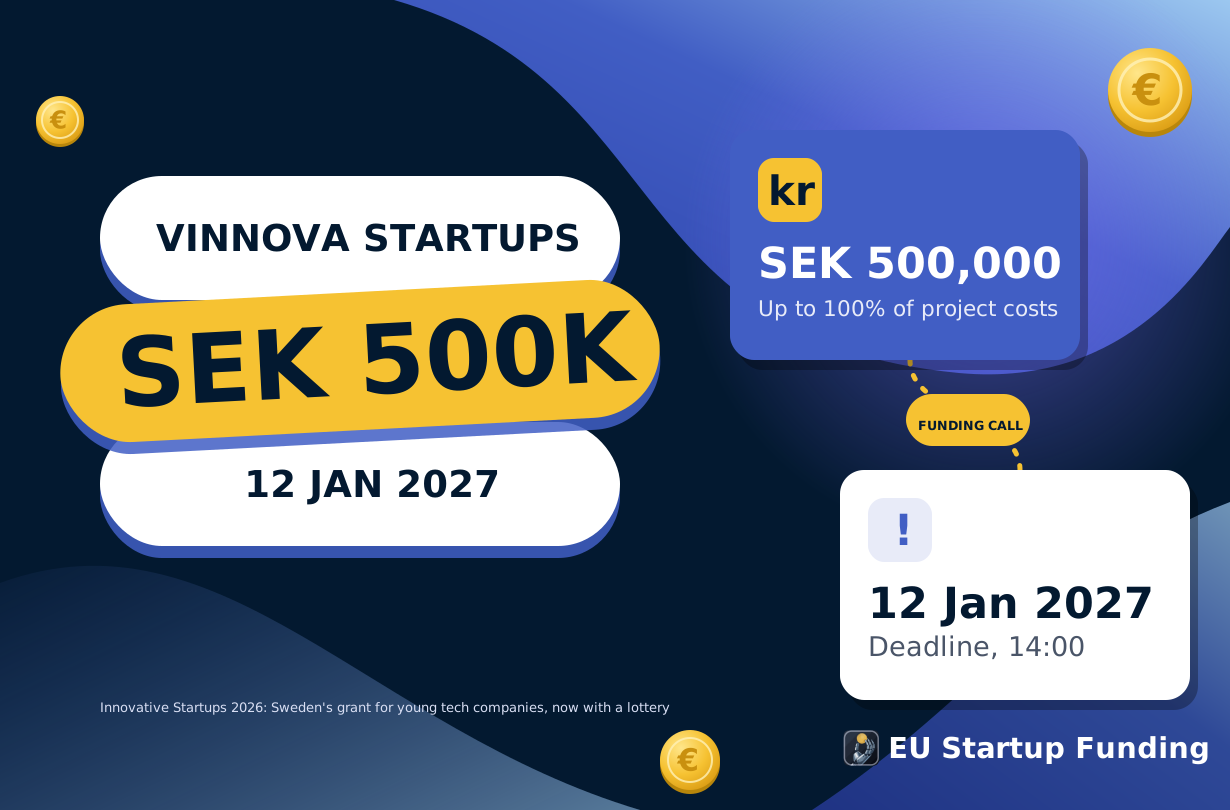
Run a young Swedish tech company and need money to test whether your idea really has a market? Vinnova's Innovative Startups 2026 call (Innovativa Startups) is open: up to SEK 500,000, about €45,000, covering up to 100% of your project costs, with no co-funding and no consortium. The deadline is 12 January 2027 at 14:00. This round has one big change: equally strong applications now go into a lottery. Here's who can apply, what Vinnova pays for and how the new selection works.
What's new in the 2026 round
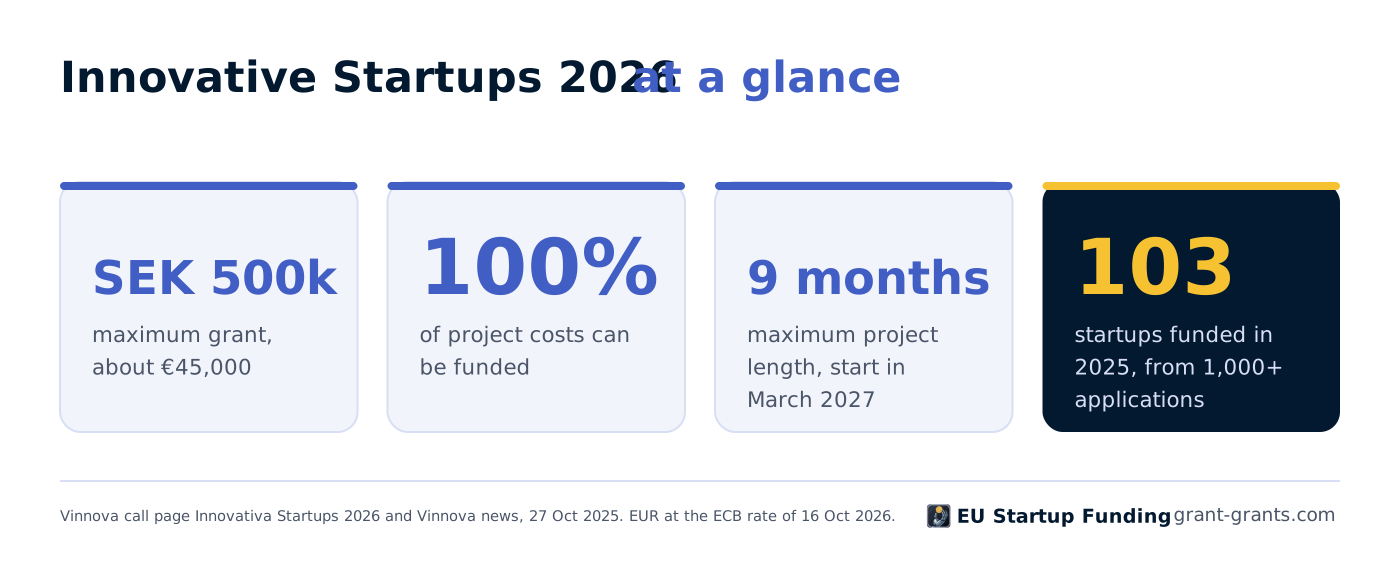
Innovative Startups is Vinnova's most popular programme. Vinnova is Sweden's innovation agency, and it says over 1,100 startups have been funded through this call since 2016. In the 2025 round, 103 startups shared more than SEK 50 million (about €4.5 million) out of more than 1,000 applications, so roughly one in ten won. Life science and IT were the largest areas. The 2026 call opened on 12 October 2026, later than first planned: Vinnova postponed the opening while it updated the selection process. (For the wider picture, see our guide to Nordic innovation funding programmes.) Compared with the 2025 call text, these changes stand out:
- A partial lottery. Applications that experts rate as meeting the criteria to a "high and equal" degree are now drawn by lot within the budget. More on this below.
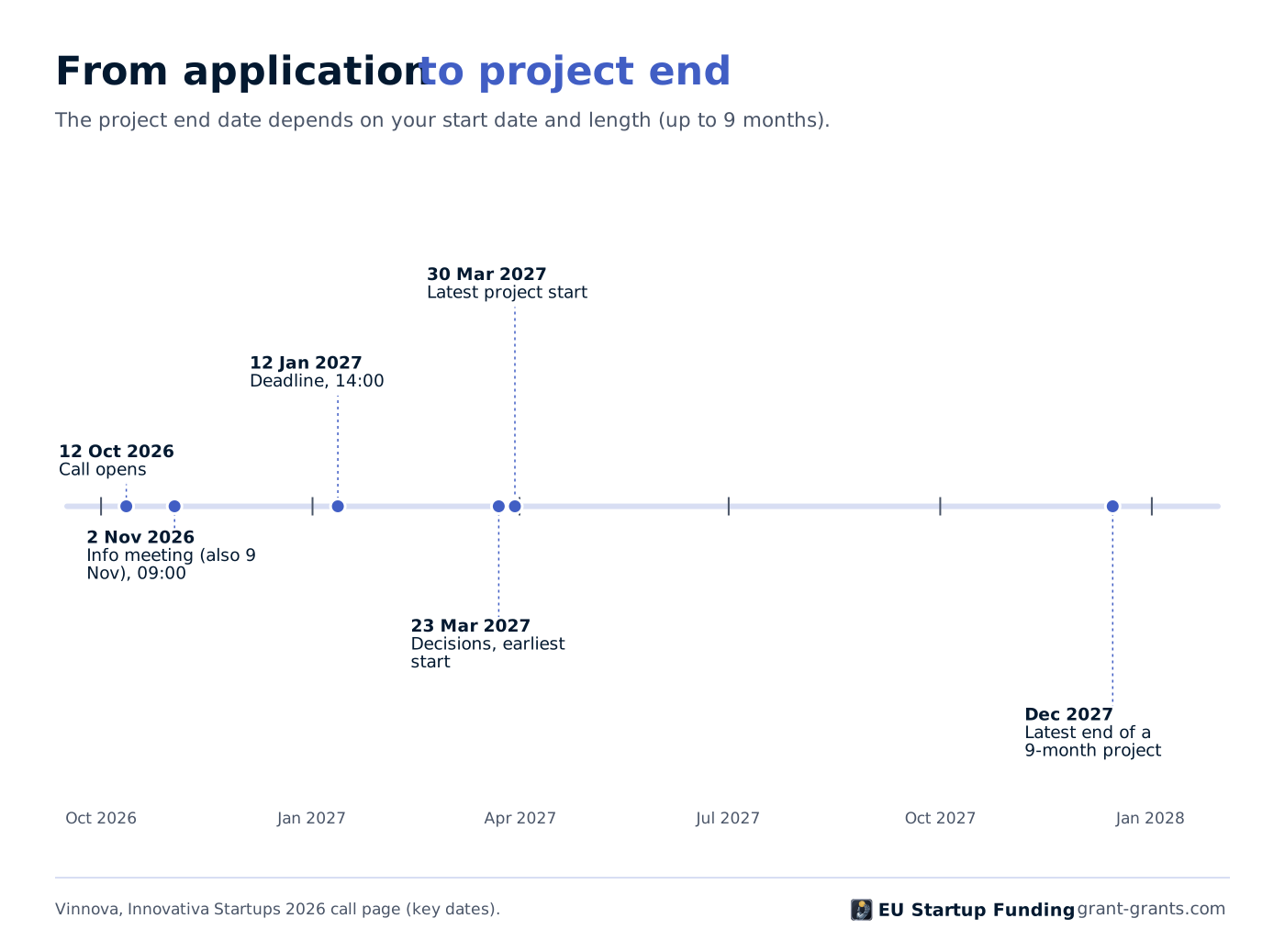
- A winter deadline and a spring start. The 2025 projects had to start in November 2025. This round closes on 12 January 2027, decisions come on 23 March 2027 and projects must start by 30 March 2027.
- No fixed cap on consultants. In 2025, consultancy costs could not exceed 20% of the budget unless you justified more. Now every consultancy and licence cost must be justified, and that justification is scored.
- Last year's winners sit this one out. Companies granted money in Innovative Startups 2025 can't apply.
- Simpler paperwork at submission. The 2025 call required F-tax, VAT and employer registration to be complete before you applied. Now Vinnova checks employer registration when it decides, if you claim salaries; a filed registration request is enough at that point. The de minimis certificate is only requested from companies being considered for funding.
Who can apply
Only a Swedish company can apply, and it applies alone. If you are a startup elsewhere in Europe, this call isn't for you; our list of startup grants in Europe covers other countries. Every formal requirement is pass or fail: miss one and Vinnova rejects the application without assessing it.
Vinnova also checks finances before deciding. The project leader must be employed by the company, and a company claiming salary costs must be registered as an employer with Skatteverket. Companies that are insolvent, in liquidation or in restructuring, with significant unpaid debts at Kronofogden, or that have used up half or more of their share capital, won't be funded.
What the money pays for
The call funds activities that check whether an innovative idea has a market, and that test and confirm its potential. Vinnova wants young, knowledge-intensive companies built on something hard to copy, such as founders' expertise, technology, data, IP, a business model or creative ability, and with an international market in view. Its aim is to bring companies closer to customer collaborations, customer revenue, investment and partnerships. These costs are eligible:
- Salaries: gross pay, employer contributions and other payroll costs.
- Equipment and premises: instruments and equipment, and rent for premises other than your normal office.
- Consultancy and licences: bought-in services, knowledge or patents. Each one must be justified in the application.
- Other direct costs: materials, supplies and necessary travel.
- Overhead: up to 30% of salary costs.
Costs must be real, reasonable, necessary for the project and booked on a separate project code. Our guide to eligible costs in grant budgets explains how to build a budget that holds up. The legal basis matters if your company is 5 to 10 years old: the grant then counts as de minimis aid, capped at €300,000 over three years across all funders, so earlier de minimis grants reduce what Vinnova can give. Our explainer on state aid rules covers the difference between GBER and de minimis.
How Vinnova picks winners, and the new lottery
Three external experts assess each complete application against three groups of criteria:
- Potential: how much more innovative your solution is than what exists, and whether it can create growth in Sweden and succeed internationally, backed by knowledge assets worth protecting.
- Feasibility: a realistic budget, plan and approach; a credible plan for commercialisation and funding after the project; why you need Vinnova's money given your current finances; and how well consultancy and licence costs are justified.
- Team: the knowledge and entrepreneurial ability to deliver; founders who control the company and drive it themselves; and a strategy for an equal distribution of power and influence between women and men. See our guide to gender equality in grant applications.
Then comes the new part. According to the Swedish call text, applications are sorted into three groups. Those that meet the criteria to a low degree are rejected. Those that meet them to a "very high" degree are funded directly. Those that meet them to a "high and equal" degree go into a randomisation group, and a lottery decides which of them get money within the budget. (The English version of the page leaves out the directly funded group, so rely on the Swedish text.)
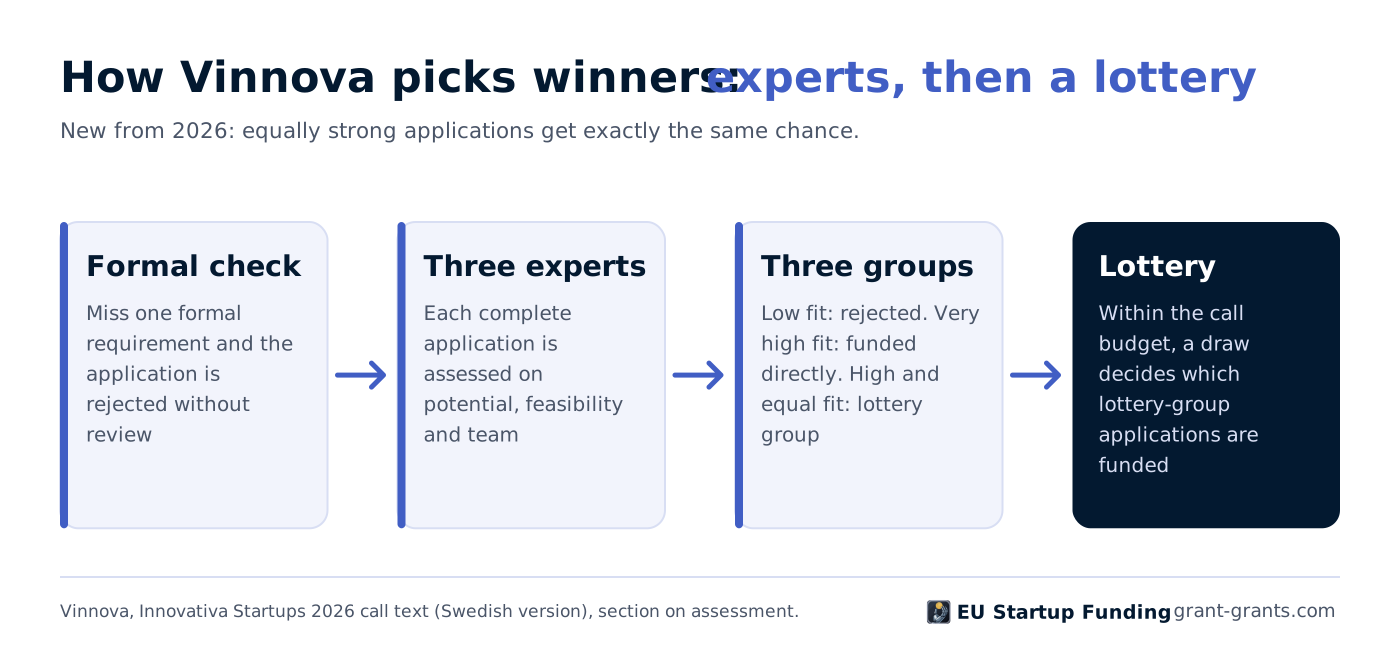
Vinnova's reason: it gets more high-quality applications than it can fund, and it is often hard to separate equally good ones. It notes that the Swedish Research Council and Formas already use partial randomisation, as does the British Academy's Small Research Grants scheme. For you, this means a strong application still gets you into the draw, but only a very strong one guarantees funding. If you are rejected, you can't appeal, but you can apply again in a later round; read our tips on reapplying after a rejection.
How to apply before 12 January
- Check every formal rule in the table above, especially age on 23 March 2027 and the size test at group level.
- Join an info meeting on Teams: Monday 2 November or Monday 9 November 2026, both 09:00 to 10:00. Sign-up links are on Vinnova's info meeting page.
- Write the application in Vinnova's e-service. You can save drafts, invite colleagues and unlock the application to change it until the deadline. Mark it as ready again after every change, or it won't be registered.
- Justify every consultant and licence and keep overhead within 30% of salaries.
- Submit by 12 January 2027 at 14:00. Vinnova emails a confirmation after the call closes; if none arrives within 24 hours, contact Team Startups.
Founder of a women-led deep-tech startup? Women TechEU offers €75,000 per startup, also as a single applicant, with a deadline two days later, on 14 January 2027.
Never miss a deadline
Innovative Startups and dozens of other EU and national calls are in our grant deadlines calendar.
FAQ: Vinnova Innovative Startups 2026
When is the deadline for Innovative Startups 2026?
12 January 2027 at 14:00 Swedish time, through Vinnova's e-service. Decisions are due on 23 March 2027.
How much can a startup get?
Up to SEK 500,000, about €45,000, covering up to 100% of the company's project costs. Projects last up to nine months.
Can a company outside Sweden apply?
No. The applicant must be a Swedish aktiebolag operating in Sweden, and it applies alone, without partners.
How old can my company be?
At most 10 years on 23 March 2027, counted from registration with Bolagsverket. Under 5 years, the grant is GBER aid; from 5 to 10 years, it's de minimis aid.
How does the lottery work?
Three experts assess each application. Very strong ones are funded directly, weak ones are rejected, and those rated high and equal go into a draw for the remaining budget.
Can I apply if I won in 2025?
No. Companies funded in Innovative Startups 2025 are excluded from the 2026 call.
