TL;DR: Does the European Commission cyberattack affect EU grant applicants?
The European Commission cyberattack reported on 19 November 2026 hit internal staff systems, according to POLITICO, and nothing reported so far says the Funding & Tenders Portal, EU Login or applicant data were touched. We found no deadline extensions linked to it. The bigger risk this week is EU grant phishing that borrows the headlines, so submit early and verify every email that asks for logins or bank details.
Developing story. Last updated 19 Nov 2026, 11:34 CET. We'll update this article as the Commission and CERT-EU publish more.
Here is what happened in the European Commission cyberattack, with the ARTEX background. This article covers one question: what it means if you apply for, or hold, an EU grant.
What do we know so far?
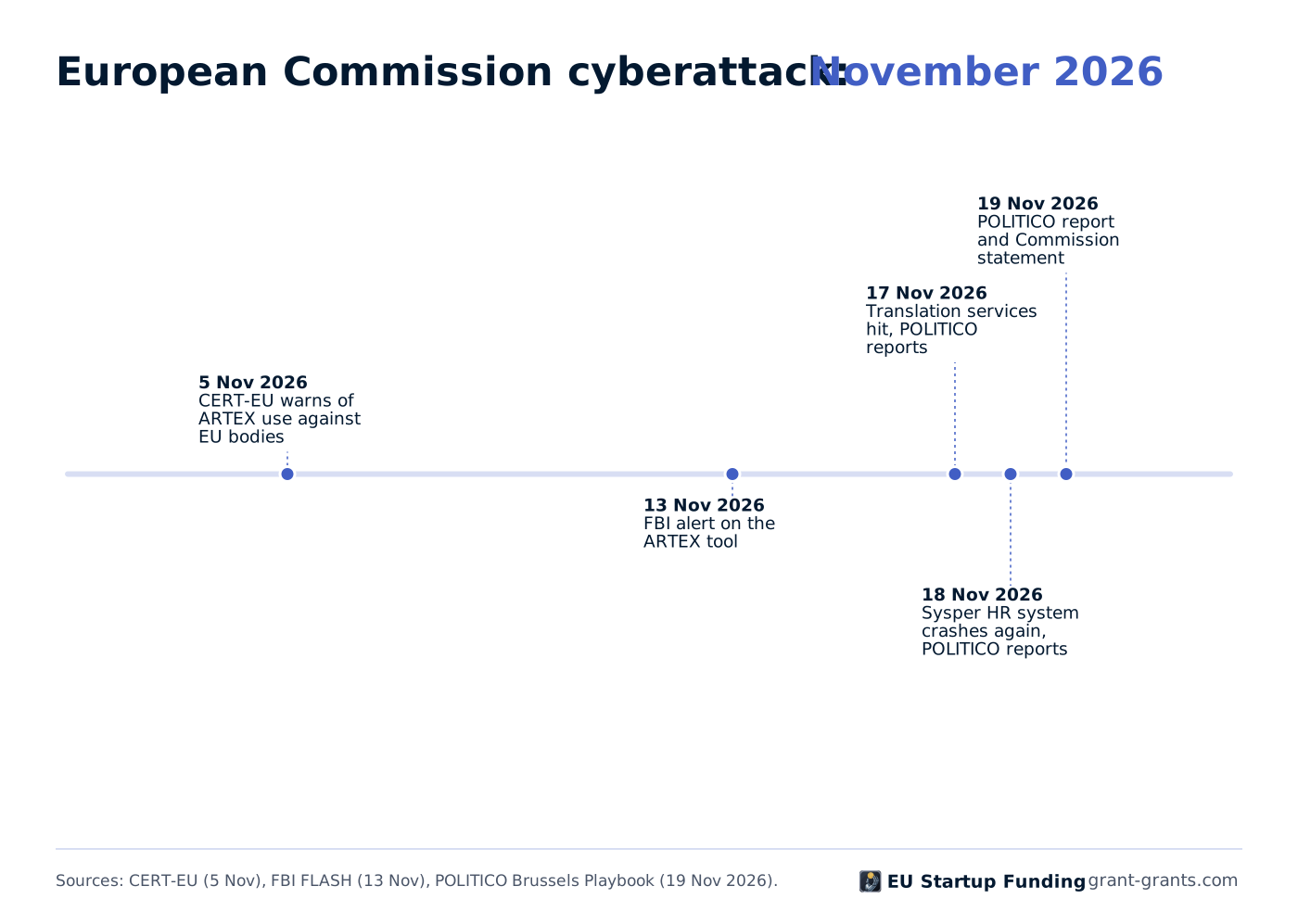
- On record: Commission spokesperson Thomas Regnier told POLITICO's Brussels Playbook: "The European Commission has taken the necessary steps in response to a detected cyber campaign." He said "individual systems were targeted" and "those concerned" were informed.
- Systems named: POLITICO, citing EU officials, says Sysper (staff payslips, leave, timesheets) and MyPMO (medical claims) went offline, with disruption lasting over 10 days.
- The tool: hackers used ARTEX, an AI tool that hunts for weak spots, POLITICO reports. CERT-EU warned on 5 November of ARTEX activity against EU bodies. Our sister site explains what ARTEX is.
- Data: investigators are still checking whether staff data was compromised. No theft is confirmed.
Are the Funding & Tenders Portal and EU Login affected?
Nothing reported points that way. POLITICO, Reuters and the outlets that followed name staff systems only. On 19 November we also checked the portal's notices and FAQs and found no outage notice, phishing alert or deadline extension tied to this incident.
What don't we know yet?
- How the attackers got in, and when it started.
- Whether staff payslips, leave or medical data were accessed.
- Whether data outside staff systems is involved. Nothing reported points to applicants or companies.
- Who is behind it. Nobody has named a group or a country.
Why does a Commission hack bring EU grant phishing?
Our own precaution (no official body has issued this warning): scammers follow the news. An email saying "after the recent security incident, please re-verify your EU Login" sounds believable this week.
The portal's FAQ on spam and phishing lists three kinds: fake portal emails asking for ID or bank details, spam that copies portal notifications, and sales pitches sent through the portal's contact function. Beneficiaries face a fourth: a 2023 portal notice, relayed by universities, warned Horizon projects about fraudsters posing as partners to redirect payments. Our guide to grant scams covers older tricks.
How do you check that an EU funding email is real?
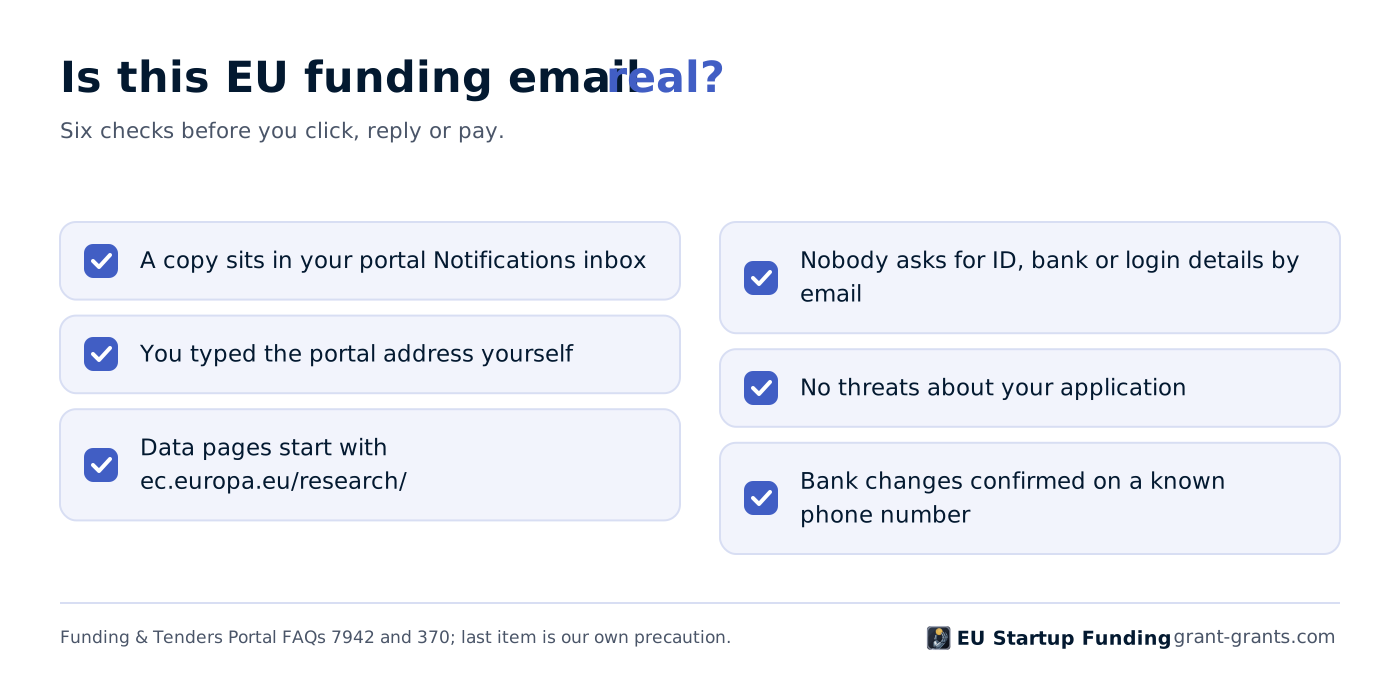
- Find a copy in the portal. Log in and check your Notifications inbox: no copy there means likely phishing, says the portal's FAQ for experts.
- Type the address yourself: ec.europa.eu/info/funding-tenders/opportunities/portal/screen/home. Pages where you enter personal or financial data start with https://ec.europa.eu/research/.
- Treat data requests by email as fake. "The EU Funding & Tenders Portal will never ask you to send important personal and financial information via email."
- Check the sender, then distrust it. Genuine Commission addresses end in @ec.europa.eu, a February 2026 Commission scam warning says, and sender names are easy to fake.
- Ignore threats about your account or application, and report the email to the portal's IT Service Desk.
What this means for you if your deadline is this month
- Submit 48 hours early. The Online Manual says "at least 48 hours before the deadline", and you can resubmit until the call closes.
- Check the confirmation email. Every coordinator contact gets one; no email means no submission.
- Keep time-stamped PDFs of Part B and annexes, plus screenshots of errors. Complaints about a failed submission go to the IT Helpdesk within 4 calendar days of closing.
- Log in from a bookmark with EU Login two-factor sign-in set up before deadline day.
- Confirm bank changes by phone on a number you already know before any partner payment. Our notes on how deadlines are counted and required registrations help too.
Never miss a deadline
EU and national calls, with exact cut-off times, are in our grant deadlines calendar, and the EIC dates before the end of 2026 are listed too.
FAQ: the European Commission cyberattack and EU grants
Was the Funding & Tenders Portal hacked in the European Commission cyberattack?
No report says so. As of 19 November 2026, reports name staff systems only, and the portal shows no incident notice.
Have EU grant deadlines been extended?
We found no extension linked to the cyberattack. Plan for your call's published deadline and submit at least 48 hours early.
How do I spot EU grant phishing?
Log in to the portal yourself and look for the same message in your Notifications inbox. The portal never asks for personal or financial information by email.
Where do I report a suspicious EU funding email?
To the Funding & Tenders Portal IT Service Desk. If it asks you to change a payment, call your partner or project officer on a known number first.
