TL;DR: what did the EU launch for chip startups?
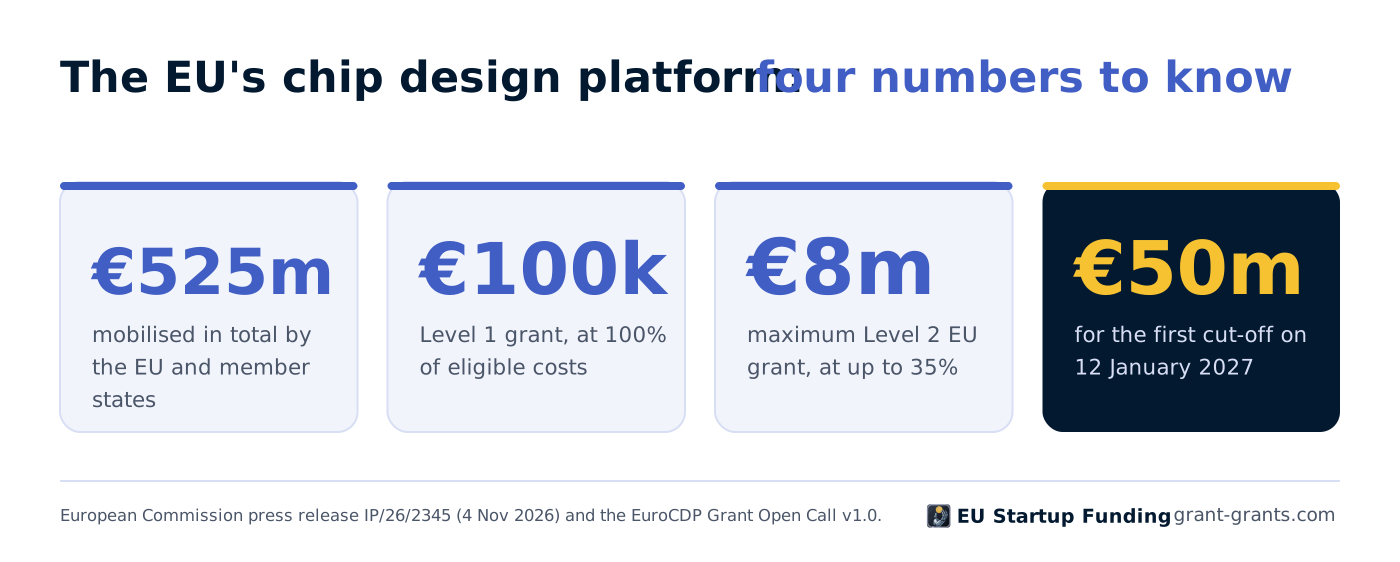
On 4 November 2026, the Commission launched the European Chip Design Platform (EuroCDP), which it says will mobilise €525 million to help European companies design their own chips. Its first grant call is already open: up to €100,000 at 100% for young startups and up to €8 million from the EU at 35% for more advanced ones, with a first cut-off on 12 January 2027 at 17:00 Brussels time and €50 million on the table. Only single SMEs can apply, and the grant pays for chip design tools, IP and prototyping services, not salaries.
Designing a chip is expensive long before the first sale: design software licences, IP blocks and a prototype run at a foundry can cost more than a seed round. That's the gap the EU's new chip design platform is meant to close. It's a programme launch with real money attached, and the first applications are due in ten weeks. Here's what's on offer, what the "€16 million" headline doesn't tell you, and who can apply.
What happened
Henna Virkkunen, the Commission's Executive Vice-President for tech sovereignty, launched the platform at eurocdp.eu on 4 November 2026. According to the Commission's press release, the platform gives chip design companies access to design tools, design support services, intellectual property (IP) blocks and manufacturing capacity, "the most expensive and the hardest to access for early-stage companies".
The money, as the Commission breaks it down:
- €440 million in grants, public money from the EU and member states.
- €85 million for the cloud platform itself, its support services and open-source chip design tools.
- Who pays: €285 million comes from the EU budget and €240 million from the countries taking part in the Chips Joint Undertaking (Chips JU).
A consortium led by the Belgian research centre imec runs the platform, with backing from the Chips JU. Twenty startups are already in its venture programmes, which offer technical and commercial training. Sources differ slightly on the total: the press release says €525 million, while the Commission's factpage says "€500 million mobilised in public investment".
The reason is a weak spot in Europe's chip industry. European chip design companies earn less than 1% of global revenues in their segment, the Commission says, and new factories in Europe will only pay off if European designers create demand for them. The platform is part of the EU Chips Act; a Chips Act 2.0 was proposed in June 2026 and isn't law yet. "It shows how Europe is ready to act on its technological sovereignty goals, not only through policy and promises, but also by investing in our future," Virkkunen said.
The first grant call: €50 million, cut-off 12 January 2027
The grants are cascade funding: the EuroCDP consortium passes on EU money from a Horizon Europe action called DECIDE FSTP (grant agreement 101316812), under the Chips JU, to the companies it selects. If you haven't applied for this kind of grant before, our guide to how cascade funding and sub-grants work explains the model. The call, EuroCDP FSTP I, opened on 4 November 2026 and stays open until the money runs out, with fixed evaluation cut-offs. The first is 12 January 2027 at 17:00 Brussels time, with an indicative €50 million; the call says this isn't the action's total budget, and later cut-offs will be announced separately.
Source: EuroCDP Grant Open Call v1.0, 4 November 2026. "Raised" means all equity, grants and loans received since incorporation, not sales revenue.
You don't need a Level 1 grant before applying for Level 2, but if you use both, Level 1 must come first. Each company, counting its linked entities, can win one award per level and €8.1 million in total under this action.
What the "€16 million" headline doesn't tell you
Both the press release and the factpage say more developed startups can get grants of "€16 million". The call document itself caps the EuroCDP grant at €8 million, paid at up to 35% of eligible costs. National, regional or other public funding can cover more of the project, but all public money together can't go above 70%, and you must put in at least 30% as your own cash from private sources.
So €16 million is only possible if your country adds roughly another €8 million on top of the EU's €8 million. That's our reading of the call's rules; the Commission hasn't spelled it out. The call's own example shows the maths for a smaller project:
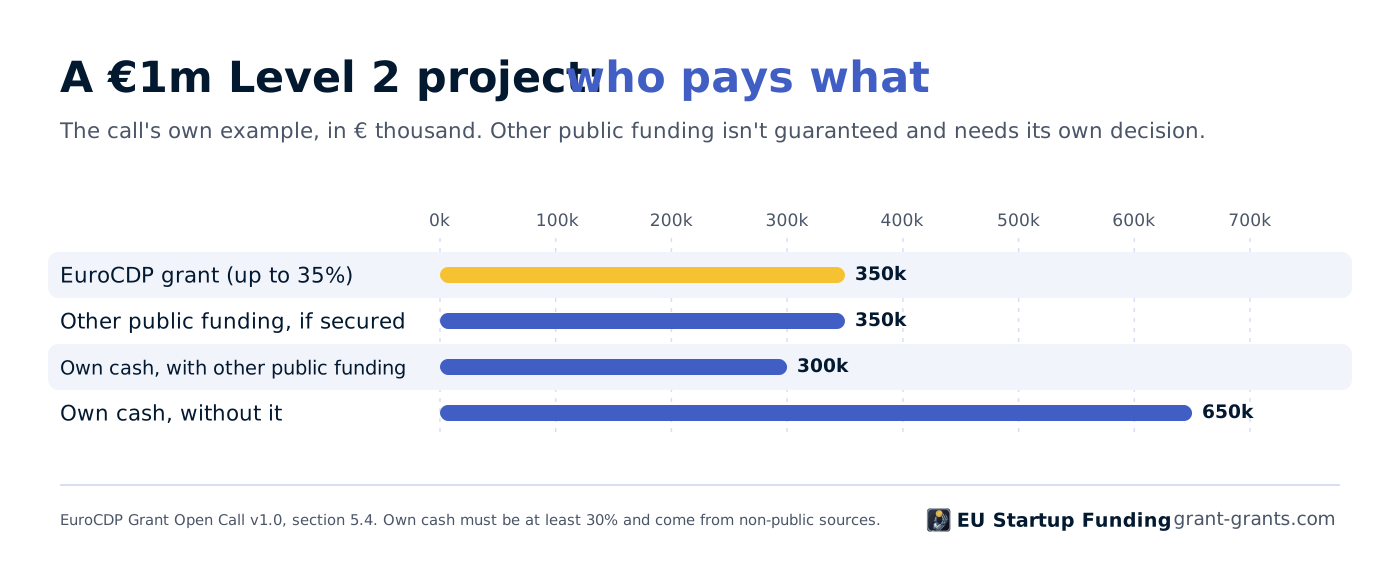
Other public funding needs its own decision, and the call doesn't guarantee it. Some countries will ask you to go through your national Chips Competence Centre, and where national rules require you to apply before work starts, you must do so. If a selected Level 2 project depends on co-funding that's still pending, it goes on a financing reserve list for up to twelve months. Read our guides to match funding requirements and State aid and cumulation rules before you build your financing plan.
Who can apply
- One SME, alone. The applicant must be a single company that meets the EU SME definition. Consortia can't apply. Startups are exactly who this call is for: there's no partner to find. Check your status with our SME definition guide.
- Based in Europe. Companies established in an EU member state or in a third country eligible for Horizon Europe funding can apply.
- Designing chips in-house. Your own team must design the critical parts of the chip in an eligible country. A project that outsources all the critical design work fails this rule.
- Registered. You need an account and a registered company on the EuroCDP platform, a Participant Identification Code (PIC) and the Funding and Tenders Portal SME self-assessment.
What the grant pays for, and what it doesn't
Source: EuroCDP Grant Open Call v1.0, section 5.1. Quotes must use the prices EuroCDP negotiated with its vendors.
Payments are fixed lump sums per milestone, released when the agreed output is accepted. Level 1 can get an advance of up to 50% of the grant, but only for approved licence costs. That makes this a grant for buying tools and fab time, not for running your company, so plan your salaries from other sources. For a deep-tech company weighing grants against a funding round, see deep tech grants for AI, quantum and advanced materials.
How proposals are scored
Independent experts score four criteria from 0 to 5: excellence, impact, implementation and EU added value. Each needs at least 3, and the total needs at least 15 out of 20. EU added value is scored first, and proposals that miss 3 there aren't scored on the rest. Ties are broken by the EU added value score, then impact, excellence and implementation. Results are due about six weeks after the cut-off, so around late February 2027 for the first round (our estimate). You can resubmit a rejected proposal once.
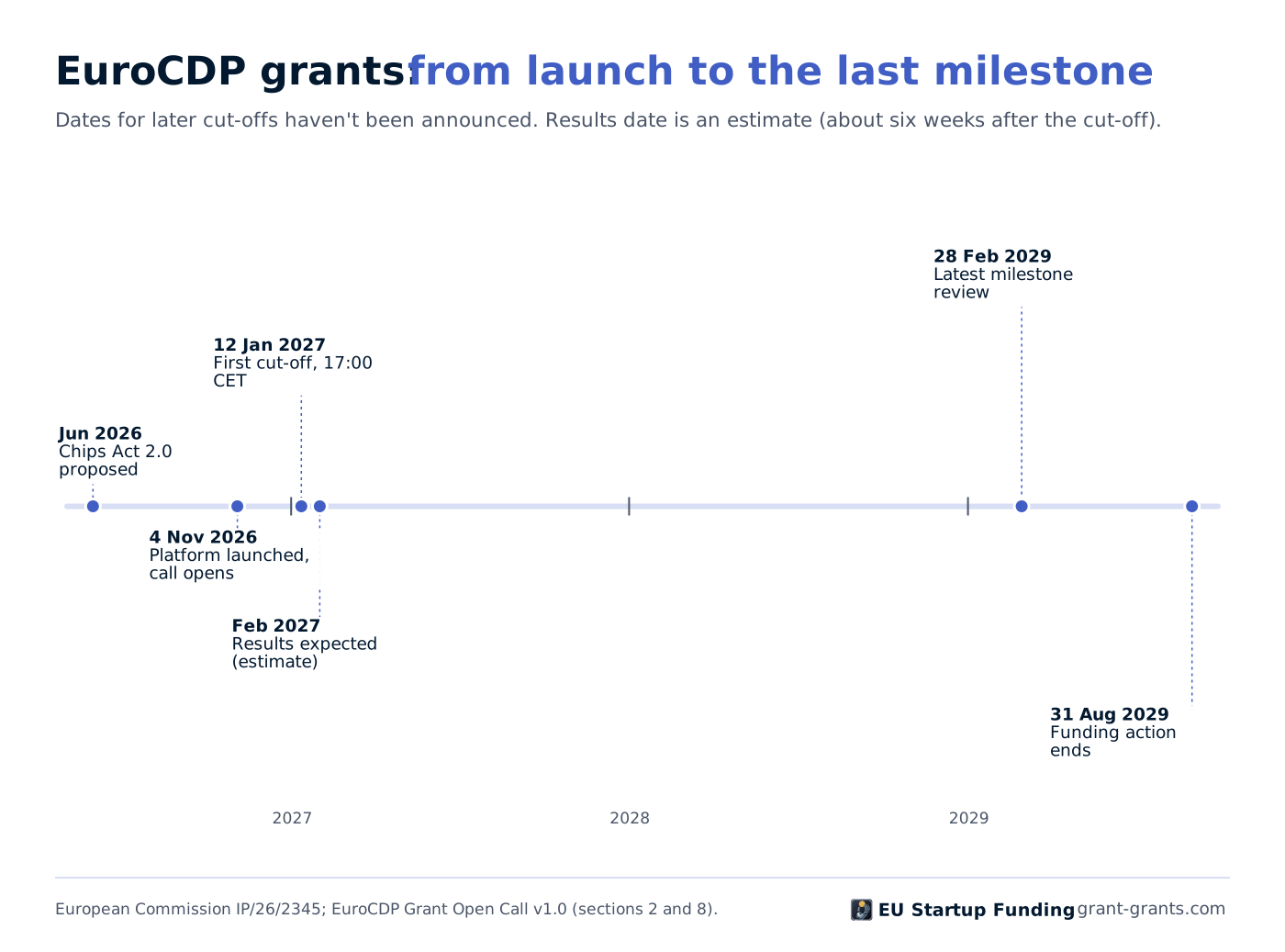
Every funded project must finish within the action, whose last milestone review is on 28 February 2029. If your tape-out depends on a foundry slot in 2029, check the dates before you apply.
Mistakes that sink a EuroCDP application
Most of these come straight from the call rules, and each one can cost you the grant before an expert reads your technical plan:
- Applying as a consortium. Only a single SME can apply. A university partner or a design-services firm can be your supplier, but not your co-applicant.
- Budgeting salaries. The grant pays only for EDA tool licences, IP licences and approved services from EuroCDP's catalogue. Staff, overheads and in-kind contributions aren't eligible, so the budget must be built from supplier quotes.
- Outsourcing the critical design. Your own team must design the critical parts of the chip in an eligible country. A project that hands all the critical work to a design house fails the eligibility check.
- Applying for Level 1 after a big raise. Level 1 is only for companies whose accumulated funding is €1 million or less, counting equity, grants and loans since incorporation.
- Counting on €16 million. The EuroCDP grant itself stops at €8 million at up to 35%. Anything above that needs separate national or regional funding, and all public money together can't go above 70%.
- Neglecting EU added value. It's scored first. A proposal below 3 out of 5 on it isn't scored on anything else.
- Leaving registration to the last week. You need a EuroCDP platform account, a PIC and the SME self-assessment on the Funding and Tenders Portal before you submit for the 12 January 2027 cut-off at 17:00 Brussels time.
Not sure this is the right call for you? Our funding finder helps you find other open EU and national calls.
What this means for you
- If you're an early chip startup, Level 1 is the easy entry. Up to €100,000 at 100% for a proof-of-concept prototype, with no co-financing, if you've raised €1 million or less.
- For Level 2, line up the private money first. At least 30% must be your own cash, and 65% if no other public funding comes through. A grant this size works best next to a funding round.
- Talk to your national Chips Competence Centre early if you want national co-funding on top. A positive EuroCDP evaluation letter can support that request.
- Get quotes now. You need supplier quotations for the tools, IP and services you want, from EuroCDP's catalogue, before you can write the budget.
- Compare the other chip money on the table. Germany's SPRIND and the Netherlands' NADI offer up to €9.6 million per team in their AI chip design challenge, with a deadline of 30 November 2026, and the EIC Accelerator funds deep-tech scale-ups with grants and equity.
Never miss a deadline
The 12 January EuroCDP cut-off and every other open EU and national call are in our grant deadlines calendar.
FAQ: the EU's chip design grants
What is the European Chip Design Platform?
A cloud-based platform launched by the European Commission on 4 November 2026 under the EU Chips Act. It gives chip design companies access to design tools, IP blocks, design support and manufacturing capacity, plus grants. A consortium led by imec runs it, with support from the Chips Joint Undertaking.
How much money is there?
The Commission says the platform will mobilise €525 million: €440 million in grants from the EU and member states and €85 million for the platform and its tools. €285 million comes from the EU budget and €240 million from Chips JU member states. The first grant cut-off has an indicative €50 million.
Can my startup apply alone?
Yes. In fact it has to: only single SMEs established in the EU or a Horizon Europe-eligible country can apply, and consortia aren't eligible. Your own team must design the critical parts of the chip.
Is the grant really €16 million?
The call caps the EuroCDP grant at €8 million, at up to 35% of eligible costs. All public funding together can reach 70%, so €16 million is only possible with about €8 million of national co-funding on top. That's our reading; the Commission hasn't explained the figure.
What's the deadline?
The call opened on 4 November 2026 and stays open until the money runs out. The first evaluation cut-off is 12 January 2027 at 17:00 Brussels time. Later cut-offs will be announced separately.
Does the grant cover salaries?
No. It covers only EDA tool licences, IP licences and approved design, prototyping, testing, packaging and cloud services from EuroCDP's catalogue. Staff, overheads and in-kind work are excluded.
Can I apply for both Level 1 and Level 2?
Yes. You don't need Level 1 to apply for Level 2, but if you use both, Level 1 must come first. Each company, counting its linked entities, can win one award per level and €8.1 million in total.
When will the first results be announced?
About six weeks after the cut-off, so around late February 2027 for the 12 January round. That date is our estimate from the call's timing; EuroCDP hasn't published a results date.
