TL;DR: What does a Delaware flip do to your EU grants?
Your European company can still win EU grants after a Delaware flip: the EIC Accelerator funds an SME established in a Member State or Associated Country, and your EU company stays there. The catch: your US parent's figures can count toward SME status, and the EIC Fund invests in a parent only if it is established in the EU or an Associated Country. STEP Scale Up and the €5bn Scaleup Europe Fund apply similar location rules.
With EU Inc stuck and founders asking the Commission to withdraw and re-table it, more European founders are weighing a Delaware flip or a move of their headquarters to the US. Here is the grant applicant's side: what happens to EIC, Horizon Europe and national funding when the top of your cap table sits in Delaware. I have built companies in the Netherlands, Malta and elsewhere in Europe and applied for EU, Dutch and Maltese grants, so I'll be blunt about the process and careful about the rules.
What is a Delaware flip, and why is it back on the table?
A Delaware flip puts a new US parent, a Delaware C-Corp, on top of your European company. Shareholders swap their shares for shares in the parent, and the European company keeps operating as its subsidiary. Our sister blog covers how a Delaware flip works for European founders.
The founder campaign behind EU Inc uses that structure as its yardstick. EU-INC and Startups for Europe judge EU Inc by one test, tech.eu reported on 19 November: "Would a founder choose it over a Delaware C-Corp?" Their verdict: "The Commission's original proposal passes that test. The Council's mandate does not." Co-initiator Andreas Klinger warned that "founders will simply incorporate elsewhere."
The fair counterweight: a JRC report from April 2026 puts relocation at 3.3% to 4.3% of VC-backed startups and 0.3% to 0.5% of others, with the US as the dominant destination, and says "97% of the VC-backed companies that relocate are doing it only partially". So the risk is quieter than an exodus: Europe keeps the team while its best-funded founders move the top company to the US.
Can a startup that flips to Delaware still get EU grants?
For most programmes, yes. EU funding checks where the applying entity is established, and your European company stays in Europe after a flip. What changes: your SME size, which company the EIC Fund can invest in, and what you may do with EU-funded IP.
Count the group for SME status. The EU ceilings are fewer than 250 staff and turnover up to €50M or a balance sheet up to €43M. The Commission's SME definition page warns that "a firm that is part of a larger group may need to include staff headcount/turnover/balance sheet data from that group too." After a flip, the Delaware parent and your EU company are one group, and a large US sales team can cost you SME status. Our guide to the SME definition in EU funding walks through the maths.
Don't treat the EU company as a front. The EIC Accelerator FAQ says relying on EU entities for blended finance or equity "should not be used to circumvent the eligibility conditions". An EU subsidiary with real staff, accounts and IP fits the rules. A letterbox invites questions.
Control rules spare US owners, for now. In 2026 the EIC's ban on grant-only beneficiaries controlled from non-eligible countries applies only to the raw materials Challenge, which exempts OECD countries such as the US. The defence equity call wants Member State guarantees for companies controlled from outside the EEA and Ukraine, and Article 22(5) lets any topic go further, so read each call and our notes on geographic eligibility.
What does the EIC Fund ask about where you are based?
This is where a flip costs money. The EIC Accelerator pairs a grant of up to €2.5M with EIC Fund equity, and the EIC Work Programme 2026 covers parent and holding companies. It lets the Fund invest in the parent only if "the parent or holding company fulfils all relevant criteria, including SME status, non-bankability for the purpose of the EIC Accelerator, and establishment in an EU Member State or Associated County" [sic]. A Delaware C-Corp is established in the US, so it fails that last test. The 2027 work programme keeps the same wording.
The EIC Fund Investment Guidelines updated in August 2026 add three conditions that matter to a flipped company:
- Eligible companies "must be established and operating in the EU Member States or Associated Countries".
- The Fund "will ensure that supported companies keep most of their value, including their intellectual property, in the EU or in Associated Countries".
- Where the Commission asks for safeguards, the Fund can take a blocking stake or insist on "securing European ownership of intellectual property and of the company". Safeguards apply to every STEP Scale Up deal and to AI, quantum, semiconductor and biotech projects that develop listed technologies.
What the text does not say: whether the EIC Fund will take equity in your EU subsidiary when every other investor holds Delaware shares. I found no official answer. Declare any parent in your application, as the work programme asks, and ask your National Contact Point (NCP) before you sign anything.
IP is the other trap. EIC beneficiaries must inform the Agency when project IP is proposed to be transferred to an entity in a non-associated third country, and the Agency may object. If your flip plan moves IP into the US parent and an EIC grant paid for it, talk to the Agency first. Our guide to IP ownership in grant agreements covers the clauses.
Higher up, the logic repeats. STEP Scale Up wants any holding used for its €10M to €30M investment established in the EU or an Associated Country. The Scaleup Europe Fund, run by EQT with €1bn from the Commission, is open to "companies located in or intending to locate to" the EU or Associated Countries, and its work programme section commits it to "give preference to European exits".
Why are founders flipping while EU Inc stalls?
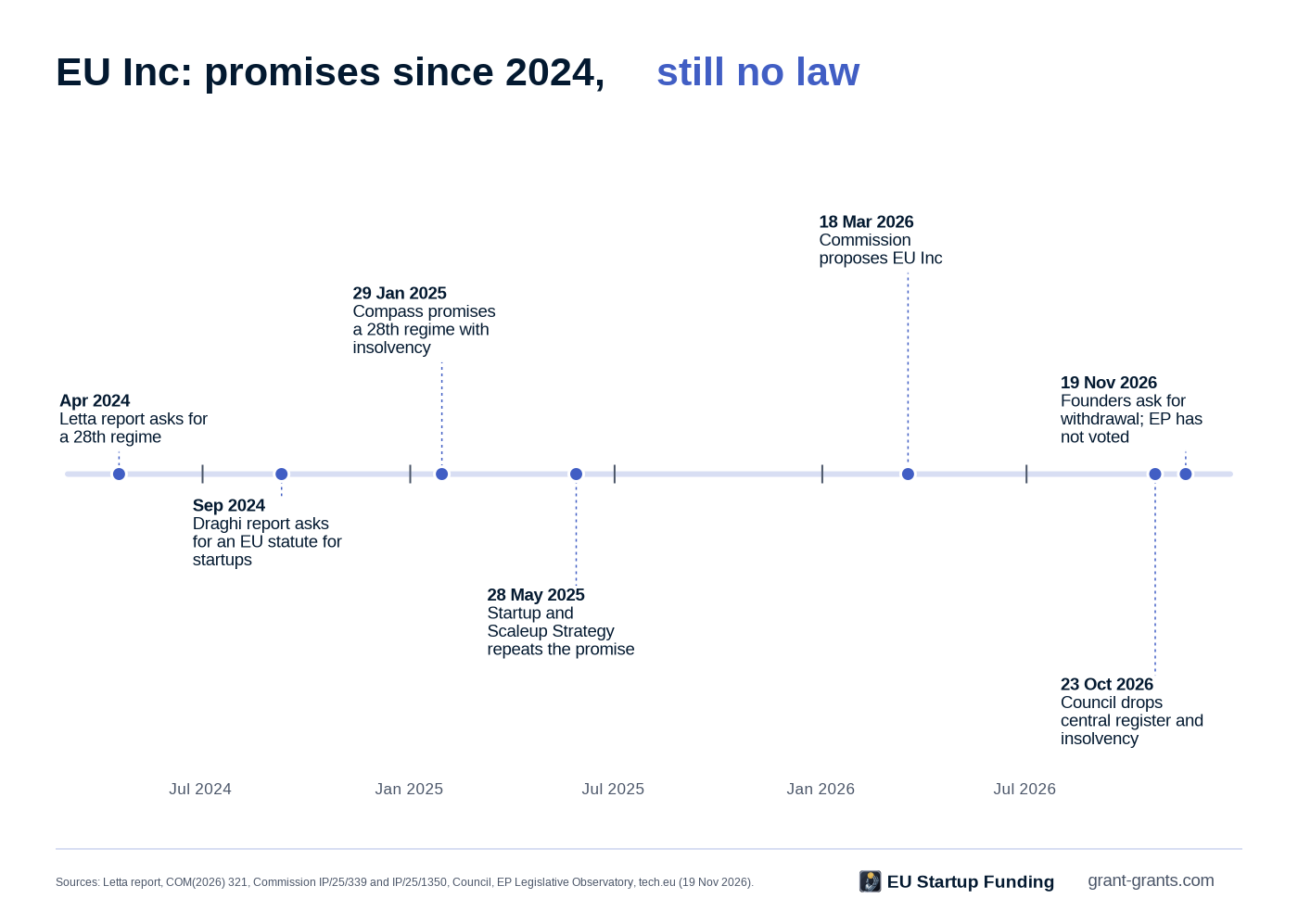
My view: Brussels promised founders one company law and keeps delivering announcements. The Competitiveness Compass of 29 January 2025 promised a 28th regime covering "relevant aspects of corporate law, insolvency, labour and tax law". The 18 March 2026 proposal kept insolvency in; the Council's 23 October position took it out, with the central register (our report on the Council's EU Inc position). Parliament's procedure file still reads "Awaiting committee decision" after the JURI vote was postponed again and again.
Count the years. Enrico Letta asked for a 28th regime in April 2024, Mario Draghi for an EU statute for startups in September 2024, and a founder still cannot register an EU Inc today. Status: EU Inc is Proposed, the Council has Adopted its position, and Parliament's is still Debated. Our explainer on EU Inc for startups covers the contents.
To be fair to Europe, its funding already rewards founders who stay: EIC grants, Dutch R&D tax credits and the Scaleup Europe Fund are money a Delaware company alone cannot touch. In my experience some US investors still make a Delaware parent a condition of the round. For an early team, a €2.5M grant that costs no equity is worth more than a tidier cap table (see equity dilution versus grants).
Who actually leaves, and what would make them stay, is the subject of our critical look at founders leaving Europe.
What this means for you if you apply for EU funding
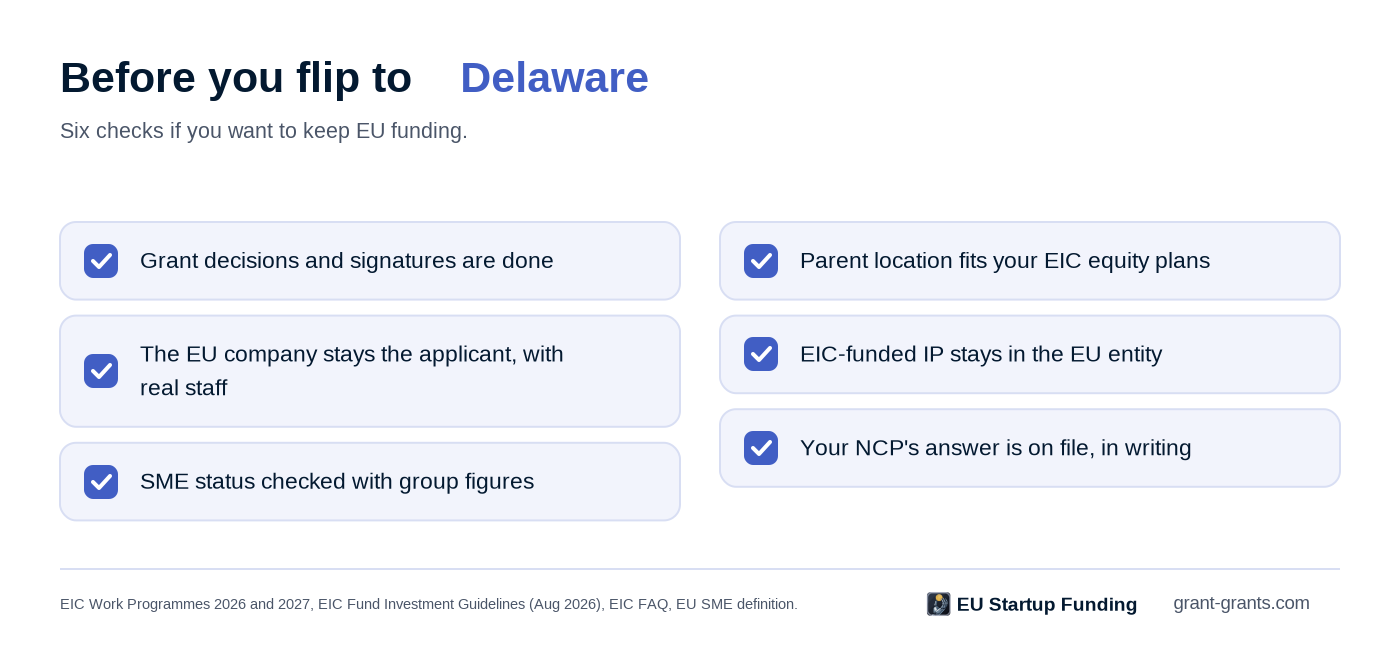
- Time the flip after grant decisions. The EIC wants establishment proven by the full proposal or signature, and any parent declared. With four Accelerator cut-offs in 2027, map the restructure against them.
- Keep the EU operating company as the applicant, with real staff, activity and accounts. Activities in other countries don't count for EIC eligibility.
- Read the ownership and control clauses in every call, and recheck SME status with group figures.
- Ask your NCP before you restructure, in writing: how does a US parent affect the equity component, SME status and any running grant?
- Keep EIC-funded IP in the EU entity, and tell the Agency before any transfer to a non-associated country.
- Check national schemes separately. RVO's conditions look at the Dutch company: WBSO at corporation tax liability, and the Innovation Credit at whether a large part of the work happens in the Netherlands. Our guide to WBSO and RVO programmes has the details.
Never miss a deadline
EU and national calls, with exact cut-off times, are in our grant deadlines calendar. The latest EIC Accelerator results show who won this round.
FAQ: Delaware flip and EU grants
Can a US company get EU funding?
The US is not on the list of countries eligible for Horizon Europe and EIC funding, unless a call says otherwise. A US company can set up or move an SME to an EU Member State or Associated Country and apply through it; the EIC Accelerator wants proof of that by the full proposal.
Is a startup with a Delaware parent eligible for the EIC Accelerator?
The EU subsidiary can apply as an SME established in a Member State or Associated Country, counting group figures where the SME rules require it. The EIC Fund only invests in parents established in the EU or an Associated Country, so ask your NCP about the equity part.
Does the EIC require IP to stay in Europe?
The EIC Fund must make sure supported companies keep most of their value, including IP, in the EU or Associated Countries. Grant beneficiaries must inform the Agency before EIC-funded IP moves to a non-associated country, and the Agency may object.
Why is EU Inc delayed?
The Commission proposed EU Inc on 18 March 2026. The Council agreed its position on 23 October 2026 without the central register and the insolvency chapter, and Parliament's JURI committee has not voted. On 19 November 2026 founder groups asked the Commission to withdraw and re-table it.
Can I keep Dutch WBSO or the Innovation Credit with a US parent?
RVO's conditions look at the Dutch company: WBSO requires a company liable for corporation tax, and the Innovation Credit requires a large share of the activities in the Netherlands. The RVO pages don't mention foreign parents, so confirm with RVO.
Should I flip to Delaware before or after applying for EU grants?
After the grant decision and signature. Declare any planned parent in your application, and get your NCP's answer in writing before you restructure.
