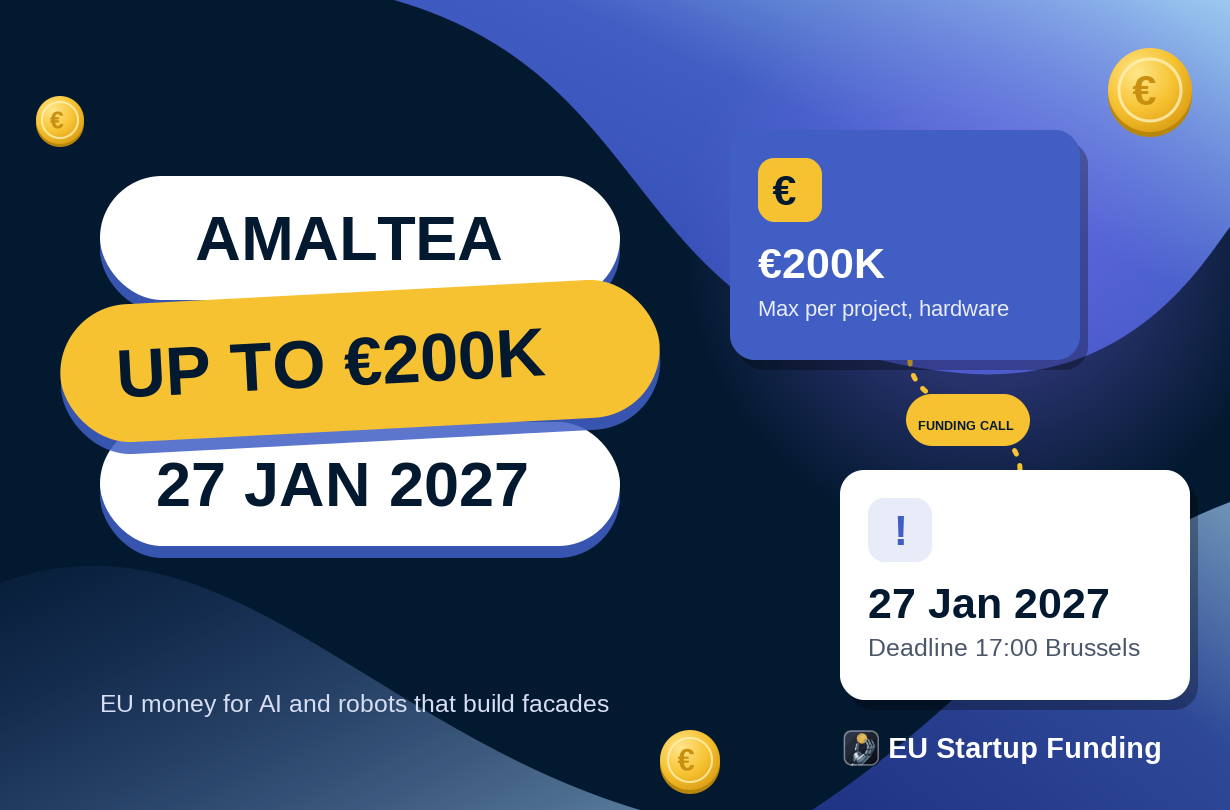
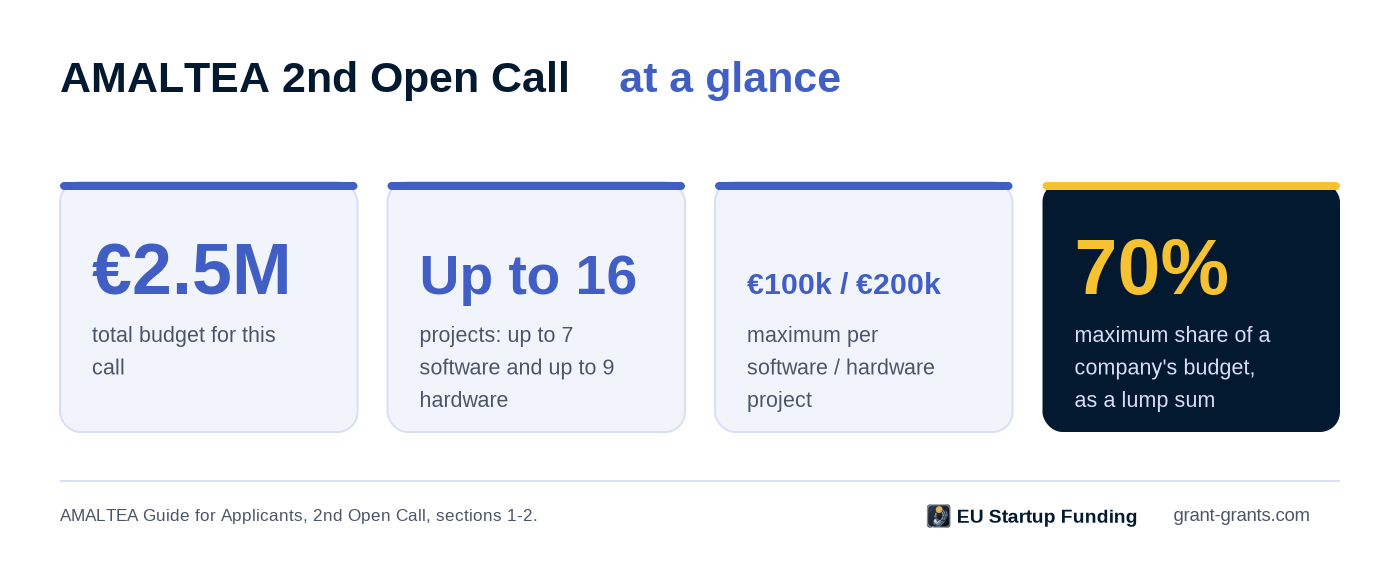
A new EU-funded call opened this morning for startups that build AI, robotics and digital-twin tools for the construction industry. The AMALTEA project, funded by Horizon Europe, is giving up to €200,000 to single SMEs and startups that develop technology for curtain-wall facades, from parametric design and robotic manufacturing to installation on site and recycling. There's €2.5 million for up to 16 projects: up to €100,000 for software and up to €200,000 for hardware, paid as a lump sum covering 70% of your project budget. You apply alone, with no consortium needed. Applications opened on 4 November 2026 at 09:00 and close on 27 January 2027 at 17:00 Brussels time. Here's who can apply, which 15 challenges you can pick from, and how the money is paid.
What's new in the second call
AMALTEA ("Advancing Green Deal Principles in sMart FacAde TechnoLogies for the construcTion sEctor based on AI, Data and Robotics") is a Horizon Europe project coordinated by Spain's Tecnalia, with 15 partners and an EU contribution of almost €10 million, according to CORDIS. It runs until the end of 2028. Part of its budget is passed on to outside companies through open calls, the EU's "financial support to third parties" model. Our guide to cascade funding and how sub-grants work explains why these calls are often the easiest EU money for a small company to win.
Compared with the first call, which ran from September to November 2025, this one is bigger and broader:
- More money: €2.5 million instead of €1.5 million, and up to 16 projects instead of 10. Both calls together share up to €4 million for up to 26 companies.
- All-new challenges: 15 challenges instead of 8, with up to 9 hardware projects this time.
- A bigger delayed payment: 20% of the grant is now held back until after the whole AMALTEA project ends (15% in the first call).
- A new rule on AI-written proposals: AI tools may be used to improve clarity, but "Applications may be rejected if found to be AI-generated and lacking a factual foundation." Our guide to using AI tools for grant writing shows where the line usually sits.
One warning: on 4 November the Open Call 2 page on the AMALTEA website still showed older details (8 challenges, 10 solutions). The Guide for Applicants, the application page and the EU Funding & Tenders notice all give 15 challenges and up to 16 projects, so follow those.
Who can apply
The guide asks for "individual SMEs (including start-ups)", which means you apply on your own. The rules in section 3:
- An SME under the EU definition, registered as a legal entity no later than the deadline, 27 January 2027. You can incorporate during the call, but not after it. Partner and linked companies count towards the size limits; our guide to the EU SME definition explains the maths.
- Based in the EU or a Horizon Europe associated country. The guide fixes the list of associated countries to the version in force when AMALTEA's own grant was signed (v3.1 of 11 July 2024), so if you're in a country that joined Horizon Europe later, ask the helpdesk before you write.
- Not linked to AMALTEA. Consortium partners, their affiliates, employees and people working for them on contracts can't take part.
- Financially healthy. No companies in liquidation, bankruptcy or "in difficulty"; an SME that has existed for less than three years doesn't count as in difficulty. Companies under EU sanctions are excluded.
- Able to pay 30% yourself. For-profit companies must show they can cover at least 30% of the project budget.
The call is aimed at digital technology developers, deep-tech and AI companies and tech providers for construction, especially in digital twins, robotics, automation, computer vision, BIM, data standards, sensor integration and human-machine interfaces. Our guides to robotics and automation funding and PropTech and smart city grants list other programmes for the same companies. If your product is the wood itself rather than the facade technology, the WoodStock Grants pay up to €50,000 for building with underused wood, with a deadline of 15 December 2026.
What it funds: 15 challenges
Every proposal must answer one of the 15 challenges in the Technical Guidelines. The solutions are tested in AMALTEA's four pilots: AI-based parametric facade design with an extended digital twin, a semi-automated facade manufacturing line at partner FDB's factory, and two real buildings, a hospital or residential building in Southern Europe and an office or residential building in Central Europe (tests on partners' premises if the buildings aren't available).
Three conditions apply to every challenge:
- TRL 3–5 to TRL 6–7. Your solution should already exist as a small-scale prototype or coded component and reach TRL 6–7 by the end. Our guide to technology readiness levels explains each level.
- It must work with AMALTEA's 10 Digital Tools, which partners are building, and depending on the challenge, your solution "might have to be made available as open source during the project execution".
- A European dimension: the proposal must show how it helps the Green Deal, the Renovation Wave and the EU goal of net-zero energy new buildings by 2030 and a net-zero building stock by 2050.
You can send up to three proposals, each on a different challenge, but only one can be funded: if several make the list, only the highest-scoring one goes ahead.
How much you get, and when it's paid
The money is a lump sum: you don't send invoices to prove costs, you prove that you reached agreed milestones. Our guide to cost reimbursement versus lump sum grants covers the difference. For companies the grant is at most 70% of the project budget, so to get the full €100,000 for software you need a budget of about €143,000, and for €200,000 in hardware about €286,000 (the guide's own examples). Non-profits can get up to 100%.
It's paid in three tranches after milestone reviews, according to section 5 of the guide:
- Software (9 months): up to €15,000 (15%) after the mentoring plan and proof of concept in month 1, up to €60,000 (60%) after the alpha version (5 months), and up to €25,000 (25%) after testing and validation (3 months).
- Hardware (12 months): up to €45,000 (22.5%) after the mentoring plan and prototype design (3 months), up to €90,000 (45%) after the prototype (6 months), and up to €65,000 (32.5%) after testing and validation (3 months).
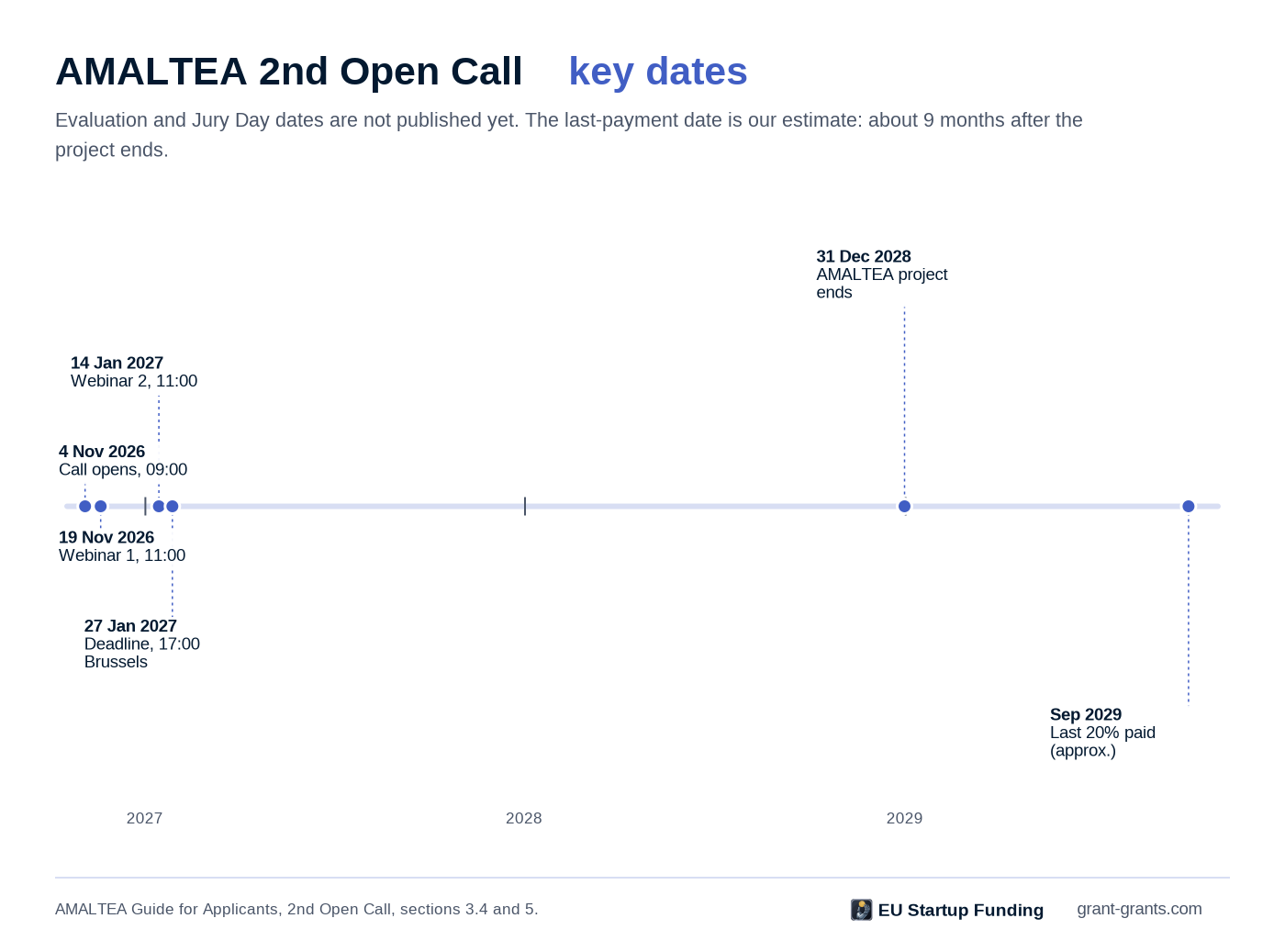
Plan your cash flow for the delayed payment. The guide says "a delayed payment mechanism may be applied to all payments": 20% of each grant is paid only once the whole AMALTEA project is completed, "approximately 9 months after the project's conclusion". The project is due to end on 31 December 2028 and may be extended, so that money could arrive around autumn 2029 (our estimate). At each milestone, reviewers score deliverables (30%), technical KPIs (60%) and deadlines (10%), and you need 7 out of 10 to stay in. Selected companies also get mentoring from the core partners, business support and an investment assessment.
How proposals are picked
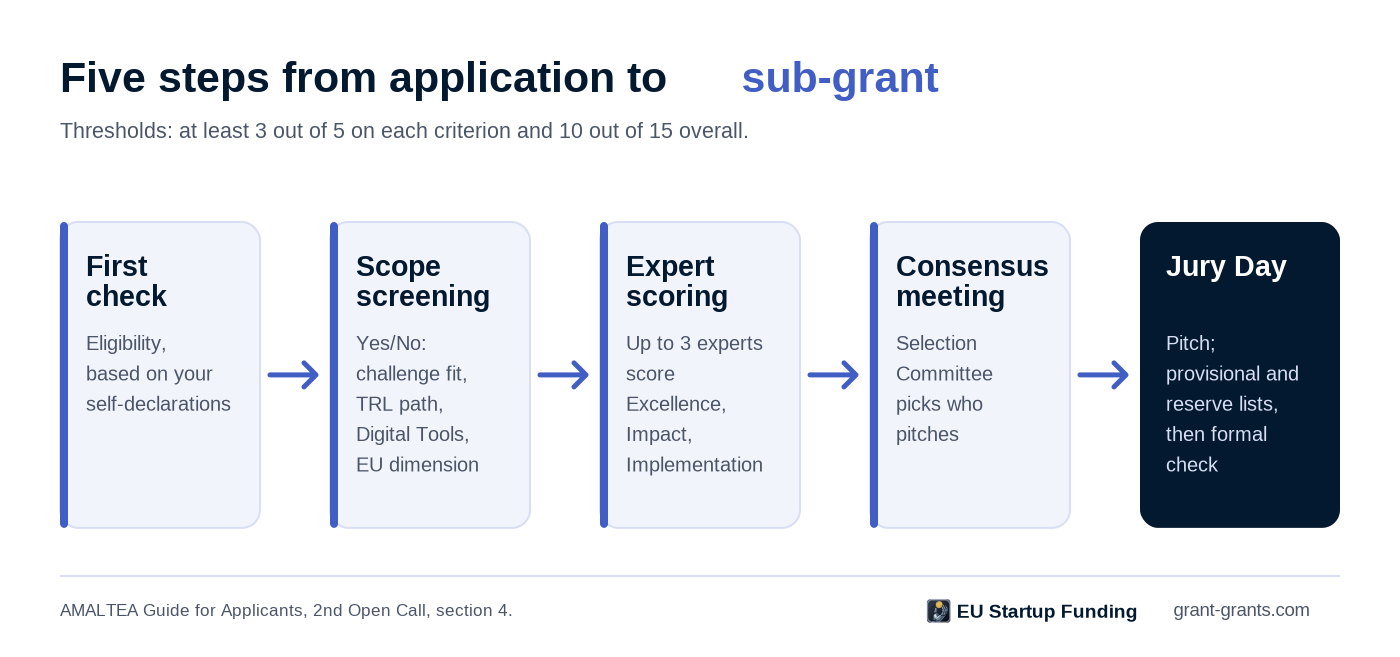
Up to three independent experts score Excellence (ambition, innovation, method), Impact (market, competition, scalability, environmental and social impact) and Implementation (team, resources, the 30% co-funding). Each criterion needs at least 3 out of 5 and the total at least 10. Ties go to the higher Impact score, then gender balance in the team. The Selection Committee then invites the best to a Jury Day pitch, judged on impact on AMALTEA's goals, the team's vision and attitude, and the benefit to your own processes. In the first call, more than 400 applications were started, 154 were submitted from 28 countries and 10 projects were selected, a success rate of about 6.5% (our calculation).
The guide doesn't give a results date and warns "you probably won't hear back for a while". Before signing, you'll be asked for company registration, ownership structure, financial statements, headcount proof and a bank form; missing a document deadline hands your place to the reserve list.
How to apply before 27 January
- Read the two documents: the Guide for Applicants for the rules and the Technical Guidelines for the 15 challenges, the pilots and the Digital Tools.
- Pick your track and challenge: software (up to €100,000) or hardware (up to €200,000), one challenge per proposal.
- Fill in the Gantt template (only the tab for your track) and upload it with the form.
- Join a 'How to Apply' webinar on 19 November 2026 or 14 January 2027, both at 11:00 Brussels time. Questions go to the AMALTEA Discord community or helpdesk.amaltea@fundingbox.com.
- Submit on OnePass in English before 27 January 2027, 17:00 Brussels time. You can edit the form until the deadline; after it, only administrative details can be corrected.
Never miss a deadline
This call and dozens of other EU and national deadlines are in our grant deadlines calendar.
FAQ: AMALTEA 2nd Open Call
When is the deadline?
27 January 2027 at 17:00 Brussels time, through the online form on FundingBox's OnePass platform. The call opened on 4 November 2026 at 09:00.
Can a startup apply alone?
Yes. The call is for individual SMEs, including startups, registered as a legal entity by 27 January 2027 in the EU or a Horizon Europe associated country. No consortium is needed.
How much funding can I get?
Up to €100,000 for a 9-month software project or up to €200,000 for a 12-month hardware project, as a lump sum covering up to 70% of the budget for companies and up to 100% for non-profits.
What must my solution do?
Answer one of 15 challenges on AI, robotics, digital twins and circularity for curtain-wall facades, start at TRL 3–5, reach TRL 6–7, and work with AMALTEA's Digital Tools.
Can I submit more than one proposal?
Up to three, each on a different challenge, but only one can be funded. If you send two proposals to the same challenge, only the last one is evaluated.
When is the money paid?
In three milestone tranches over 9 or 12 months, but 20% of the grant can be held back until about 9 months after the AMALTEA project ends, which is planned for 31 December 2028.
